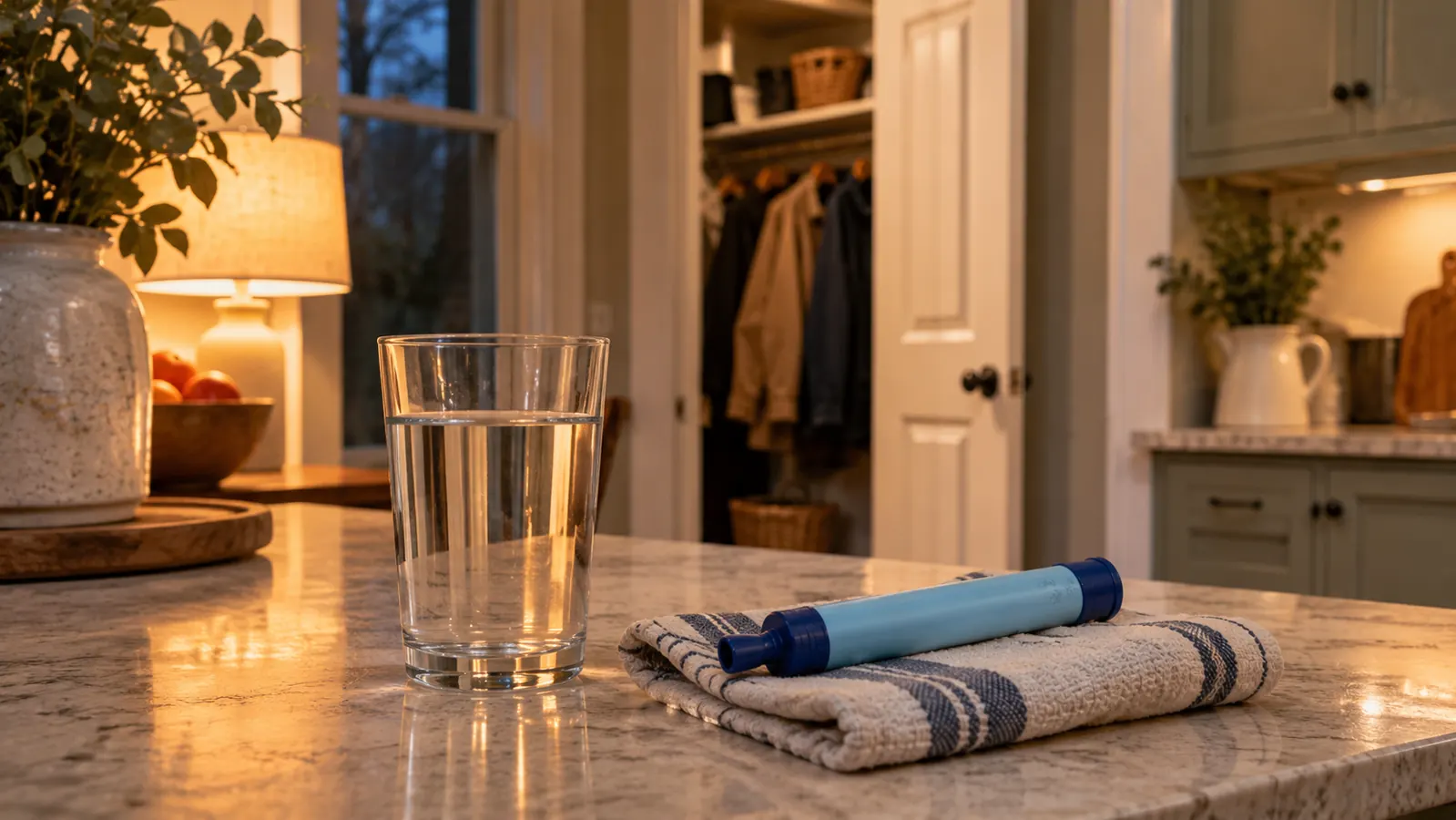
The water is the part I got wrong. In last January's ice storm the power went out on a Tuesday evening and did not come back until about noon on Friday, and by Wednesday the radio said our utility district was under a boil water notice because the water plant had lost power. We keep six gallons of bottled water in the hall closet. By Saturday there were about two left, and the notice did not lift until Sunday. That is the evening I finally took my LifeStraw down off the closet shelf and drank a glass of tap water through it. Twelve months of owning it. Nine of those months in the pack. One glass.
So this is not a story about a filter that saved my life in the wilderness. I am sixty one, retired after thirty years carrying mail on one rural route, and I live at the end of a gravel road on public water. My husband Hollis and I bought two LifeStraw Personal filters last November, one for each of us, along with the other things that now live in the hall closet. This is what twelve months of ownership looks like when almost nothing happens.
The Quick Verdict
Small, light, needs no power or batteries, and it did its one job on the one evening I asked it to. It does not remove viruses, chemicals, fuel or salt, and it serves one person at a time.
Amazon Check Today's Price →The water filter that rode in a backpack for nine months and worked on the first glass
No power, no batteries, nothing to keep up with in a closet. At 1.62 ounces it is the lightest thing in my pack. If a boil notice ever goes up on your street, you want this already in the bag.
Amazon Check Today's Price on Amazon →How I've Used It
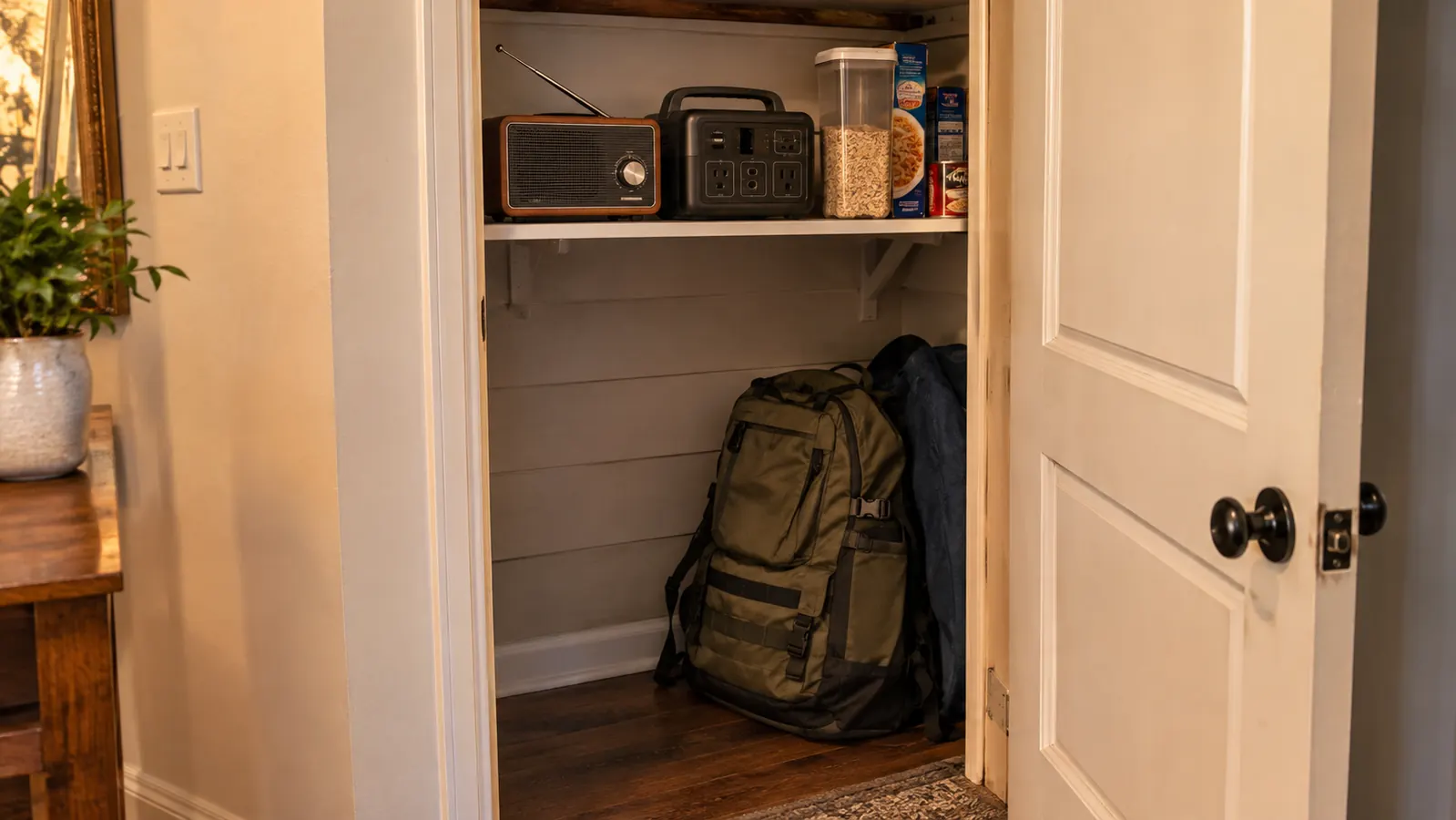
From last November until February, both filters sat on the hall closet shelf next to the backpack. In February I moved them into the pack itself, in a pocket where I can find one without turning on a light, and that is where they have been for about nine months now. I moved them in February because the ice storm had just shown me that a shelf and a pack are two different distances from the door. The pack sits on the floor just inside the closet door. I go through it on the same four dates I go through everything else in that closet, the first of March, June, September and December, and a check takes about ten minutes. The filters get the same treatment as the food bars: I look at them, I put them back, I close the pack. Then I forget about it until the next date.
I have drunk through mine exactly once. Hollis has never used his at all, and I am not going to pretend otherwise to make the review sound busier than it was. There were no camping trips, no hikes, no test runs in the yard. I did not take it out in the spring to try it on the creek, because the creek is not drinking water and pretending otherwise would teach me nothing. The three days without power in January were the only event of the year that mattered, and even then the filter was the last thing I reached for, not the first, because the notice told us to boil and we boiled.
What nine months in a pack did to it: nothing I can see. It is 1.62 ounces according to the listing, light enough that the weight is not worth thinking about. It has not cracked and it does not rattle. There are no batteries in it to leak and no charge to keep up, which is the reason I picked it over anything with a light on it. I have not had to clean it, because it has not been used enough to need cleaning. A thing that sits still and asks nothing of you is worth a lot in a closet you open four times a year.
The Boil Water Notice
Here is what a boil water notice actually is, because I had never lived under one. It is an instruction from your utility: the water may be carrying something, so boil it or use bottled. In our case the plant had lost power, and the radio said so around noon on Wednesday. Until the power came back on Friday we boiled water on the two burner camp stove out on the back porch, never inside, or we poured from one of the six gallons. After that I boiled on the kitchen range until the notice lifted on Sunday. Boiling is what was asked of us and boiling is what I would do first every single time. The filter was a backstop sitting in the closet.
Tuesday night we ate cold food from the refrigerator. Wednesday we were still eating from it, because the cold had not spoiled yet. The signal on my phone went weak and then stopped for most of Wednesday, so the radio on the kitchen table was the only thing telling us anything. Thursday the road stayed iced and nobody left. Friday about noon the power came back, and the food in the refrigerator was lost by then because it had been three days. The notice did not lift until Sunday, two days after the power came back, which surprised me. I had assumed the two things traveled together.
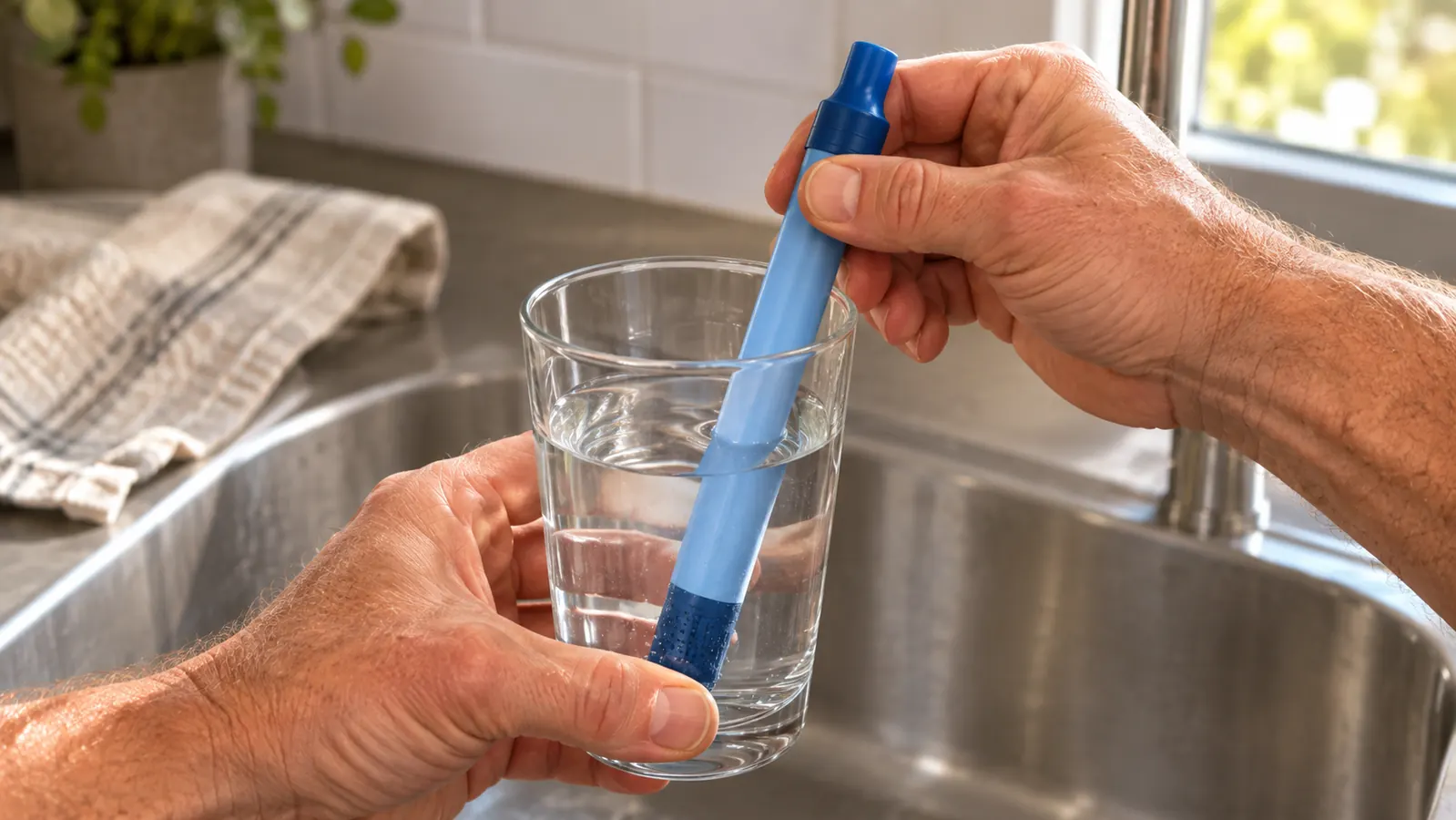
By Saturday evening we were down to about two gallons of bottled. I got one filter down off the shelf, filled a glass from the kitchen tap, and drank it through the straw. It took the better part of a minute, and it tasted like water. That was the whole event. I did not drink from the creek at the bottom of the road, and I would not, because the listing is clear about what the filter handles and a creek after two days of rain is a different conversation entirely.
Hollis never used his. If the notice had run another week, or if the bottled water had been gone, I would have handed it to him and we would both have been drinking through a filter, one at a time. That is the honest picture of how two filters work for two people. They work, and they work in a line.
What the Listing Says It Does
The LifeStraw listing describes a hollow fiber membrane. It says it removes 99.999999 percent of waterborne bacteria, including E. coli and Salmonella, and 99.999 percent of parasites. It says it removes microplastics down to 1 micron and reduces turbidity. It says no electricity or battery power is required, and that is the claim I can vouch for without any equipment at all, because I have never put a battery in it or plugged it into anything. The listing also gives a low temperature range of 1 degree Celsius, which I mention only because it is the one number on the page I have no experience with.
The lifetime figure on the listing is 4,000 liters, which it also calls 1,000 gallons. I have put one glass through mine, so I cannot tell you whether that number holds up in the field and I am not going to repeat it as though I had tested it. What I can tell you is that the number is not the reason I bought it. I bought it because it weighs 1.62 ounces, needs no power, and does not care whether anyone has looked at it since February.
What It Will Not Do
It does not remove viruses, and it does not remove chemicals, fuel, or salt. That is not a flaw I discovered by testing. It is what the listing says, and it matters, because floodwater can carry every one of those things. A virus is smaller than a bacterium, and a hollow fiber membrane with a 1 micron rating is not built to catch it. Chemicals and fuel dissolve in water rather than float in it, so there is nothing for a filter of this kind to strain out. Salt is dissolved too. None of that is a knock on the product. It is a description of the job. A reader who expects it to make a chemical spill safe has bought the wrong object.
It is also one person at a time. Two filters, two people, which is why I bought two and not one. If there are four of you, then two filters is not a plan, it is a queue. And it is a straw, so it needs a glass or a bottle to drink out of. In a kitchen with running water that is nothing at all. Standing over a filled bucket in the dark, it is something, and you should know it before the night you need it.
The other thing it will not do is tell you whether the water is safe. It is not a test kit. When our notice lifted on Sunday, it lifted because the utility said so, not because I had checked anything. A boil notice is the utility telling you that boiling is the answer, and I would not use a filter to argue with them. That is the order of operations I would use again: listen to the utility, boil or use bottled, and keep the filter for the gap between what you stored and what you need.
Where It Fits With the Rest of My Water Plan
The filter is the fourth thing in line, not the first. First is stored water, and six gallons for two people across three days was thin by Saturday. Second is a way to boil, and for us that is a two burner propane camp stove used outside on the porch with two cylinders on hand, one of which we used and part of the second. Third is the notice itself, which told us what to do and which I would follow again without arguing. The filter covers the case where the first three run short, and last January they ran short enough that I used it.
The list in my head runs radio, power station, food, water filter, backpack. The radio is for news. The power station is for phones and light. The food kit is for meals. The LifeStraw is for backup water. The backpack is for leaving. No overlap. Nothing was bought as a set. Each thing answered a gap the one before it left.
If you are building this out from nothing, my advice is boring and I stand by it. Put water in the closet before you buy anything with the word filter in the name. Then a heat source you can run outside. Then two of these, one for each person in the house, because a single filter for a family of four is a decoration. And read the notice when it comes. No product I own will keep you safer than doing what your utility and your county tell you to do.
What I Liked
- 1.62 ounces, so it adds nothing to a pack you have to carry
- No power, no batteries, no charging, nothing to keep up with in a closet
- Listing states 4,000 liters of capacity, far more than two people will drink in an emergency
- Two filters cover two people, one at a time, with no setup
- Came through nine months in a backpack with no visible wear
Where It Falls Short
- Does not remove viruses, chemicals, fuel, or salt, and floodwater can carry all of them
- One person at a time, so a family needs one each
- It is a straw, so you need a glass or a bottle of water to drink from
- It cannot tell you whether water is safe, and it is no substitute for a boil notice
One glass of tap water on a Saturday evening, two gallons of bottled water left in the closet, and a notice that did not lift until Sunday. That is the entire field test.
Who This Is For
For the household that already has water stored and wants a backstop that will not fail from neglect. For the person who keeps a bag in a closet and wants one thing in it that needs no batteries and no attention. For a two person house like ours, where two filters is a complete answer to the question. And for anyone on a public water system who has read a boil notice and wondered what they would actually do if the bottled water ran low before the notice lifted, which is what happened to us on a Saturday evening in January.
Who Should Skip It
Skip it if this is the only water plan you have. A filter in a drawer and no stored water is not preparation, it is a gesture. Skip it if your worry is chemicals, fuel, or salt water, because it addresses none of those and the listing says so plainly. Skip it if you need to treat water for four people at once. And skip it if you want a purifier that handles viruses, because that is a different product with a different set of tradeoffs, and I would rather you buy the right thing than buy the thing I own.
Two filters, one for each person, and a closet you stop worrying about
Mine has ridden in a backpack since February and it worked on the first glass I asked it for. The time to own one is before the notice goes up, not after.
Amazon Check Today's Price on Amazon →