There are two ways to end up with a go-bag in your hall closet. You buy the Ready America 70280 and you are finished in one order, or you build one yourself, item by item, from a list you wrote at the kitchen table. I went back and forth on that for weeks before last December. I worked the homemade version out on paper, carried the list in my coat pocket, and then I bought the bag.
Here is the short of it. If you want the job done this weekend, by someone who has been putting it off for a while, the Ready America 70280 wins on time, on cost, and on how much of the list is genuinely in the bag when it arrives at your door. If you want a bag built around what your own household eats, drinks and takes for medicine, building your own wins, and it is not close. Both of those are true at once. I am not neutral here, since I own the bag, but I priced the other route honestly and I will tell you where it beats mine.
| Ready America 70280 | Building your own | |
|---|---|---|
| Time to finish | One order, one box, on the closet floor the day it arrives | Evenings of list-making and several separate store trips |
| Cost | One purchase and one receipt, with today's price right on the listing | The same money spread over a dozen buys that rarely get totaled up |
| Coverage of the basics | Food, water, blankets, ponchos, dust masks, gloves, first aid, lightsticks, whistle, tissue pack | Whatever you remembered to buy, which is usually water and a flashlight |
| Food you will actually eat | Two 2,400-calorie bars, which is the same bar twice | Whatever your household already eats, within reason |
| Water volume | 12 sealed pouches at 4.225 ounces, a fixed amount | You set the amount, and you carry the weight of it |
| Fit to your household | Two people, three days, one fixed list | Sized to your medications, your diet, your spare glasses |
| Shelf life and upkeep | Five years on the bars and pouches per the listing, one date to watch | A different date on every single item, tracked by you |
| Weight and pack | 7.8 pounds in a nylon pack measuring 9.5 by 6 by 12 inches | However heavy you make it |
| Adding your own items | The pack has room, and mine holds filters, papers and cash | The whole bag is your own items |
What Is Actually in the Ready America 70280
The listing calls it a two-person, three-day kit, and the design is that almost everything comes in twos. Two food bars at 2,400 calories each, so 4,800 calories between them. Twelve sealed water pouches at 4.225 ounces. Two survival blankets, two ponchos, two dust masks, four nitrile gloves, two twelve-hour lightsticks. A 33-piece first aid kit, a whistle and a tissue pack. It all rides in a nylon pack that weighs 7.8 pounds and measures 9.5 by 6 by 12 inches.
Shelf life is the part that sold me. The listing puts five years on the food bars and the water pouches. I have owned this bag eleven months, so I am reporting what the label says, not what I have lived through. Still, a long date on the two things that go bad first means the bag mostly sits there and does not need me for anything.
The bag is not the whole plan. Mine carries our two LifeStraw filters, copies of our papers, a written list of our medications, a phone cable, cash in small bills and a spare pair of glasses. The first aid kit is a starter kit, not a pharmacy. If you take a blood pressure pill every morning, that bottle is your job, not the manufacturer's.
What Building Your Own Actually Takes
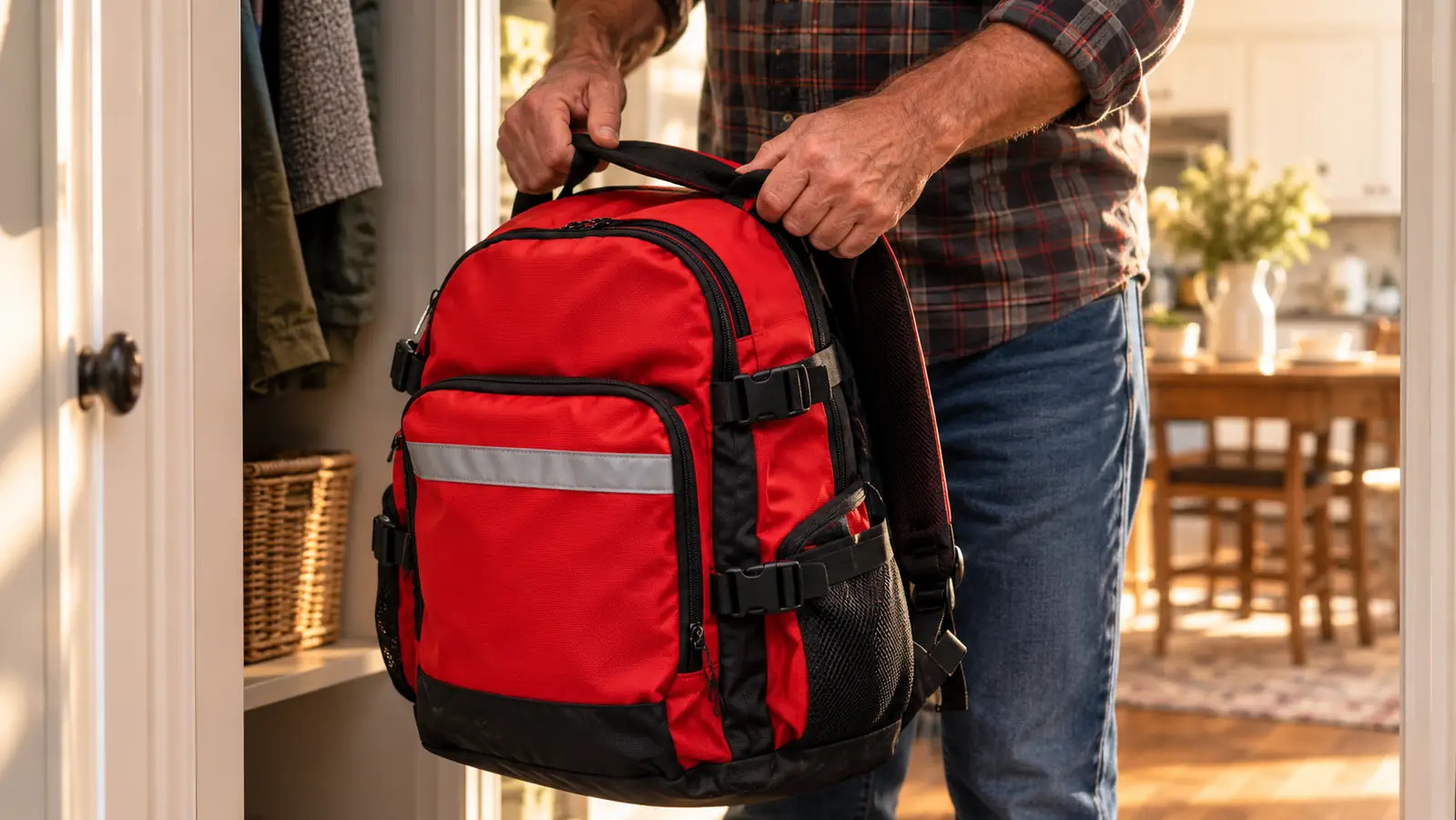
I am not going to pretend the homemade version is complicated. It is a list, and the list is short: water, food that needs no cooking, a light, a first aid kit, something for warmth, copies of your papers. Most of it sits in one aisle of a hardware store or a big-box store, and any of it can be bought in an afternoon if the afternoon exists.
What it takes is evenings. Every category is its own decision, and none of the decisions feel urgent until the night they do. How much water is enough? Which first aid kit? Do you buy a folding knife or a multi-tool? Multiply that by fifteen or twenty items and you have a project on your hands instead of an errand. That is exactly where I stalled, and I do not think I am unusual.
Then the dates scatter. The bars have one date, the pouches another, the adhesive in the first aid kit another, the batteries in the flashlight another. Upkeep turns into a spreadsheet you will not keep up with. With the bag, a check is about ten minutes on the first of March, June, September and December, the same four dates I charge the power station, and then it goes back on the floor.
And the last part is the one nobody warns you about. A homemade bag that is half finished is worse than no bag at all, because you have decided you are the kind of person who has one. Ours would have lived in a tote in the garage with six bottles of water and a flashlight in it, and I would have told myself it was handled.
Where the Ready America 70280 Wins
Time and finish. Mine arrived as one box and went straight to the floor just inside the hall closet door. There was no trip where I stood in an aisle deciding between two flashlights while my ankles ached. For a person who has been meaning to do this for a while, the gap between intending and finished is the whole problem, and this bag closes that gap in one order.
Cost sits on the same side, and I say that without quoting a figure, because prices move and yours will not be mine. Everything lands on one purchase and one receipt, and today's price is on the listing where you can see it for yourself. The homemade version spreads the same money over a dozen separate buys that most people never total up. What you also get is a bag packed to a standard: two people, three days, every category covered, nothing missing because you were tired and the store was closing.
The bag was in the truck about ten minutes after the deputy came down the road. Nothing had to be found, because everything was where I had left it.
Where Building Your Own Wins
Food first. The bars in this bag are the same two bars, twice. They are dense and they keep, and that is the entire job of them, but nobody is going to look forward to the second one. I keep two 4Patriots 72-Hour kits on the closet shelf as well, and those need boiling water and a heat source, so they are a different tool for a longer event. If you want a bag where the food is food your family would eat on an ordinary Tuesday, you have to build it yourself. The kit cannot guess.
Water is the second place. Twelve pouches at 4.225 ounces is a fixed amount, and over three days for two people it is thinner than I would like. That is the number in the bag I would add to. I moved our filters into the backpack in February, and that is precisely the adjustment the homemade crowd is right about: the bag gives you a floor, not a ceiling.
What the Bag Does Not Cover
The bag has blankets, not heat. It has no stove, no fuel, no way to warm a room, and no answer for a boil water notice. Ours is a house with a wood stove in the den, and cooking without power happens outside on the back porch on a two-burner propane camp stove, never indoors. None of that lives in the bag. It lives in the house, and the bag is for the night you leave the house.
It has no radio, and mine never will, because I want the radio where I can hear it. Mine is a Midland ER310 that sits on the kitchen table from November through May. If you want news inside the bag, that is your addition. Same for cash, documents, a phone cable, a spare pair of glasses that actually fits, food for anyone with a dietary need, and anything a pet needs. The bag is a floor. You are the ceiling.
One order, two people, three days
7.8 pounds of food, water, warmth and first aid in one nylon pack that arrives finished. Add your medications and your papers and quit meaning to do this.
Amazon Check Today's Price on Amazon →The Night the Bag Left the Closet
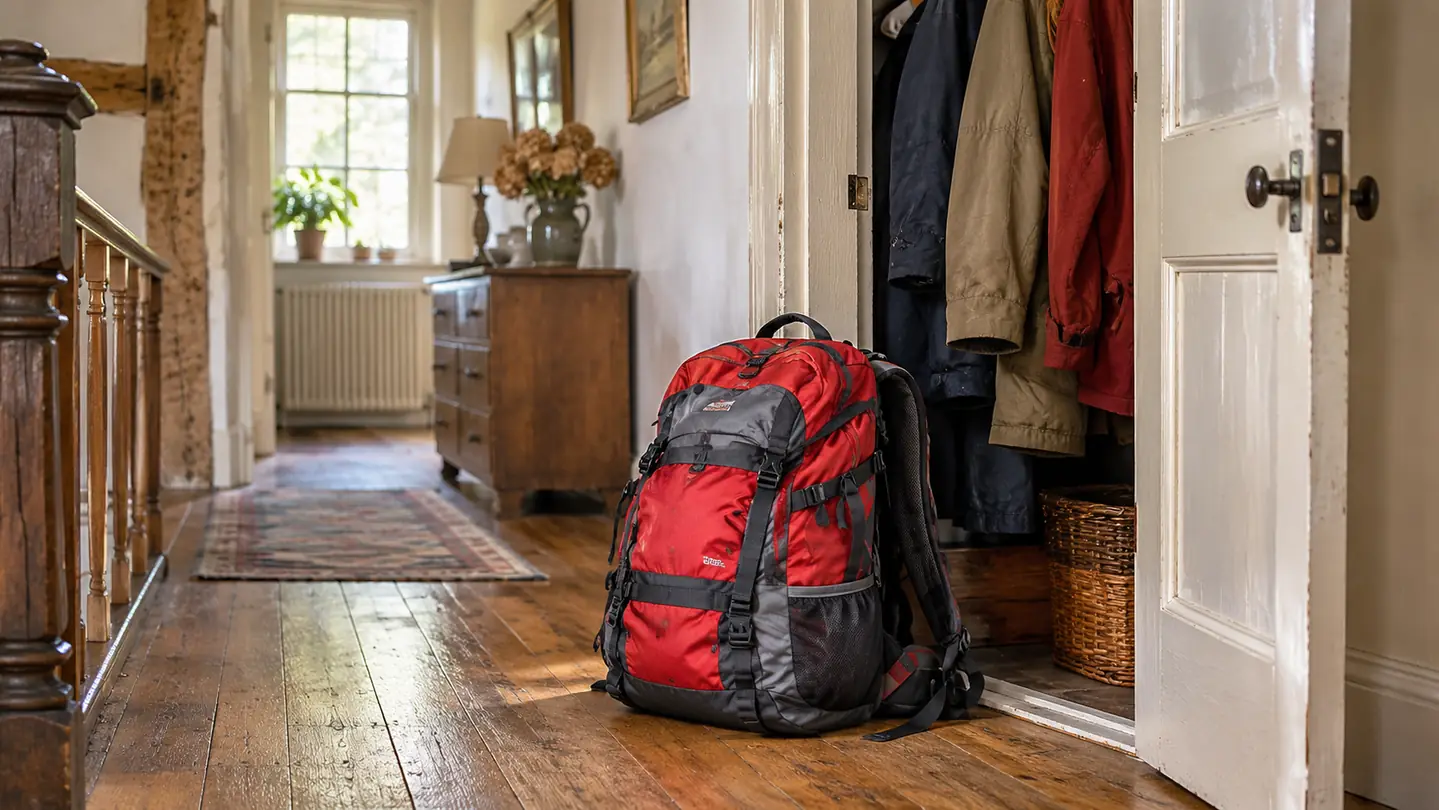
The reason I stopped second-guessing it was a night in April. We had two days of rain and the creek at the bottom of the road came up fast. At dusk a deputy came down the gravel and told the low households to leave. I took the backpack from the floor just inside the hall closet door, and we were in the pickup in about ten minutes.
We spent one night in a church fellowship hall in town and came home the next afternoon. The water reached the yard and stopped short of the porch. The house was not damaged. In the fellowship hall we used the poncho and the tissue pack, split one food bar between us, and drank water pouches. That is all it was, and I am not going to dress it up.
But that is the honest case for a bag that comes assembled. At dusk, with somebody at the door telling you to go, you do not want to be walking through your own house collecting things. The bag did its job by being in one place and being finished. It also told me something about the homemade version I had priced out on paper in the weeks before I bought this one: mine would still have been a list.
How I Would Split the Difference
If you are somewhere in the middle, here is the version I would hand to a neighbor. Buy the bag, then treat it as a starting point and not a finished answer. Put it on the floor where you will see it every day. Then add, in this order: your medications and a written list of them, copies of your papers, a phone cable, cash in small bills, a spare pair of glasses, and one food item you know you will eat.
That gets you a finished bag on the first afternoon and a bag that fits your household by the end of the month, and you never once have to stand in an aisle deciding which flashlight. The reason to do it in that order is simple. An unfinished plan is the one that fails, and a finished bag you keep improving beats a perfect list you never shop.
Who Should Buy Which
Buy the Ready America 70280 if you have been meaning to put a bag together and have not. Especially if there are two of you and you are both old enough to keep a medication list. Buy it, then spend one afternoon adding your papers, your medications, your glasses, some cash in small bills and a phone cable. That is a real bag in a day instead of a project in the garage.
Build your own if you cook and have strong opinions about what you will eat, if someone in the house has a medical or dietary need the kit cannot cover, if you want more water than twelve pouches, or if the project itself is the point and you know you will finish it. And if you are honest enough to admit you will not finish it, buy the bag and improve it. That is what I did, and I would do it again.
The bag that was in the truck in ten minutes
Two people, three days, 7.8 pounds, sitting on the floor by the door. Add your papers and your medications and stop meaning to do this.
Amazon Check Today's Price on Amazon →