
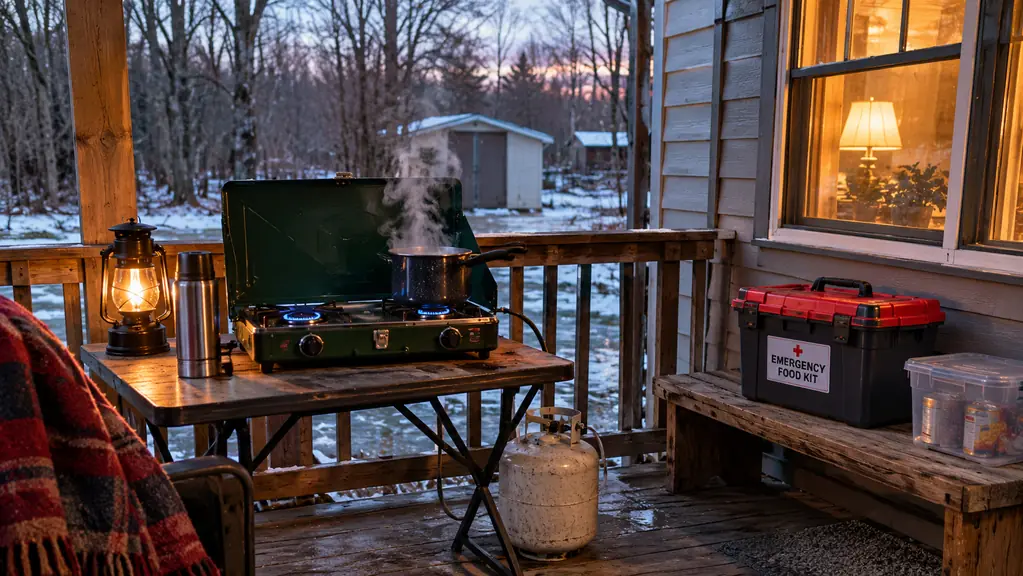
I bought two 4Patriots 72-Hour Survival Food Kits in November of last year, and for about two months they sat in their box on the hall closet shelf doing nothing at all. That is what an emergency food supply is supposed to do, and I want to be honest that I had no way to judge these kits until the ice storm of late January. Then the power went out for three days, and the six meals we ate off the porch stove came out of one of those kits.
I bought them because of a storm the summer before, one that took the power out and showed me I had nothing in the house but a flashlight and a bad attitude about the whole subject. I did not buy a set of anything. The kits went into the cart alongside two water filters, one for me and one for Hollis, and I have never regretted the order I did it in.
So this is not a review written from the box. It is a review written after eating the food and then replacing it in March. I am 61, retired after thirty years carrying mail on one rural route, and I do not tell people to buy things. I tell them what I keep in my house and what it did when the lights went out. Here is what these kits did.
One thing before I get into it, because it is the whole ballgame: the 4Patriots kit is not a meal you can eat out of the pouch dry. It needs boiling water and it needs a heat source. If you have not thought past the food, the food does not help you.
The Quick Verdict
Good food, honest portions for two people, and a fifteen minute cook time I could manage on a camp stove in the cold. It only works if you have water and a way to boil it.
Amazon Check Today's Price →The kit that fed us for three days, one kit per person
The 4Patriots 72-Hour Kit holds 20 servings and about 4,800 calories in triple-layer Mylar pouches, with a listed shelf life of up to 25 years when stored below 75 degrees. One kit covered two people for six meals.
Amazon Check Today's Price on Amazon →How I've Used It
Our power went out on a Tuesday evening when freezing rain brought a limb down on the line. By Wednesday evening we had eaten everything worth eating out of the refrigerator, so I took the kit box off the hall closet shelf and carried it to the kitchen. Hollis had the two-burner propane camp stove set up on the back porch, which is the only place that stove ever gets used, and still the only place I would use one.
Here is what that evening actually looked like, because the small logistics are the part nobody writes down. The box is heavier than it looks and there is nowhere flat to set it down on the porch rail, so I carried the pouches out through the kitchen door one at a time. The porch faces north and the wind was coming across it. The pot took a good while to come up, longer than it takes on my range inside, and I stood there with my hands in my coat pockets waiting on it. Then you pour, you stir, you let it sit and simmer, and you carry two pouches back inside while they are still hot.
The kit fed us six meals between Wednesday evening and Friday around noon, the two of us eating together. I never opened the second kit. It went back on the shelf still sealed when the power came back, and I replaced the opened one in March so we would be even again.
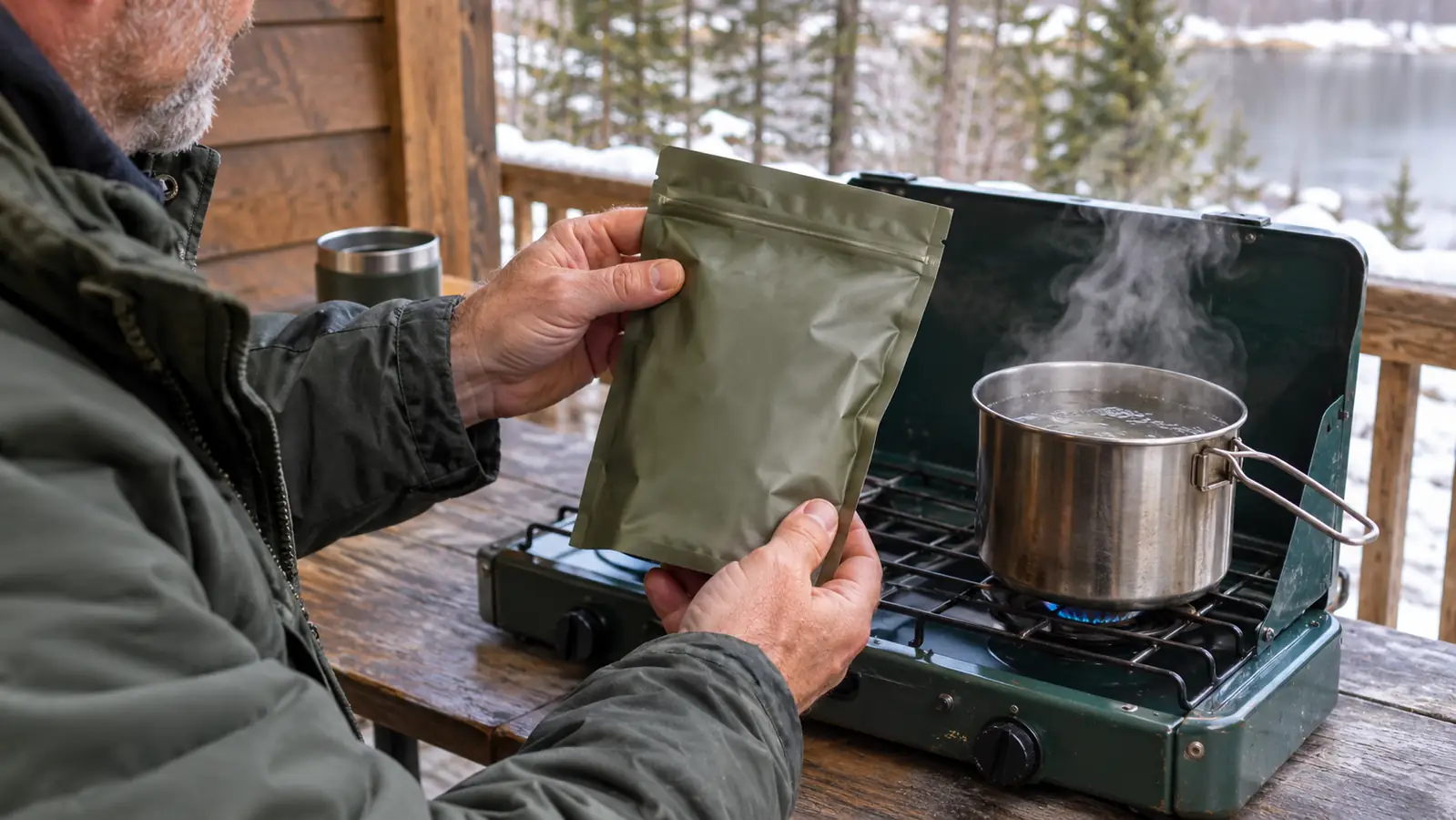
The first meal took the longest because I was reading the pouch and guessing at the water. About fifteen minutes start to finish is the figure on the listing, and that matched what I saw. If you are heating water on a camp stove in freezing weather, add that on top. Nothing about the cooking is hard. It is just not instant, and a hungry person on the second night wants instant.
By the second night I had a routine. Put the water on first, then open the pouch and read the back of it again even though I already knew what it said, then stand there until the water rolled. Reading it again was not necessary. It just gave my hands something to do that was not being cold.
What Is Actually in the Box
Each kit is 20 servings, about 4,800 calories total, which works out to roughly 1,600 calories a day for three days. That is light. Hollis spent his working life on a county road crew, and about 1,600 calories a day is light for anybody who is used to eating like that. If you have a grown man in the house, or a teenager, or anybody doing real physical work through an outage, understand that one kit per person is a floor and not a comfortable number.
On the calorie math, one thing worth doing before you buy is to sit down and multiply. About 1,600 calories a day is well under what a working man needs and under what I eat on a normal quiet day. I am not saying the kit is stingy. I am saying it is a three-day kit for a person having a quiet three days, not for somebody out chopping wood. Add a jar of peanut butter and a sleeve of saltines to that shelf and you have closed most of the gap for very little money.
The food is vegetarian. The meals are the kind that go into a pouch with boiling water and turn creamy: sweet oatmeal for breakfast, mac and cheese, creamy rice and vegetable. The packaging is triple-layer Mylar, and it is the sturdy sort of pouch that stands up on its own once you get the water in it, which matters more than you would think when your hands are cold.
Storage is where I would pay attention. The listing says up to 25 years, and says best results below 75 degrees, protected from heat, air and moisture. Our hall closet is an ordinary inside closet in a heated house, and I am not going to pretend I have a thermometer in there. What I will say is that 25 years is a label claim and not something I can vouch for, because I owned these kits for about two months before I ate from one. Anybody claiming otherwise about a kit they bought in the last few years is repeating the box. If your only storage is a garage that bakes in July or a shed out back, this is not the product for that spot, and the listing will tell you so in the same breath it tells you 25 years.
What It Tasted Like, Months Later
Fine. Not fine for emergency food. Fine, full stop. Hollis had exactly two opinions over three days: the mac and cheese was fine, and the oatmeal was too sweet. I agreed with him about the oatmeal. The creamy rice and vegetable was the one I would pick again, and I say that as somebody who has never once chosen rice and vegetables over macaroni.
The mac and cheese is the one I expected to be disappointed by and was not. It comes out thick, closer to a baked casserole than a sauce, and it holds heat long enough that the second person is not eating cold food. The oatmeal is where all the sugar went. Hollis took one bite, said it was too sweet, and he was right, and I ate mine anyway because it was warm and there was ice on the porch rail. If I were restocking I would put a small bag of plain oats on the shelf beside the kits for exactly that reason.
What surprised me was how normal the whole thing felt. You are cooking on a porch in the cold with a camp stove hissing, then eating by the wood stove in the den, and the food is warm and salty and tastes like something from a school cafeteria in a good way. There is no strange aftertaste, no texture that makes you stop chewing. The creamy rice and vegetable needed the full sitting time to thicken up. Stir it too early and it stays soupy, and then you have a pouch of warm rice water and nobody to blame. On the third day of an outage, warm and normal is worth a lot more than interesting.
The catch is water. I want to be plain about this because I think it is the thing people skip. Every one of those meals needed boiling water, and that water has to come from somewhere and then it has to be boiled. We had six gallons of bottled water stored and were down to about two by Saturday. If you are on a municipal system and a boil notice lands on top of your outage, the food and the water and the heat source are one problem, not three.
Six meals, two people, three days, one opened kit. The food was the easy part. The water and the fire were the work.
What the Heat Source Really Costs You
I keep a two-burner propane camp stove and two small propane cylinders for exactly this. We used one cylinder and part of the second across three days of boiling water for food and for drinking. That is the number nobody puts on a food kit listing: cooking this food is also your water treatment, so every meal burns fuel twice.
I ran the figures on that fuel afterwards, because I am the sort who does. The cooking was the smaller draw on the cylinder. The boiling for the notice was the bigger one, pot after pot on the same burner. If you are buying a stove around this kit, buy more cylinders than you think you need and store them out of the weather, and check that they are full before the forecast turns.
A camp stove goes outside on the porch, always, and away from windows. I would say that even if you already know it. Carbon monoxide does not care that you are cold and in a hurry.
One thing did go wrong and it was mine. I had let the lighter for the camp stove go missing sometime in the months before, so I lit the burner with kitchen matches out of the drawer. It worked. It also meant that if those matches had been damp, or if the drawer had been empty, I would have had a box of food I could not cook. I bought a spare lighter afterwards and it lives with the stove now. Check your fire-starting before you need it, not during.
Living With It Between Emergencies
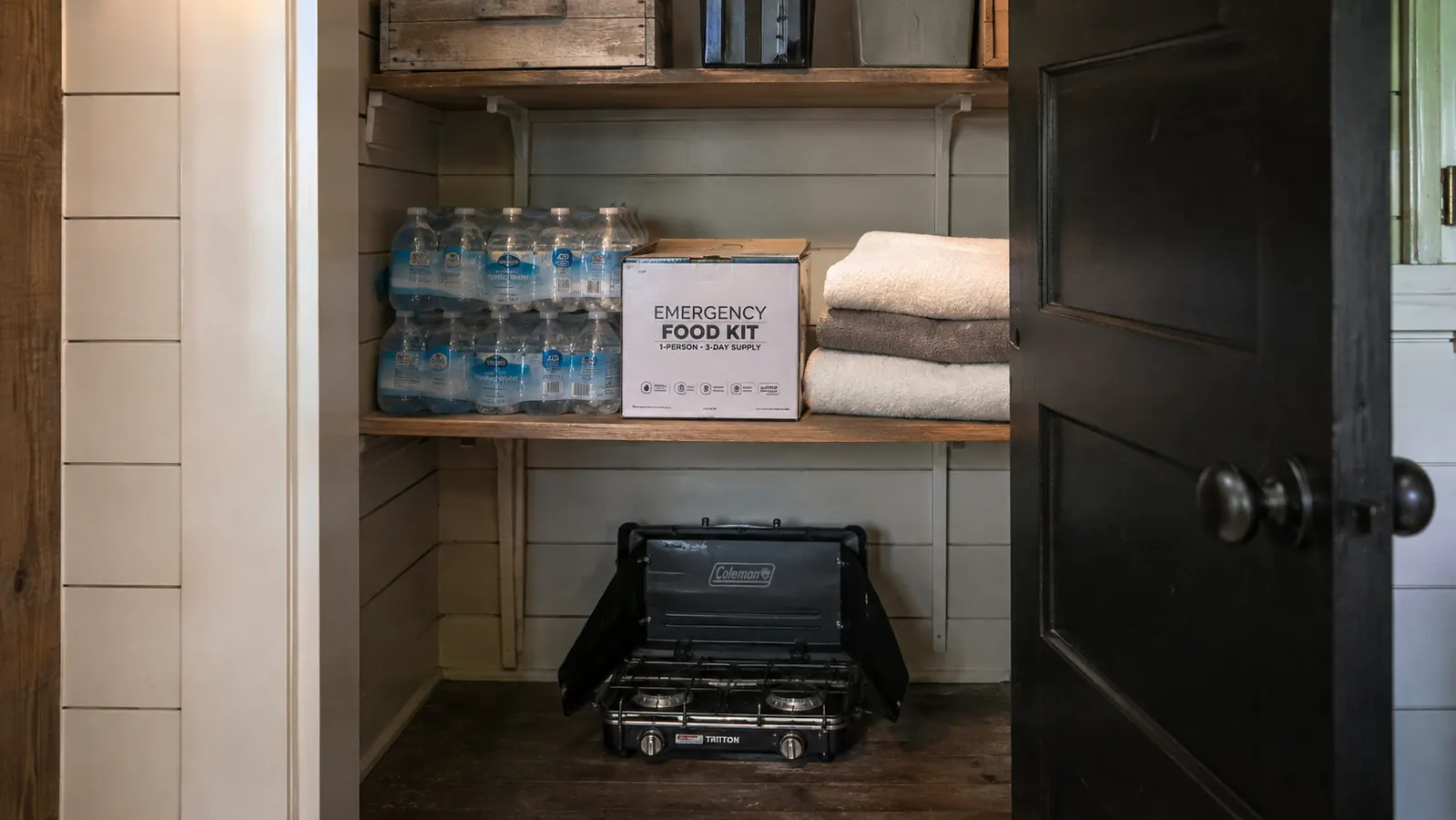
The kits live on the hall closet shelf, both of them together in the one box they came in. That box is not small. It is about 11 by 10 by 4 inches, so it takes a real shelf, not a corner. Ours sits on the hall closet shelf and, in the warm months, shares it with the weather radio.
One thing I would tell anybody setting this up: put the whole thing where you will trip over it. Ours is in the hall closet because that is the closet with a shelf at the right height and floor space in front of it. If yours ends up in a basement behind a lawnmower, you have a kit you will not go get at ten at night in freezing rain, and you have spent the money anyway.
Repacking after the storm was the easiest part of the whole thing. The unopened kit went back on the shelf, I ordered a replacement for the one we ate, and that was that. No rotation schedule, no dates to check every month, no cans to turn. That is the actual argument for a kit like this over a canned pantry. A can of soup in a cupboard is a can you have to watch. This is a box you can forget about, and forgetting about it is the point.
I still keep a canned pantry with a hand can opener, and I would tell anybody to do the same. The cans are what you eat in the first two days while the refrigerator food is still good. The kit is what you eat on day three when there is nothing left to lose.
What I Liked
- Food tastes normal, not like something you tolerate
- About fifteen minutes start to finish
- One kit per person is easy to store and easy to forget
- No rotation schedule, no dates to track
- Six meals from one kit for two people, as listed
Where It Falls Short
- Needs boiling water and a heat source, which is a second purchase
- About 1,600 calories a day is light for a grown man or heavy work
- Sweet oatmeal is sweeter than it needs to be
- The 25-year shelf life is a label claim you cannot verify in a year
- The box is bulky on a shelf for the amount of food in it
Who This Is For
This is for the person who knows they ought to have something in the closet and keeps putting it off because the whole subject feels like a hobby they do not want. Two kits, one per person, is a reasonable afternoon of shopping and then you are done. It is also for anybody on a municipal water system, because a boil notice is the most likely thing to land on you and this food pairs with the water you already stored.
It suits a two-person household, an older couple, somebody living alone who wants three days covered without thinking about it again. It suits anyone who already has a camp stove or a grill and a couple of cylinders.
Who Should Skip It
Skip it if you have no way to boil water and no intention of buying one. A food kit you cannot cook is a box of disappointment, and I would rather you spend the money on a camp stove and a case of soup first.
Skip it if you are feeding four or more, or if there are teenagers in the house, unless you are buying more than one kit per person. And skip it if you want something you can eat cold out of the package with no preparation at all. There are bars and pouches for that. This is not that, and the listing says so plainly if you read it before you buy instead of after.
Follow what your local officials tell you. If they say boil, boil. If they say leave, leave. Nothing in a closet keeps anybody safe on its own, and I would not want anybody reading this to think a box of food is a plan.
Two kits, one shelf, three days covered
Each 4Patriots 72-Hour Kit is 20 servings and about 4,800 calories, vegetarian, in triple-layer Mylar pouches. Add boiling water, simmer, and eat in about fifteen minutes. Buy one per person and a way to boil water.
Amazon Check Today's Price on Amazon →