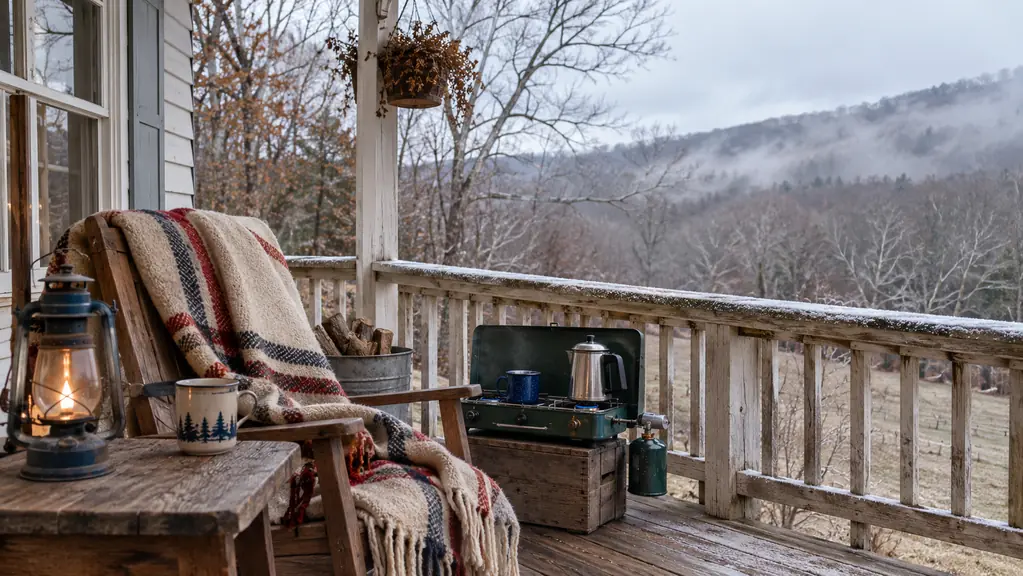
A canned pantry is not a bad plan. I want that on the table first, because this subject turns into an argument and it should not. I keep a canned pantry. I keep a hand can opener beside it, and I eat out of it in ordinary weeks. But when the ice took the power out for three days this past January, what fed us came off the hall closet shelf in a box: the 4Patriots 72-Hour Survival Food Kit. The cans stayed where they were. So here is the short answer after twelve months of keeping both. The cans are easier to eat. The 4Patriots kit is easier to be ready with.
That is the whole trade, and I would rather you see it plainly than buy a box of food expecting it to open itself. A can of soup asks one thing of you, a can opener. A pouch from the kit asks for water and heat, about fifteen minutes of attention, and in exchange it sits on a shelf without asking you for anything between now and the day you reach for it.
| 4Patriots 72-Hour Kit | A Canned Pantry | |
|---|---|---|
| Eating it with no power | Needs boiling water and a heat source, about 15 minutes start to finish | Open the can and eat it cold |
| Water it demands | Water for every meal, on top of your drinking water | The food carries its own liquid, so it costs you no cooking water |
| Food your household already likes | Vegetarian meals: oatmeal, mac and cheese, creamy rice and vegetable | Whatever you already eat on a Tuesday |
| Packaging | Triple-layer Mylar pouches, a barrier against heat, air and moisture | Metal cans that dent, rust, and need a can opener you have to remember |
| Calories in one box | About 4,800 calories total, roughly 1,600 a day across three days | Whatever you put on the shelf, and much of a can's weight is water |
| Keeping it ready | Nothing to rotate. Keep it below 75 degrees and leave it alone | Every can has a date, so you eat through it or you lose it |
| Grabbing it in the dark | One kit off the shelf | Sorting through cans, plus the can opener |
| Putting it together | Arrives as a kit. One decision, one time | Built one grocery run at a time over months |
How I Ended Up Keeping Both
The canned pantry came first, and it came the way most pantries come, one grocery run at a time. I did not sit down and design it. I bought two extra cans when something was on the shelf, and after a while there was a shelf worth of them plus the hand can opener, which matters more than the cans. A pantry without a can opener is a shelf of decoration.
The food kits came last November. A storm the summer before had put the power out overnight and left me with nothing in the house that was ready in the sense I now mean by ready. So I bought two 72-Hour kits, one for me and one for Hollis, and they went into the hall closet in the single box they came in. Then they sat there for about two months doing nothing, which is exactly the job.
Keeping both is not indecision. They answer different questions. The pantry answers what will we eat this week if the store run does not happen. The kit answers what will we eat if the power is out, I cannot cook on the range, and the road is iced. Those turned out to be two different questions, and only one of them had an answer on my shelf in January.
What the Kit Actually Asks of You
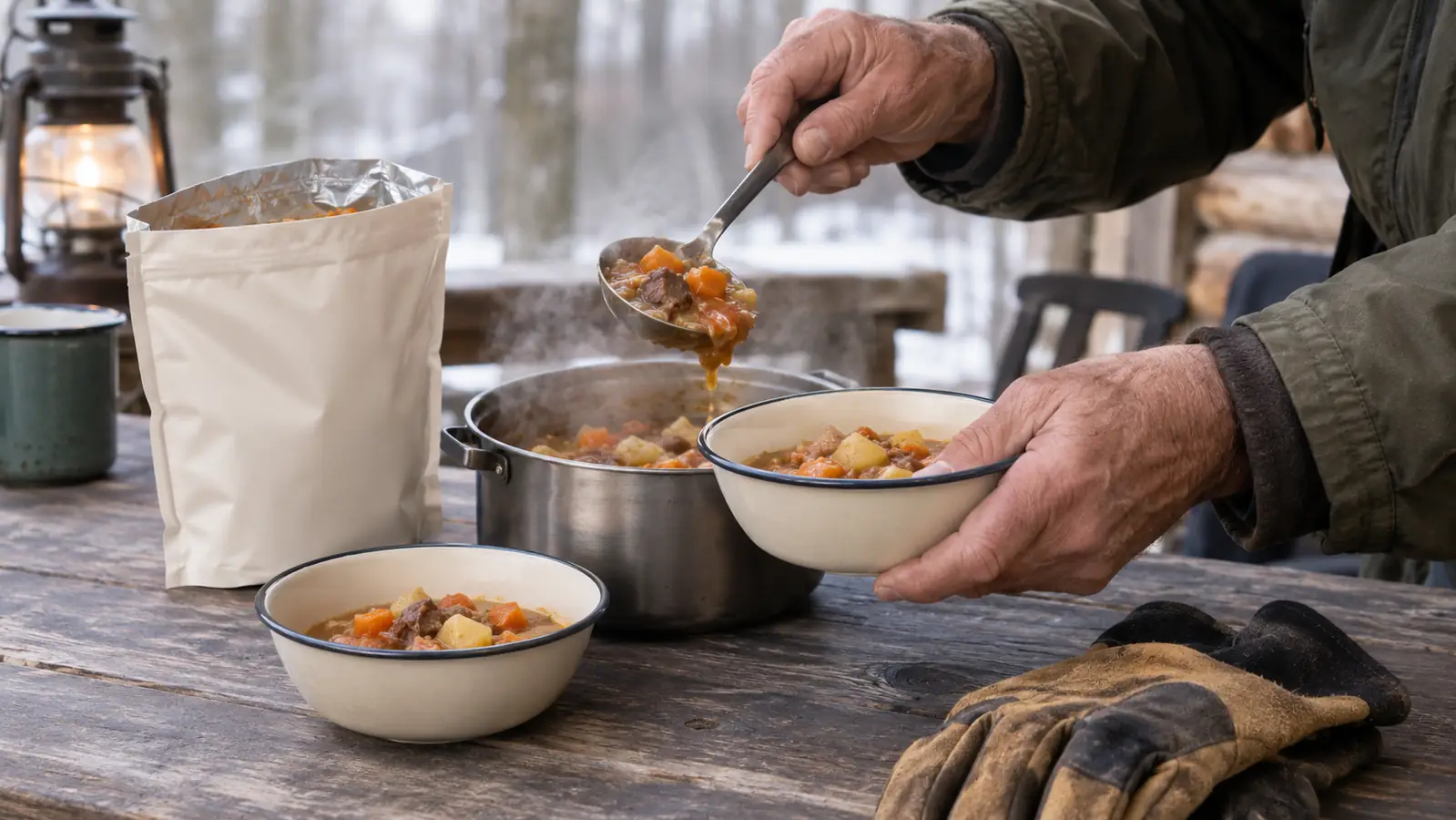
The catch is water and heat, and I am not going to soften it. Every meal in the kit needs boiling water and a simmer, and the label puts the whole thing at about fifteen minutes from start to finish. Fifteen minutes is not long. But it is fifteen minutes on a heat source that cannot run indoors if that heat source is propane. Mine is a two-burner camp stove that lives on the back porch and stays on the back porch, because a camp stove in a kitchen is how people die in house fires.
The label numbers are these. Each kit holds twenty servings, about 4,800 calories total, which the label divides as roughly 1,600 a day across three days. I will tell you what I told Hollis. 1,600 is light. It is enough to keep you upright and not enough to keep you cheerful, and the label itself allows that you may want more. If you are a big man, or you are working outside in the cold all day, plan on more than the box says.
The food is vegetarian, and the pouches are triple-layer Mylar, a barrier against heat, air and moisture. The instructions say to keep it below 75 degrees, and that is the one rule I actually follow. Ours lives on the hall closet shelf, an ordinary inside closet in a heated house. The meals I have eaten are oatmeal, mac and cheese, and a creamy rice with vegetable. One pot, two spoons, fifteen minutes.
Six meals for two people came out of one kit, cooked on a camp stove on the back porch, and the canned pantry stayed shut the whole three days.
Where the 4Patriots Kit Wins
It wins on readiness, and readiness is the one thing a canned pantry is genuinely bad at. A kit needs no rotation. You put it on the shelf and leave it alone. My cans all carry dates, and I have to eat through them or throw them out, and throwing out food you bought for an emergency is a small tax you pay every year whether anything happens or not. The kit does not charge that tax. It does not ask you to remember anything except the 75 degree rule.
It wins on the box. One kit from the box is three days of food for one person, and the second kit is the second person. Try that arithmetic with cans. I carried groceries up my own driveway for thirty years of routes and I know what a three day supply of canned goods weighs once you have to move it. The Mylar also does something a can cannot do, which is shrug off a knock. A can dropped on a gravel driveway at the wrong angle is a can you cannot open, and now the food is gone and the can is still there.
Where a Canned Pantry Wins
The pantry wins on the day the water is out and the porch is iced over, because a can needs no water and no heat. You open it and eat it cold, out of the can, with a spoon, and you get on with your day. That is a real advantage and it is precisely the case the kit cannot answer. If your plan has no way to boil a pot, the kit is a box of powder you cannot use, and no number of calories on a label fixes that.
The pantry also wins on what it tastes like at hour forty of a storm. Canned peaches. Canned chili. The soup your household actually eats without being talked into it. Hollis thought the mac and cheese was fine. And a pantry is not a purchase, it is a habit. You build it a little at a time, and what it takes from you is shelf space and attention.
Fix the water and heat problem first. Then this is the shelf you never think about again.
The 4Patriots 72-Hour Survival Food Kit is twenty servings and about 4,800 calories per kit, vegetarian, in triple-layer Mylar. It needs boiling water and a heat source, which is the honest catch, and it takes about fifteen minutes. If you have a camp stove and a porch to run it on, this is the part of the closet that stops occupying your head.
Amazon Check Today's Price on Amazon →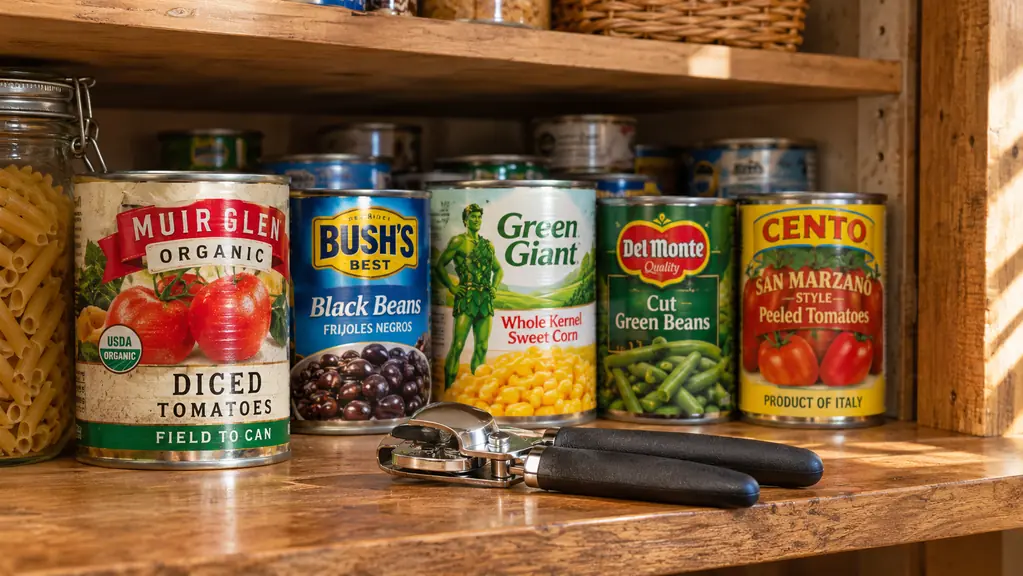
The Three Days I Actually Ate From It
Wednesday evening was the first kit meal. The power had gone out Tuesday around six, we had eaten cold out of the refrigerator for a day, and I had decided the refrigerator food was not going to improve. I carried the box from the hall closet to the kitchen, took one kit out, and left the second one sealed in the box. That was on purpose. If the storm ran long, I still had an untouched kit.
The camp stove was already out on the porch. I had let the lighter go missing, so I lit the burner with a kitchen match, which is a thing to check before you need it and I have since bought a spare. Water in the pot, pouch into the water, simmer, fifteen minutes. We cooked on the porch because that is the only place the stove gets used, and we carried it in to the den to eat. Six meals came out of that one kit between Wednesday evening and Friday midday, the two of us eating together, and the last one was lunch on Friday around the time the power came back.
What I remember is that the oatmeal was too sweet, which Hollis said out loud and I agreed with, and that the mac and cheese was fine, which is higher praise than it sounds at the end of a week like that. There was a boil water notice in the middle of it, which is a separate subject. Three days, two people, one kit, and the second kit went back on the shelf still sealed. I replaced the opened one in March.
The Thing I Got Wrong
I thought of the box as food. It is food plus a procedure, and the procedure is the part people skip when they imagine the storm. You are not opening a pouch and eating. You are finding water, finding a heat source, keeping the heat source outdoors, and standing on a cold porch for fifteen minutes while it simmers. That is not hard. It is also not nothing at six in the evening on day two.
I also had the portions wrong in my head. The label figure of 1,600 a day is one person's day, and there are two of us. That is why I bought two kits rather than one, and it is the single piece of advice I would give anyone building this shelf. Buy one per person. One kit covering six meals for the two of us is not the same as one kit covering three full days for two people at full portions, and I would not want to find that out during the storm instead of before it.
What It Takes to Keep Both
Shelf space and one habit. The kits sit on the closet shelf in their box, the cans sit on their shelf, and every three months I go through both. The cans get checked for dates I am close to and I cook those into a normal week. The kit gets checked for the box being intact and the closet being dry. The whole thing takes about ten minutes.
The honest ledger on the kit is short. It needs water, it needs heat, it needs fifteen minutes and a pot, and it gives you about 1,600 calories a day, which is on the light side. The honest ledger on the pantry is just as short. It needs a can opener, it needs rotation, it is heavy if you ever have to move it, and much of what is in a can is water. Neither ledger is a reason to skip the other one.
Who Should Buy Which
If you have a camp stove, a porch to run it on, and a way to store water, the 4Patriots kit is the part of your shelf that stops taking up room in your head. Buy one per person, put it somewhere that stays below 75 degrees, and forget it until you need it. If you have none of those things, buy the cans first and buy a hand can opener, then go solve the heat problem before you buy any food that has to be cooked.
Most households will end up with both, and that is not a dodge. The cans cover the ordinary week and the cold meal on day one. The kit covers the long middle of a storm, when the refrigerator food is gone, the road is iced, and nobody is coming up the driveway. I found out which one I actually needed in January, and it was not the one I would have guessed when I started. Follow your local officials on the boil notices and the evacuation orders. No box of food changes that.
Twelve months on a shelf, and it did exactly what the box said it would
Two kits, one per person, twenty servings and about 4,800 calories each, vegetarian, triple-layer Mylar, roughly fifteen minutes from start to finish. It needs boiling water and a heat source outdoors, so settle that first. After that it is the easiest thing in the closet to be ready with.
Amazon Check Today's Price on Amazon →