
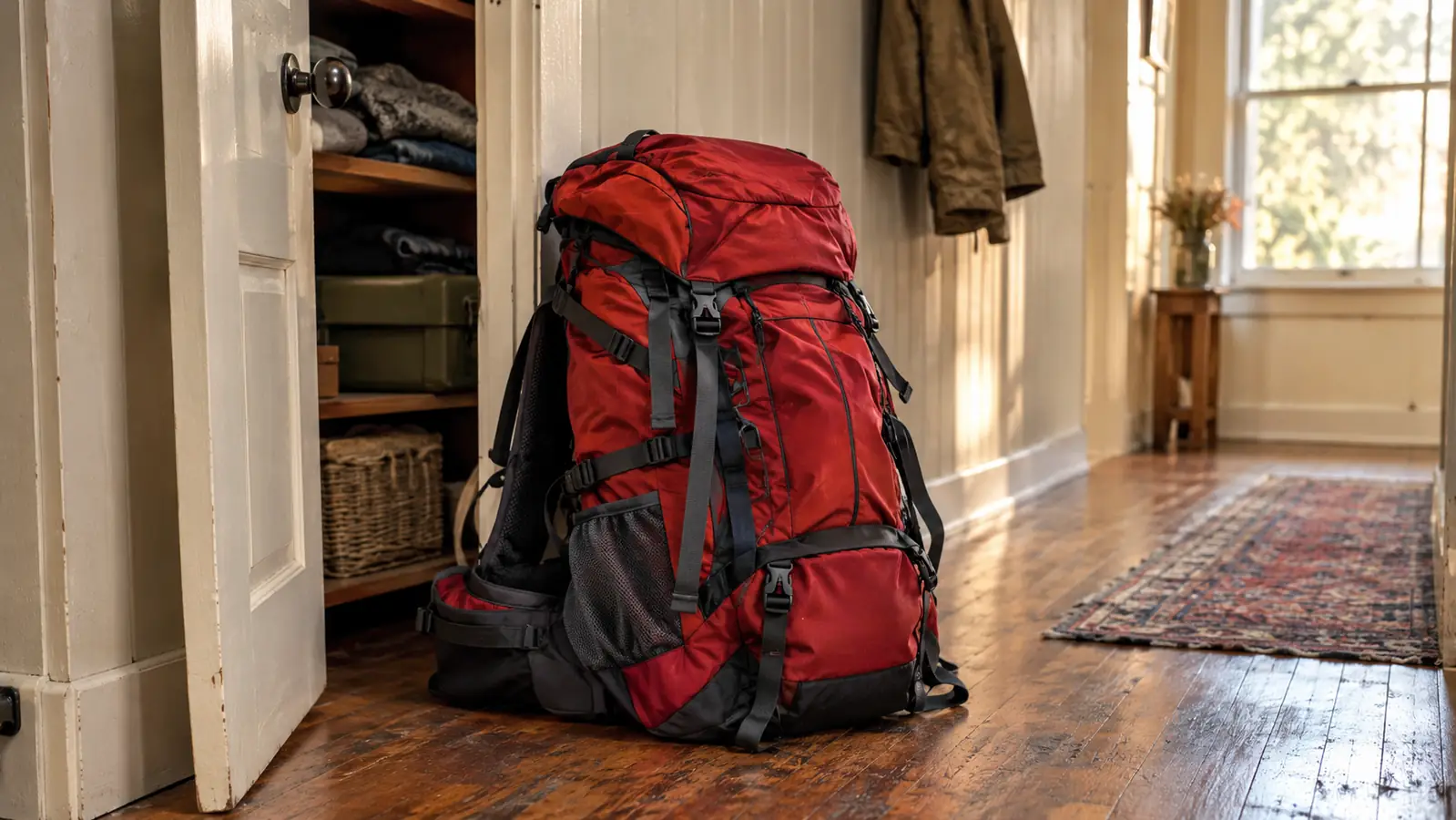
The deputy came down our road at dusk in April and told the low houses to leave. I had about ten minutes of decisions in front of me and I made one. I opened the hall closet, took the Ready America backpack off the floor just inside the door, and set it in the truck. Everything else had been settled months earlier, on a kitchen table, with a notebook open and the bag turned upside down beside it.
That is the whole point of packing a bag ahead of time, and it is not a clever point. The packing is not the hard part. The hard part is sitting down once, on an ordinary afternoon, and doing it properly, so that on the evening it matters you are not standing in a closet trying to remember whether the lightsticks are any good and where the copies of the insurance papers went. What follows is the order I did it in, around the bag I bought last December, and the arithmetic that made me change it in February.
The bag I carried out the door was packed before the deputy knocked
The Ready America 70280 is a two-person, three-day backpack at 7.8 pounds. It holds the food, water, blankets, first aid kit and ponchos. You add your own papers, your own medication list, and your own judgment about what your house needs.
Amazon Check Today's Price on Amazon →Step 1: Empty it on the kitchen table and read what the label actually promises
I emptied the Ready America bag onto the kitchen table the afternoon it arrived and matched every item against the listing, because a bag you have not opened is a bag you do not know. The set is labeled two person, three day. It weighs 7.8 pounds, measures 9.5 by 6 by 12 inches, and the shell is nylon.
Here is the inventory, and I would learn it. Two food bars at 2,400 calories each, so 4,800 calories for the pair. Twelve sealed water pouches at 4.225 ounces each. Two emergency ponchos. Two survival blankets. A 33-piece first aid kit. Two dust masks and four nitrile gloves. A whistle. Two lightsticks rated for twelve hours. A tissue pack. The listing puts a five-year shelf life on the bars and on the pouches, and that is the number that matters most once the bag is sitting in a closet.
Knowing that list by heart is worth more than it sounds. In the flood the poncho came out and the tissue pack came out and we split one food bar between us and drank water pouches. I did not have to dig. I knew the first aid kit was in there and I knew which pocket it was in. That is a small thing that stops being small at dusk with a deputy in the driveway.
The first question I asked was whether two people could carry it. At 7.8 pounds, one person can, and one person generally will, and that is worth knowing before you start adding your own items on top of it. Hollis and I are past sixty with the knees to show for it. The bag is light enough that this was never a discussion.
Step 2: Put the paper in first, because no kit on earth includes it
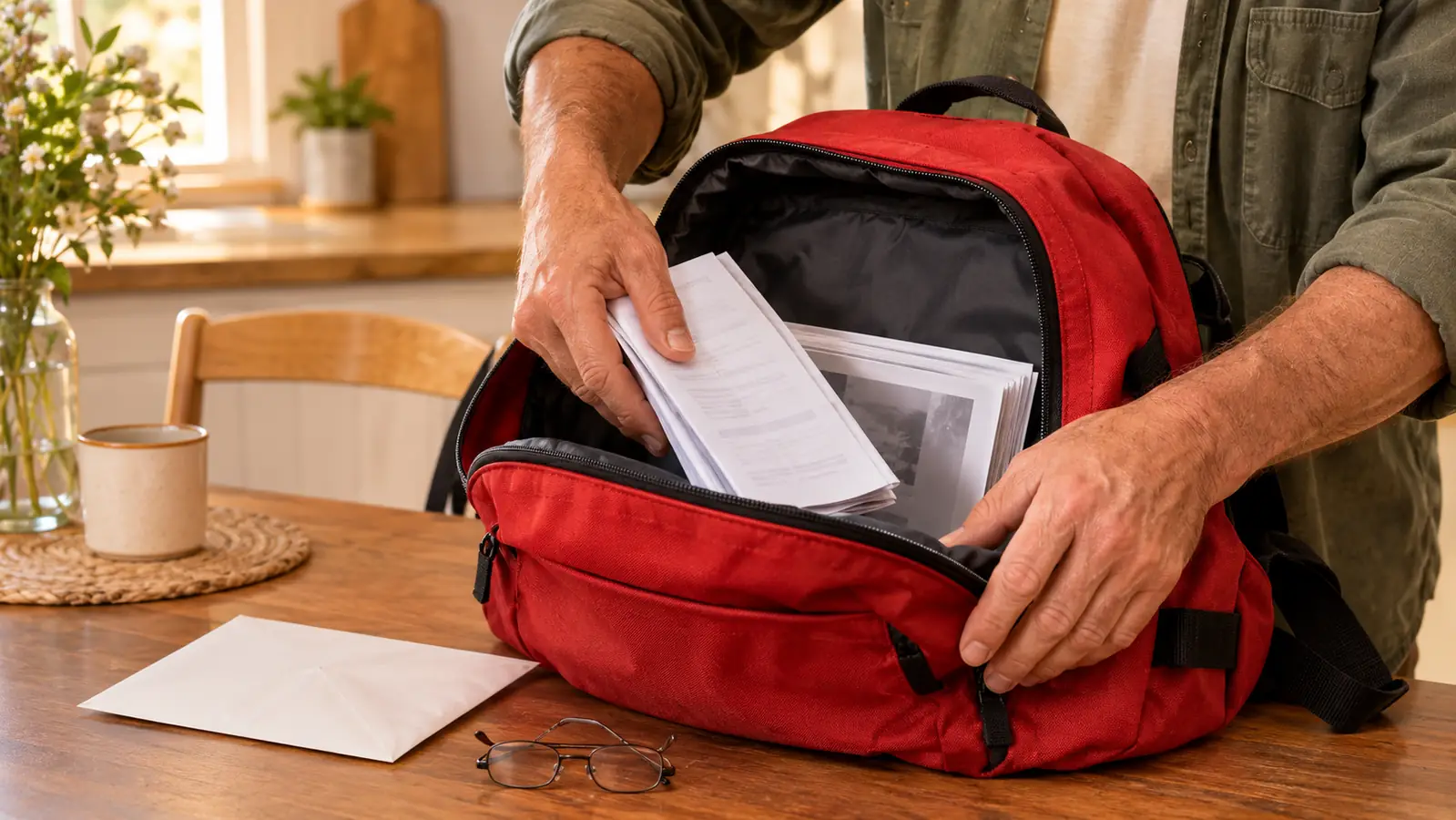
Every manufactured bag stops at hardware and calories. The things that slow you down at a shelter are paper. I put in copies of our papers, a written list of the medications Hollis and I take with the doses on it, and a spare pair of glasses. Copies, not originals. The originals belong somewhere in the house you can reach without the bag, and a bag gets set down on a fellowship hall floor where it can wander off.
The medication list is the one I would argue for hardest. If you spend a night on a folding chair under fluorescent lights and somebody asks what you take, you will not reliably come up with the name of the second pill, let alone the dose. Write it down. Write the doses. Update it every time the pharmacy changes something, which is not once, it is whenever it happens.
I also added a spare pair of glasses. Not in the phone. On paper, in the same envelope, because a phone is a battery and a battery is a countdown.
None of this weighs anything. An envelope of paper and a spare pair of glasses is a few ounces, and it is the difference between a night that is merely uncomfortable and a night where you cannot answer a simple question about yourself.
Step 3: Add the small things that weigh nothing and get remembered forever
A phone cable. Cash in small bills. A list of your medications. Those three add almost no weight and cover the two most common failures in any emergency, which are a dead phone and a card reader that cannot reach a network.
Small bills, specifically. If the power is off, nobody at a register is making change out of a drawer, and a large bill for a bottle of water is a problem for both of you. Mine stays flat in the bag and I do not borrow from it for the grocery store, because cash that gets borrowed is cash that is not there when you want it.
A camp stove, if you own one, stays outside, never in the house, and never in the bag. A bag is not a reason to bring a stove indoors. The same goes for a generator: outside, away from the windows, every time. I have never owned one, but Ray up the road does, and that is where his stays.
I keep the cable in the bag and not in the drawer by the charger, because a cable that lives in a drawer is a cable that gets borrowed and stays borrowed. A replacement costs less than the trip back inside.
Step 4: Do the water arithmetic out loud
Twelve pouches at 4.225 ounces works out to about 51 ounces of water in the whole bag. Split two ways over three days, that is roughly eight ounces a person a day. The bag says three days and the bag is not lying, but that water is for drinking. It is not for cooking, it is not for washing, and it is not for rinsing a cut.
That arithmetic is why the two LifeStraw filters went into the bag in February, one each. They weigh about 1.6 ounces apiece, need no power, and you drink straight through them. The listing says they remove bacteria and parasites and microplastics down to one micron, up to 4,000 liters, and I am quoting the listing there because I have not tested any of that myself. What they do not remove is viruses, chemicals, fuel or salt, and floodwater can carry every one of those. A filter is not permission to drink out of a ditch.
So the pouches are the plan and the filters are the backup to the plan. If your utility puts out a boil notice, boil, or drink the pouches. Both the bars and the pouches carry a five-year shelf life from the manufacturer, and that date is the thing to look at every time you open the bag. A bag full of food that aged out in a dark closet is a bag that has been lying to you.
The two bars at 2,400 calories each sound generous until you divide them. Two people, three days, 4,800 calories total, which is 800 a day apiece. That keeps you upright. It does not make you comfortable, and it is no substitute for the canned goods in your pantry if you are staying home instead of leaving.
Step 5: Pick four dates and give it ten minutes
I check the bag on the first of March, June, September and December. Those are the same four dates I top up the power station, so it is one habit instead of two. A check takes about ten minutes. I open it, read the dates on the bars and the pouches, look over the lightsticks, confirm the papers are the current copies, and put a hand on every item on the list.
Ten minutes, four times a year, is the entire maintenance schedule. The way a bag fails is not that it wears out. It is that it sits for a long stretch with an expired bar at the bottom and a medication list still naming a pill you stopped taking.
It lives on the floor just inside the hall closet door. Not on a shelf, not in the attic, not behind anything. On the floor, at the front, where a person who has been woken up can put a hand on it in the dark. That is the reason it was in the truck in ten minutes in April instead of twenty-five.
The one thing I would not do is tape it shut or zip tie it tidy. A bag you have to cut open is a bag you will not open on a Tuesday night to check a date, and a bag nobody opens is a bag nobody knows.
What Else Helps
A bag covers leaving. It does not cover staying, and staying is what most of these nights turn out to be. A backpack in a closet does nothing about a line down at the bottom of the road and nothing about a boil notice. Those are separate jobs with separate gear, and pretending one bag handles all of it is how a person ends up with a closet full of nothing in particular.
The other thing that helps is deciding now where you would go. Ours was not complicated, because in April we went where the deputy's office sent people, which was a church fellowship hall in town, and we came home the next afternoon. The water reached the yard and stopped short of the porch and the house was not damaged. That outcome owed a good deal to where the creek sits and not much to me.
So follow what your local officials tell you, and leave when they say leave. Nothing in a bag is a promise that you will be safe, and I would not want you to read this and think otherwise. What the bag buys you is the ten minutes. Ten minutes not spent hunting for a poncho is ten minutes of driving before the water gets across the road, and on a bad evening that is the whole difference.
And keep it by the door you actually leave by. A bag in a basement is a bag you will go back into the house for, and going back into the house is how people get hurt.
Ten minutes from the deputy's knock to the pickup, and not one thing in that bag was packed that evening.
Pack it once on a quiet afternoon, then leave it by the door
The Ready America 70280 carries food, water, blankets, a first aid kit and ponchos for two people for three days at 7.8 pounds. The papers, the medication list and the cash are yours to add. Do it this week, then check it four times a year.
Amazon Check Today's Price on Amazon →