
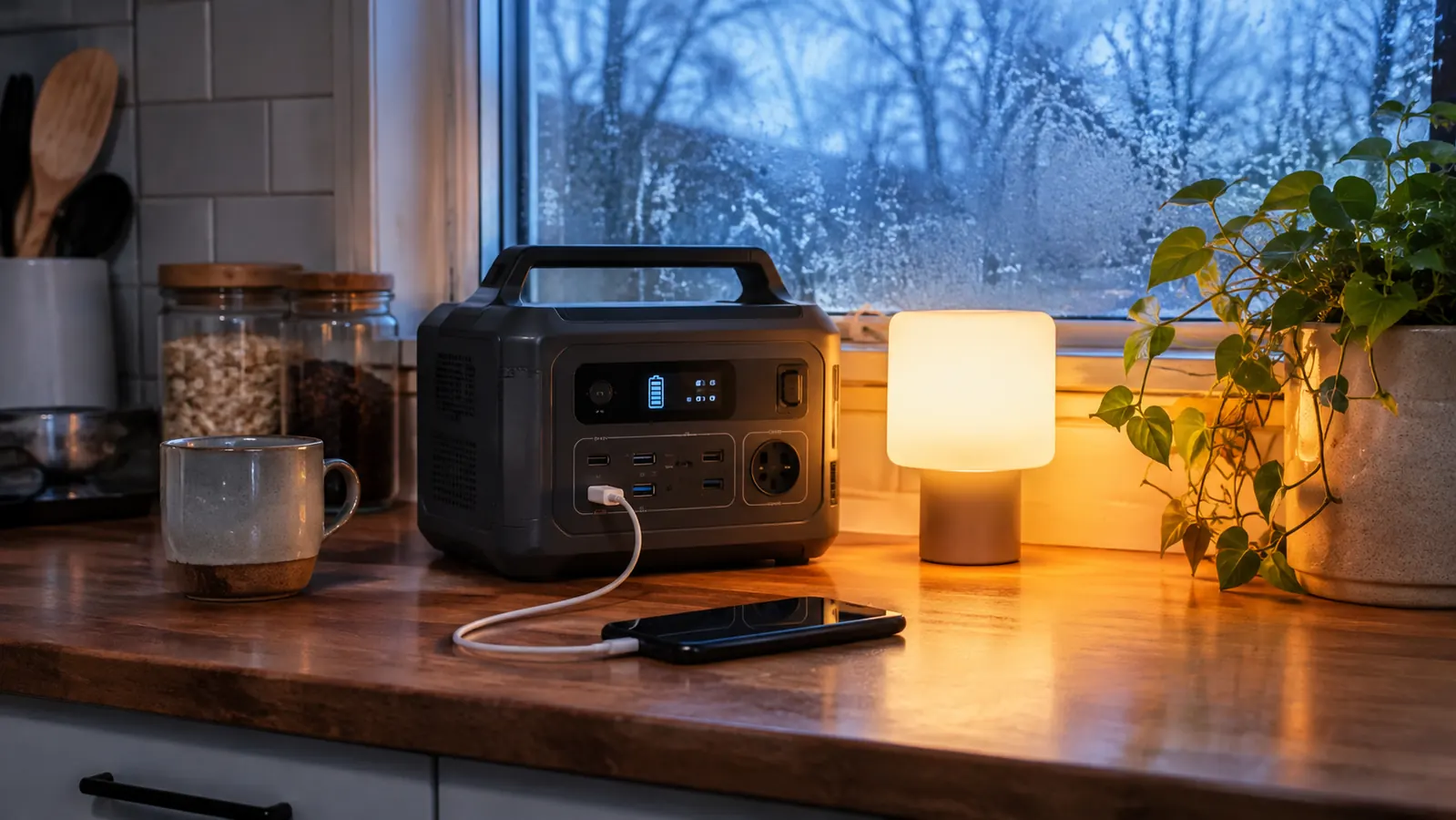
I did not buy a power station to run my house. I bought one so that on a bad night I could charge two phones and keep one lamp lit, and the Jackery Explorer 300 has done exactly that. I carried the box into the hall closet thirteen months ago and set it on the floor at the front, and since then it has come out for real one time: the ice storm this past January, three days with the power off. It started that storm at 100 percent and it finished at about 30. No recharge in between, no fuel to store, no engine running in the yard at two in the morning.
I am 61, retired off a rural mail route after thirty years of driving the same roads through every kind of weather. Hollis and I live at the end of a gravel road in the hills of middle Tennessee. What got me started was a storm the summer before. I am not outfitted for the end of the world and I am not interested in pretending I am. There are five things in my hall closet and a canned pantry, and the Jackery is one of the five. This is what it did, what it will not do, and what I would tell a neighbor who is thinking about the same purchase.
The Quick Verdict
Quiet, light enough to carry from the kitchen to the bedroom, and it did the two jobs I bought it for. It is backup for phones and light, not for your house.
Amazon Check Today's Price →Two charged phones and one lit lamp, three days running
The Explorer 300 started the ice storm at 100 percent and finished at about 30, running two phones and one LED lamp and nothing else. That was the entire plan and it held.
Amazon Check Today's Price on Amazon →How I've Used It
I bought it in October of last year, a month after the radio, a month before the food kits and two months before the backpack. Nothing in that closet was bought as a set. I read listings one at a time and picked what covered a job I could actually picture: news, phones and light, meals, water, and a bag to leave with. The Jackery got phones and light because that was the part of that dark night I kept turning over in my head.
It lives on the floor at the front of the hall closet, not on a shelf. The listing puts it about 7.5 pounds with a handle, which is light enough to carry room to room, but I am not lifting anything over my head in the dark, and the floor is where a heavy thing belongs. When the forecast turns I carry it to the kitchen counter and top the phones up before the weather arrives. After it passes, it goes back on the closet floor.
I measured the closet floor before I bought it. The listing gives the case as 15.43 inches deep, 9.92 wide and 11.89 high, about the footprint of a milk crate stood on end, and that told me it would sit at the front without blocking the door. The handle is on top and the whole thing comes up in one hand. I have carried it from the closet to the kitchen and from the kitchen to the den without setting it down. A machine you cannot move stays where you left it.
I charge it from the wall every three months, on the first of March, June, September and December, and I check the backpack on those same four dates. A check of the bag takes about ten minutes. That is the whole routine. There is no app to open, no fuel to rotate, nothing to drain. It either reads full or it does not, and I can see that in a second once it is on the counter.
What the Explorer 300 Actually Is
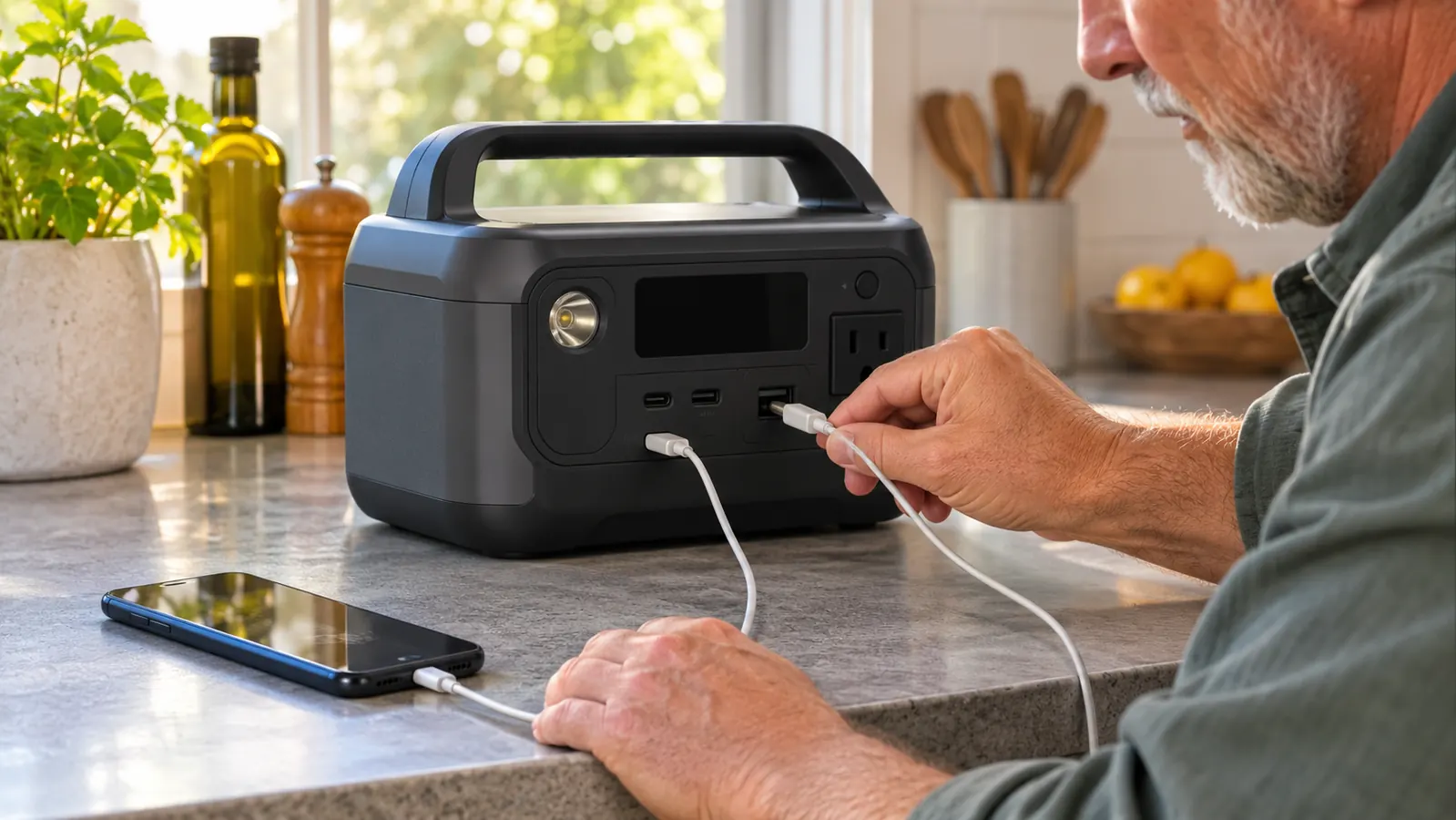
The listing gives it 292 watt-hours, a 300 watt rated output and a 600 watt peak. In plain terms it is a battery in a plastic case with a handle, and the number I care about is not the watt-hour figure but what it buys me: how many phone charges and how many evenings of lamp light. It has 2 AC outlets, one 100W USB-C port, two USB-A ports and a 120W car port. It comes with an AC adapter and a car charger cable, and it charges from the wall in about 4 hours.
The battery is LiFePO4, and the listing rates it at over 4,000 charge cycles. I cannot check that from my kitchen and I am not going to pretend I did. What I can tell you is that thirteen months in, topped up four times a year, it has taken a full charge every time and held it. The afternoon before the ice came I set it on the counter and it read 100 percent, and I had no reason to doubt the number on the display.
Here is the part I want to be plain about, because I have read enough listings to know how they read. A 300 watt rated output is not a lot. This unit is sized for small loads, and in my house the small loads I care about are phones and light. I have never plugged the refrigerator into it, or the range, or the heat pump, or a space heater. I did not buy it expecting to, and I would not tell a neighbor it could. If your picture of a power station is a refrigerator humming through a three day outage, this is the wrong size of machine for that picture.
During the storm the phones went on the USB ports and the lamp on an AC outlet. I have never used the car port or the car charger cable that came in the box, and I have never plugged anything with a motor into it. That is not a complaint about the machine. It is an honest description of what a 300 watt unit gets used for in a house like mine: the small things you reach for without thinking, on the one night the wall socket is dead.
Three Days on the Kitchen Counter
The ice came in late January, on a Tuesday, freezing rain that brought a limb down on the line at about six in the evening. I had already set the Jackery on the kitchen counter that afternoon because the forecast was bad, and it read 100 percent when I set it down. Tuesday night it went to the bedroom floor beside the bed with us. Wednesday it sat on the counter in daylight and moved to the den that evening, because we had shifted our sleeping to the den where the wood stove was. Thursday was the same. Friday around noon the power came back on.
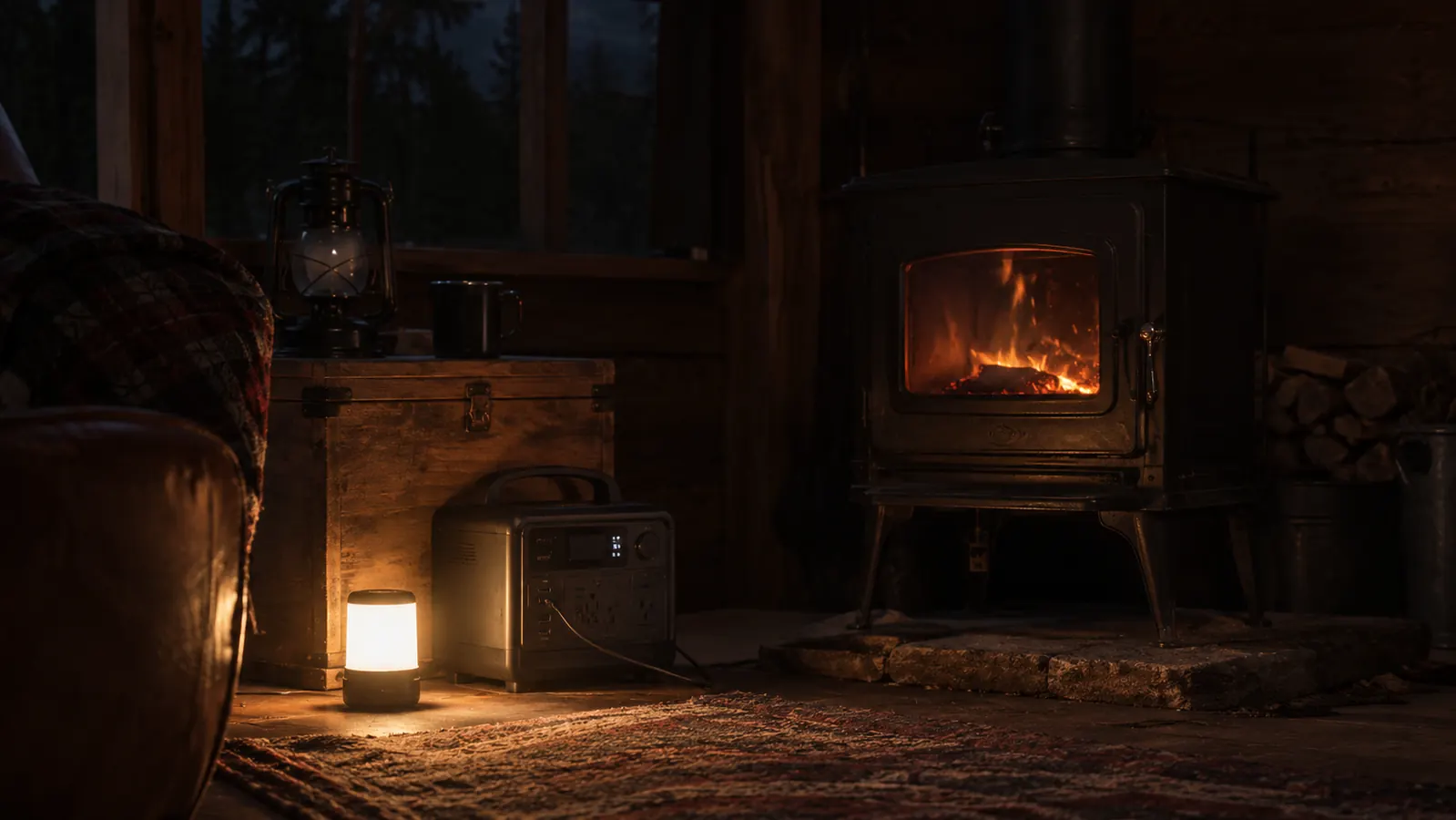
Tuesday night the Jackery sat on the bedroom floor between the bed and the wall where I could reach it without getting up, and the lamp burned on the dresser. Wednesday and Thursday we had moved to the den with the wood stove, so it came with us and sat on the floor by the couch. That was the whole of the logistics. No extension cord through the house, no wiring, nothing to set up. You pick it up, you put it down, you plug the lamp in.
Two phones and one LED lamp. That was the entire load, and I want to say it plainly because it is the honest shape of this review. Nothing in this house ran a heater off it, and nothing with a motor was ever plugged into it. The phones went on the USB ports in the evening and came off when they were full. The lamp sat on the counter, then on the floor of the den, and burned all evening, and it was the difference between a dark room and a room where we could read and not think about the ice.
It never got recharged during the storm. Nothing charged it from the truck and I do not own a solar panel. That is why starting at 100 percent mattered. Three days of two phones and one lamp took it from 100 to about 30 percent, so about 70 percent was used and about 30 was left when I carried it back to the closet floor and plugged it into the wall.
The rest of that storm belonged to other things: the radio on the kitchen table, the food kits that fed us six meals, the backpack that was never opened. The Jackery's part in it was quiet and small and it worked.
What It Did Not Do
Three things went wrong during those three days, and none of them were the Jackery's fault, but all three show where its limits sit. The food in the refrigerator was lost on the third day, because 292 watt-hours is not going to carry a refrigerator and I never pretended it would. The camp stove lighter had gone missing and we used kitchen matches instead. The cell signal dropped on the Wednesday.
The honest summary is that this is a small battery with a handle. A 600 watt peak will start loads that a 300 watt rating alone would not, and the listing is clear about both numbers. What it will not do is carry a house. In a three day outage with the temperature dropping, the Jackery is the thing that keeps your phones alive while you solve the heat problem another way. Ours was a wood stove in the den, and it held the room at about 62 degrees.
The other limit is that it is only as good as the last time I charged it. In my setup it cannot make its own power, since I do not own a solar panel and did not buy one. So the four dates on the calendar are not a suggestion. If I had let it sit at 40 percent going into a storm, I would have gotten about a day out of it instead of three.
How I Keep It Ready
The routine is short. On the first of March, June, September and December it goes on the wall charger until it reads full, which takes about 4 hours, and the backpack gets checked the same morning. Then it goes back on the floor at the front of the closet, where I can get a hand under the handle without moving anything else out of the way.
I keep the four dates on the paper calendar on the refrigerator. There is no reminder on the machine and the display will sit at 40 percent without a word. If a person will not write it down, they should buy something they are willing to check, because a battery that is half empty is half a storm.
When bad weather is forecast it comes to the kitchen counter early. That is my one rule and it is not complicated. This past January was the only time the rule got used for real, and I would rather carry it across the kitchen for nothing than be hunting for a light at midnight. After the power came back I charged it from the wall at about 30 percent and put it away.
What I Liked
- Ran two phones and one LED lamp for three days and finished at about 30 percent, with no recharge
- About 7.5 pounds with a handle, light enough to carry from the kitchen to the bedroom and the den
- No fuel, no fumes and no noise, so it can sit on a kitchen counter and in the room where we sleep
- LiFePO4 battery, rated by the listing at over 4,000 charge cycles
- Charges from the wall in about 4 hours, which fits a short quarterly routine
Where It Falls Short
- 300 watts rated output will not run a refrigerator, a range, a heat pump or a space heater
- 292 watt-hours is roughly three days of phones and one lamp, not a house backup
- It cannot make its own power in my setup, since I do not own a solar panel
- Two AC outlets covers a lamp and a charger, not much more
- It is easy to forget the quarterly top-up, and a half empty battery is half a storm
It started the ice storm at 100 percent and finished at about 30, running two phones and one lamp and nothing else. That was the entire plan, and it held.
Who This Is For
This is for the household that wants the phones charged and a lamp burning when the line goes down, and does not want to store fuel or listen to an engine. It is for somebody who will put four dates on a calendar and keep them. It sits on a closet floor, it comes out without a truck and a funnel, and it runs indoors where you are, which is the whole reason I picked it over the loud thing up the road.
It suits a small house, an apartment, or a person living alone who wants one quiet thing that works. If your outages are short and your main worry is information and light, 292 watt-hours goes further than you would guess, and it goes further still if you charge the phones in the evening and let the lamp do the rest.
Who Should Skip It
If you are shopping for something to run a refrigerator, a heat pump, a space heater or a range, skip this one and stop looking at 300 watt units entirely. The numbers do not stretch. Finding that out in the dark with a freezer thawing is a bad way to learn it, and I would rather tell you now.
Skip it too if you will not charge it on a schedule, or if you want a system that makes its own power, which means a solar panel I do not own and cannot speak to. And if what you actually want is whole house backup wired in behind a transfer switch, this is not a step on that path. It is a different job, done by a different machine.
The quiet thing in the hall closet that did its two jobs
Thirteen months, one real outage, two phones and a lamp for three days, and about 30 percent left when it was over. If that is the job you need covered, this covers it.
Amazon Check Today's Price on Amazon →