

Plenty of people figure a house like mine ought to have a gas generator. I understand the thought. A gas generator is the machine people picture when they picture an outage: something in the driveway, a cord run through the door, the refrigerator humming again. Then I remember our one real outage, the ice storm last January, and I remember what we actually needed. We needed two phones charged and one lamp lit after dark. That is the job the Jackery Explorer 300 did, and it did it without fuel, fumes or a trip to town.
The short answer is that these two machines solve different problems. The Jackery Explorer 300 is a 292 watt-hour battery with 2 AC outlets, one 100W USB-C port, two USB-A ports and a 120W car port. It is for phones and light. A portable gas generator is an engine that makes household current from fuel, and it can run heavy equipment when it is sized for the load. If your main concern is the food in the refrigerator or the heat pump in freezing weather, the generator is the tool that fits that job. If your main need is a charged phone and a lit room, the Jackery is the one that fits inside the house.
| Jackery Explorer 300 | Portable gas generator | |
|---|---|---|
| Main job | Phones and light during an outage | Heavy household loads when sized for them |
| Power source | Battery charged from a wall outlet | Gasoline engine |
| Indoor use | Runs indoors on a counter | Must run outdoors, away from windows |
| Exhaust | No exhaust | Carbon monoxide, so never indoors |
| Noise | Quiet enough for a kitchen counter | Audible up the road when the wind is right |
| Fuel storage | No fuel to store | Gasoline and stabilizer to store safely |
| Moving it | About 7.5 pounds | Designed to stay in one outdoor spot |
| Heavy appliances | Will not run a refrigerator, range, heat pump or space heater | Can run those loads when sized correctly |
| Upkeep | Top up every three months | Oil changes, fuel treatment and seasonal starting |
| Best for | Phones and light in a short outage | A household that needs refrigeration, heat or a pump |
What the Jackery Explorer 300 Actually Is
The Jackery Explorer 300 is a battery in a compact case, not an engine. The listing gives it 292 watt-hours of capacity and a 300 watt rated output. Those numbers matter because they tell you what kind of work it can do. A phone charger and an LED lamp draw very little. A refrigerator, a range, a heat pump or a space heater draw far more, and this unit will not run them. I never tried to run any of those on it, and I would not.
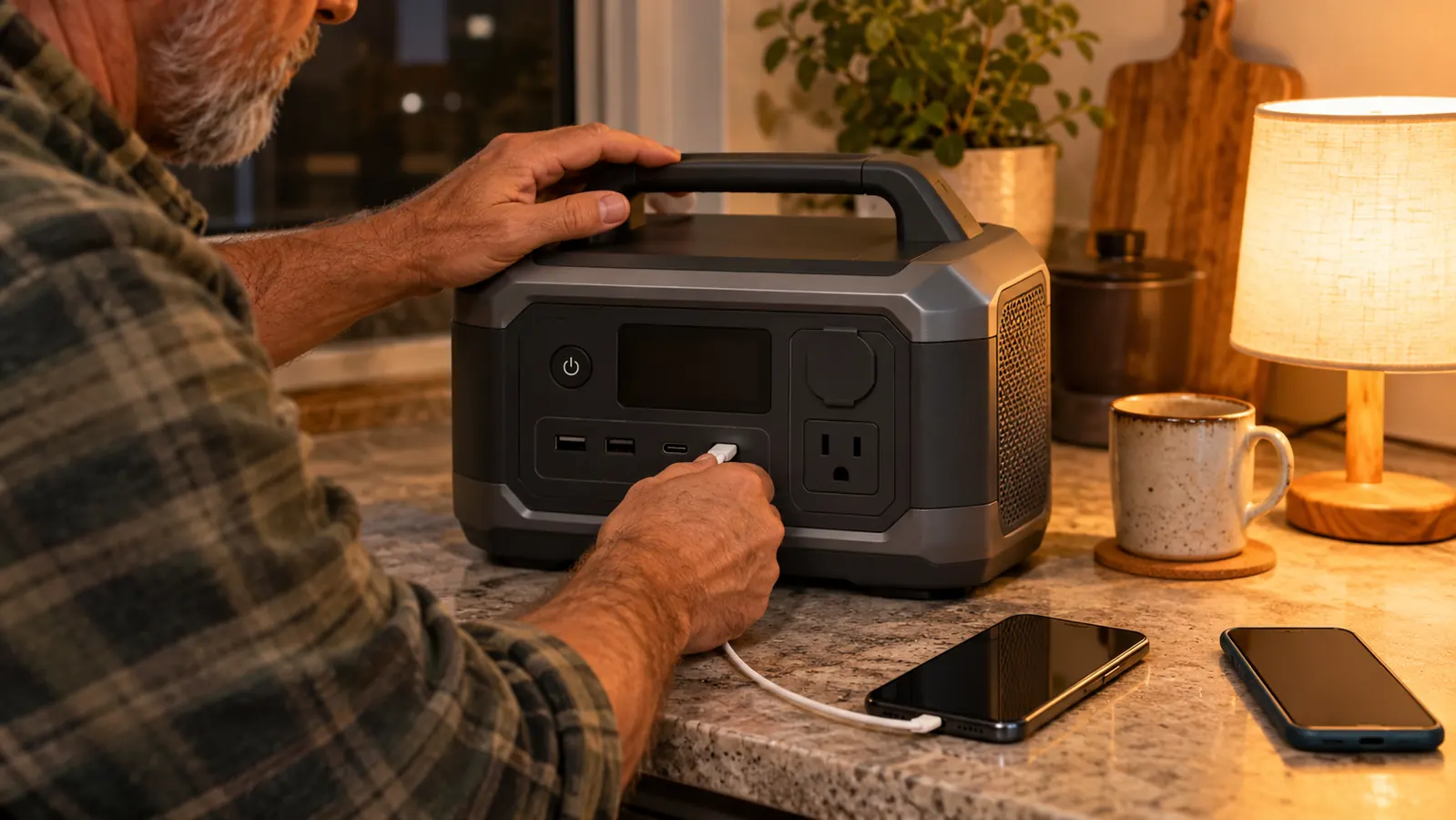
The outlets are the part I use. It has 2 AC outlets, one 100W USB-C PD port, two USB-A ports and a 120W car port. The USB ports are what charged our two phones during the ice storm. The AC outlets are there for the lamp we used. The car port is an option I have not needed, though the unit comes with a car charger cable. It charges from a wall outlet in about four hours.
It weighs about 7.5 pounds, which is why it could go from the kitchen counter to wherever we slept. The case is compact plastic with a handle on top, and that handle is the reason I can pick it up with one hand and carry it down the hall in the dark. It lives on the floor at the front of the hall closet, not up on a shelf, because 7.5 pounds lifted off a shelf in a dark hallway is how people get hurt. The battery is LiFePO4, and the listing says it is built for over 4,000 charge cycles. I top mine up every three months, on the first of March, June, September and December, whether it has been used or not. That routine takes a few minutes and it is the whole maintenance schedule. There is no oil to change, no fuel to treat and no choke to set.
The Test That Mattered: Three Days in January
Last January, freezing rain brought a limb down on the line at about six in the evening on a Tuesday. The power stayed out for three days. I had moved the Jackery Explorer 300 to the kitchen counter before the weather got bad. It started at 100 percent. It ran two phones and one LED lamp, nothing else. The phones charged on the counter through the day and the lamp sat beside them after dark. Each morning I looked at the reading the way you check a fuel gauge on a long drive, and each morning it had come down a little, slower than I expected. At night it went where we slept, the bedroom the first night and the den after that, and back to the counter in the morning. It was never recharged during the outage. By Friday at noon, when the power came back, it was at about 30 percent.
That is a small job, and I want to be plain about it. The Jackery did not save the food in the refrigerator. We lost that on the third day. It did not heat the house. The wood stove did that, and it held the den at about 62 degrees, which is why we slept in the den the last two nights with the unit on the floor beside us. It did not run the range or the heat pump. What it did was keep our phones alive and give us light in the room we were sitting in. For two people in a house with a wood stove, that was enough. For a house with a freezer full of meat or a heat pump, it would not be enough.
Ray, who lives about a quarter mile up the road, owns a gas generator. He walked down on Thursday to check on us and said his generator was running fine. I do not know the make or the size, and I did not ask. What I know is that he had a machine outside making power while we had a battery on the counter. Both of those things were true at the same time. The question is which one fits your house.
The Jackery did not save the refrigerator. It kept our phones alive and put light in the room. That was the job I needed done.
The Questions I Would Ask Before Buying Either One
Start with the load, not the label. Walk through your house and write down what you actually want to keep running when the power is out, then read the watts printed on the back of each one. Add them up. If the list is two phones and one lamp, the total is small and the Jackery Explorer 300 fits it easily. If the list includes the refrigerator, the range, the heat pump or a space heater, the Jackery does not fit it, and no amount of wishful thinking changes that. Its rated output is 300 watts. A gas generator can fit a heavy list if it is sized for the load and set up the way the manufacturer says. The mistake I see people make is buying a battery for a generator job, or a generator for a battery job.
Then ask where the thing will live. My Jackery lives on the floor at the front of the hall closet and comes to the kitchen counter when a storm is forecast. A gas generator cannot live there. It has to run outdoors, away from windows, and you need a safe place to store fuel that is not inside the house. If you do not have that outdoor space, the generator is not a practical answer no matter how much power it makes.
Then ask who will do the upkeep. I top up the Jackery every three months on the first of March, June, September and December. That is the whole routine. A generator needs oil changes, fuel treatment and a start now and then. If the answer to who will do that is nobody, the generator will let you down. If the answer is you, and you will actually do it, the generator can be the better tool for a long outage.
Where the Jackery Explorer 300 Wins
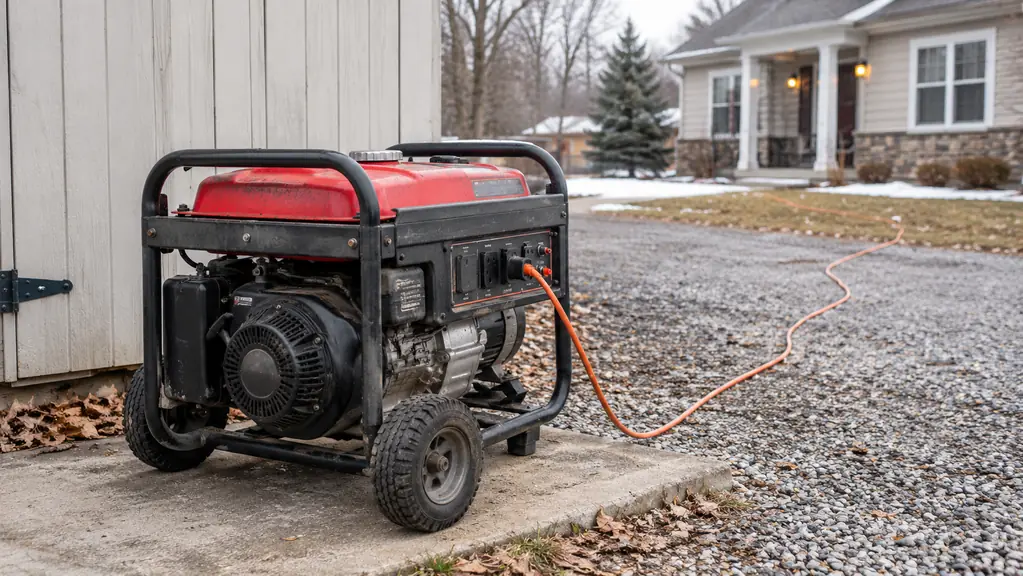
The first win is that it belongs inside the house. A gas generator has to run outdoors, away from windows, because it produces carbon monoxide. That is not a small detail. It means a cord, a door that has to stay cracked or a hole in the wall, and a machine running in the weather. The Jackery sits on the counter. It has no exhaust. It makes no noise worth mentioning. I can carry it to the room we are using and set it down, and on the second night I carried it to the den without waking Hollis.
The second win is the upkeep. I charge it every three months. I do not store gasoline, treat gasoline or wonder whether the carburetor will start in January. I do not change oil. The listing says the LiFePO4 battery is built for over 4,000 charge cycles, and I have owned it for 13 months. The only thing I have done is top it up on the same four dates each year. If you are the kind of person who puts off maintenance, that matters more than a spec sheet.
None of this makes it a generator. It is a battery for phones and light. I say that because the worst thing you can do is buy it expecting a refrigerator to run. It will not. If that is what you need, keep reading.
Where a Gas Generator Wins
A gas generator wins on the loads that matter most in a long outage. If the job is the refrigerator, the range, the heat pump or a space heater, the Jackery Explorer 300 is the wrong tool. It will not run those. A generator sized for the load can. That is the honest case for it, and it is a strong one. A refrigerator full of food is worth more than a charged phone to a lot of households, and in a cold snap a heat pump is worth more than both.
A generator also wins on duration if you can keep it fed. It runs as long as you have fuel and the machine keeps working. Ray's ran through the ice storm. But a generator is not a set-and-forget appliance. It needs oil changes, fresh fuel, a safe place to store that fuel and a start procedure you can remember in bad weather. It has to stay outside, away from windows, and you have to follow the manufacturer's instructions. If you will not do that work, do not buy one.
The battery that fit my kitchen counter
The Jackery Explorer 300 is a 292 watt-hour battery for phones and light. It is not a generator, and it will not run a refrigerator, a range, a heat pump or a space heater. If those are the jobs you need done, look at a generator. If your job is a charged phone and a lit room, see the listing.
Amazon See the Jackery Explorer 300 on Amazon →Who Should Buy Which
Buy the Jackery Explorer 300 if your outages are short or your needs are small. Buy it if you want charged phones and a lamp, and you already have another way to heat the house. Buy it if you want something that lives on a closet floor, comes out when a storm is forecast and goes back when the storm passes. Buy it if you are not going to maintain an engine. The one thing I would add is a second way to charge those phones if you have it, because a battery that starts at 100 percent on Tuesday is at about 30 percent by Friday and it will not refill itself. That is the household I know, and it is why the Jackery is the one I own.
Buy a gas generator if you need to run heavy equipment: a refrigerator, a freezer, a range, a heat pump, a space heater or a pump. Buy it only if you will keep it outside, away from windows, and maintain it. Buy it if you have a safe place to store fuel and you are willing to learn how to start it in bad weather. If you are not willing to do those things, the generator will sit in the shed and the battery will be the thing that works. That is not a knock on generators. It is just how people are. Whatever you buy, follow local officials and evacuation orders. No machine is worth staying put for.
If phones and light are the job, this is the tool
The Jackery Explorer 300 is 292 watt-hours, about 7.5 pounds, and charges from a wall outlet in about four hours. It has 2 AC outlets, one 100W USB-C port, two USB-A ports and a 120W car port. It is for phones and light. Check the listing for the full specs.
Amazon See the Jackery Explorer 300 on Amazon →