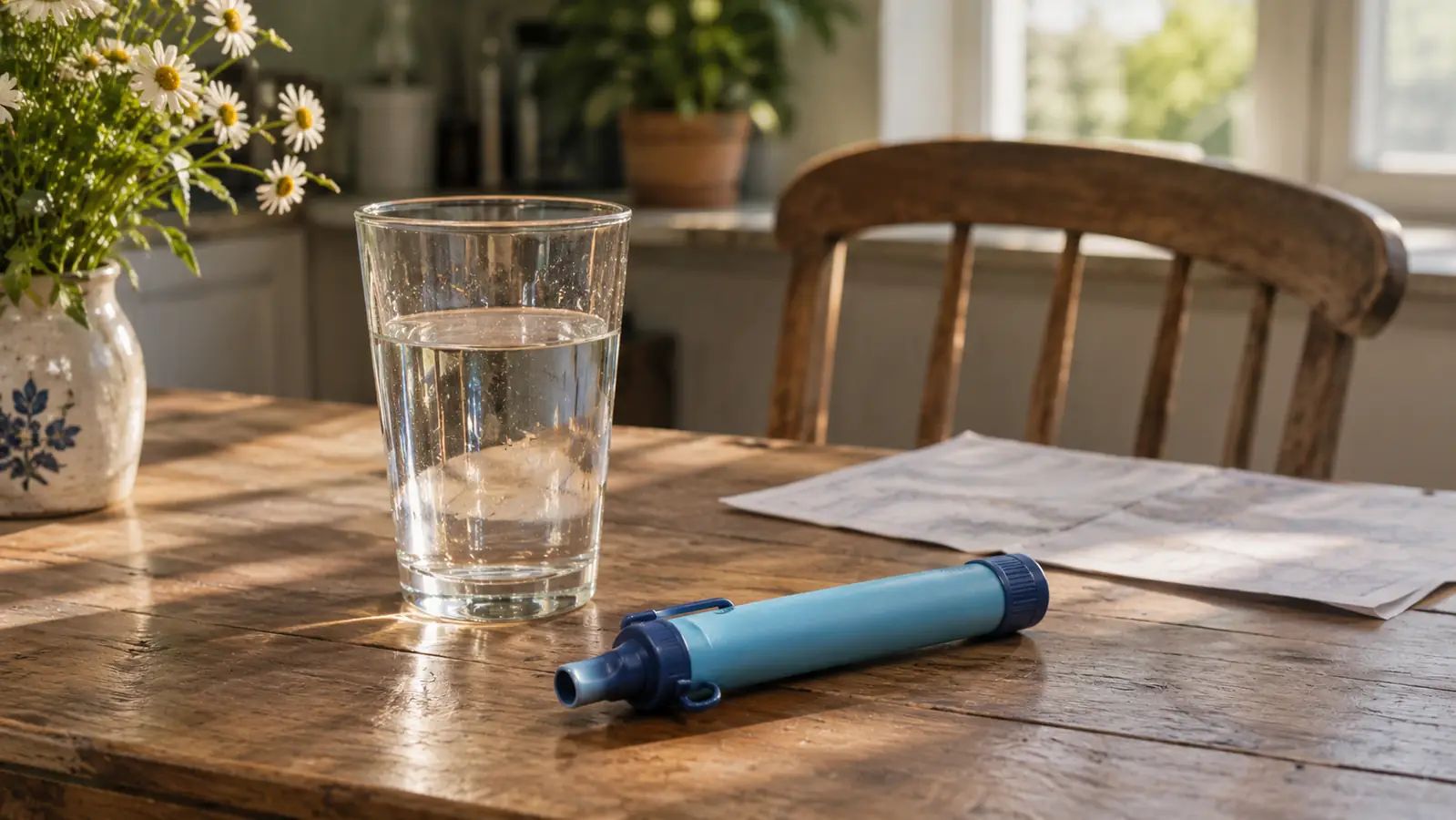
The thing nobody says out loud in the reviews is that a LifeStraw is a straw. One person, one drink, one mouth on the end of it, and no water held anywhere for later. I knew that when I bought mine. I still had to live through a boil water notice to understand what it means in a house with two people in it.
I am Marlene Tolliver. I carried mail on the same rural route for thirty years and retired three years ago, and Hollis and I live at the end of a gravel road in the hills of middle Tennessee, on the utility district water and not a well. I bought two LifeStraw Personal filters last November, one for each of us, and they have been in the hall closet and then in the backpack ever since. I have drunk through mine exactly once. This is an honest review of what that one glass taught me, and of the three things this filter cannot do, because the three things matter more than the one thing it does well.
The Quick Verdict
A light, power free backup for one person's drinking water. It is not a household water plan and it is not a substitute for a boil notice.
Amazon Check Today's Price →The One Piece of Water Gear That Lives in My Backpack, Not on a Shelf
Two filters, one for each of us, 1.62 ounces apiece with nothing to charge and nothing to switch on. It is the lightest thing in the bag and the one I hope stays there. Listing details and today's price are on Amazon.
Amazon Check Today's Price on Amazon →What the Listing Claims, and What I Can Confirm
The listing is unusually specific, and I take that as a good sign. It says the hollow fiber membrane removes 99.999999 percent of waterborne bacteria, E. coli and Salmonella among them, and 99.999 percent of parasites. It says it takes out the smallest microplastics found in the environment, down to 1 micron, and reduces turbidity. It says one filter will provide 4,000 liters, which is 1,000 gallons. Those are the listing's numbers. I did not test them and I could not test them.
The hollow fiber membrane is the part I had to read twice. As I understand the description, it is a bundle of very fine tubes with walls full of holes, and water goes through the walls while anything larger than the holes stays on the outside. One micron is the figure the listing gives for those holes, and it is small enough to catch the microplastics it talks about. That is a description of how the thing is built, not a result I produced in my kitchen. The same design is why it weighs 1.62 ounces and why it never needs a battery, and both of those I can check for myself any time I like.
What I can confirm is everything else on the sheet. It weighs 1.62 ounces. It requires no electricity or battery power, so there is nothing to charge in a house that has lost its power and nothing that will be dead when you reach for it. There is no switch to flip and no pump to work. After months in a closet and then months in a bag, mine looks and behaves exactly like it did the day it came out of the wrapper.
What I cannot confirm is any of the microbiology. I have put one glass of tap water through this filter in the whole time I have owned it, and one glass of water in a kitchen is not a test of a filtration membrane. If you want the percentages verified, you are trusting the listing and the lab behind it. I would rather write that plainly than let a glass of water in my house sound like proof of anything.
How I've Used It, Which Is Barely At All
I bought them in November of last year, in the same order as the two food kits, and the reason was a storm the summer before. I did not buy a filter because I expect our water to fail. I bought it because I had already been surprised once and did not care to be surprised twice.
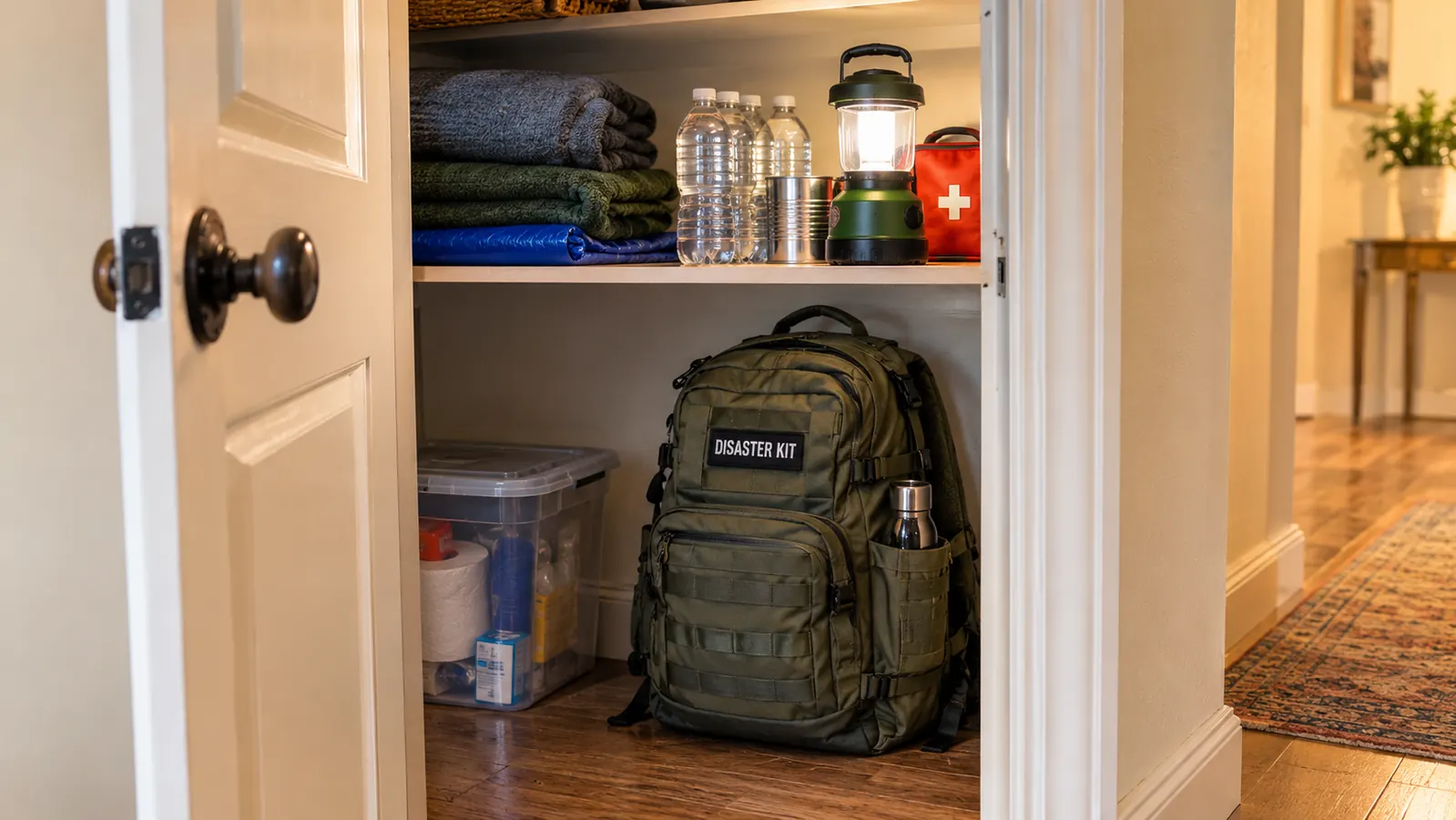
For the first three months both filters sat on the hall closet shelf, still wrapped, next to the spot where the backpack would eventually live. In February I moved them into the Ready America bag, one in each side pocket, and that is where they have been for the last nine months. Neither has been used since. The bag sits on the floor just inside the closet door and goes wherever the bag goes, which so far has been one night in a church fellowship hall during the creek flood in April. The filters stayed in the bag that night and were not touched.
From noon on Wednesday of that storm, water stopped being a habit and became a chore. I filled the pot at the kitchen tap, carried it out the back door, and boiled it on the two burner camp stove on the porch, because that stove does not come inside this house for any reason and never will. Then the pot came back in and cooled on the counter, and we drank from it or poured it into whatever was clean. Six gallons of bottled water was what we started with. The boiling is what carried us, and if you asked me today I would say the same thing to you that I said to Hollis at the time.
Freezing rain brought a limb down on the line on a Tuesday evening in late January, the power went out, and it stayed out for three days. Around noon on Wednesday the radio reported a boil water notice for our utility district, because the water plant had lost power. That notice is the only thing that has ever made me take these filters seriously, and it is also the reason I did not use one for three more days.
The Saturday Evening I Actually Used It
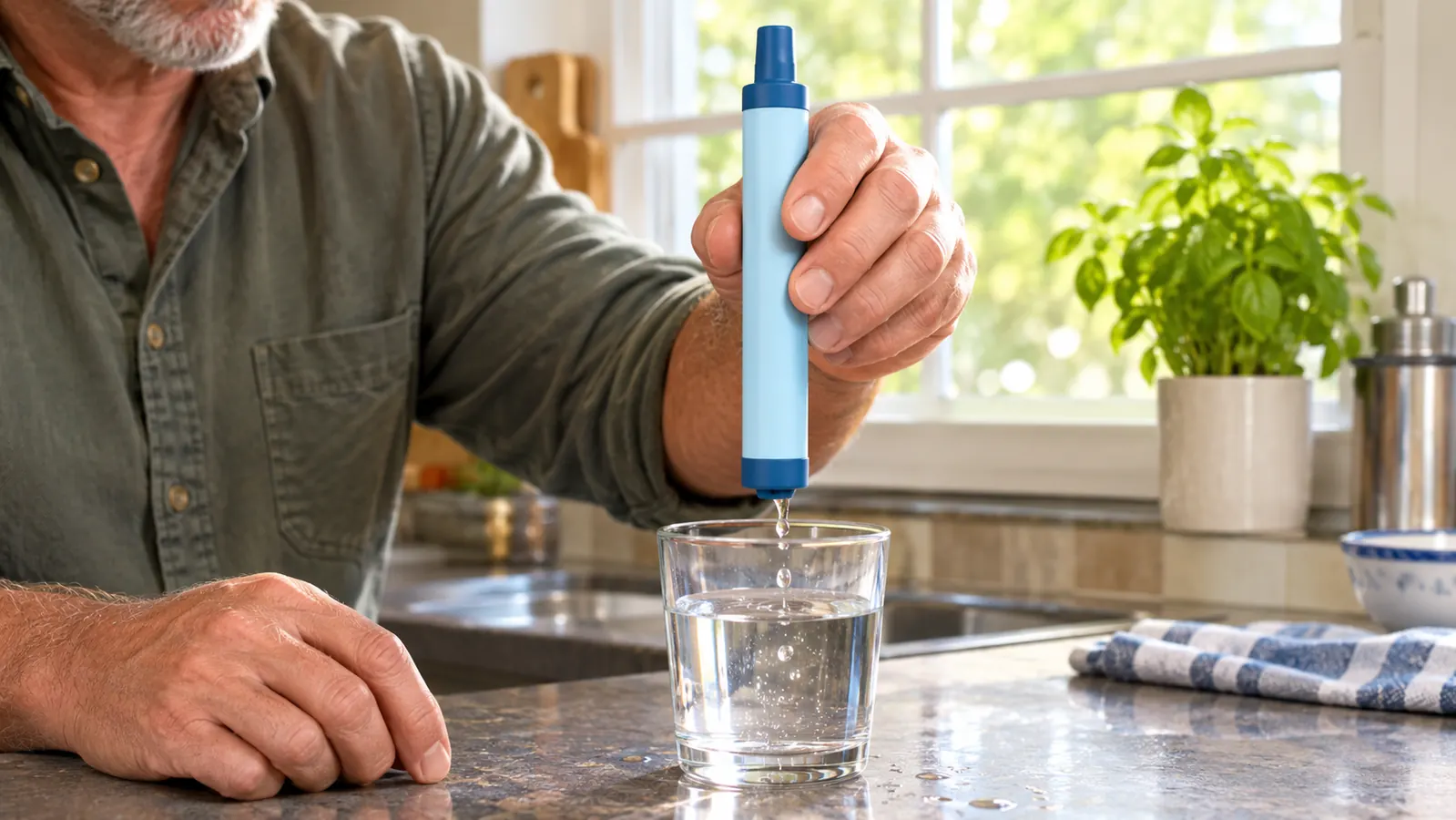
We had about two gallons of bottled water left by Saturday and I did not want to spend the last of it on a single glass. So I filled a glass from the kitchen tap, took my filter down from the closet shelf, and drank it through that. That was the entire event. Not a creek, not a puddle, not floodwater. Tap water, in my own kitchen, on the fourth day of a notice that said boil.
The filter was still in the wrapper it came in. I opened it at the sink, which felt strange after about two months of walking past it on a shelf, and I held the bottom end down in the glass and pulled. The glass was an ordinary tumbler, filled a little past halfway. I did not time myself and I would not trust a number if I had, but it took the better part of a minute with a pause in the middle, and my jaw noticed the work more than my stomach did.
You drink through it the way you drink through a straw, and it takes a good deal more pull than a straw in a glass of tea. Then the glass was gone. It did not taste of anything in particular, which is exactly what I wanted from it. I washed the glass, put the filter back on the closet shelf, and went back to boiling water on the kitchen range for everything else, because the notice said boil and I am not going to argue with the utility district about it.
Hollis has never used his. Not once. He drank bottled and boiled water with me all week and never asked for the filter, and I did not push it at him. If you asked me today what I would reach for first in a water emergency, it would be a pot and a heat source, then a bottle, and then the filter. That ordering is the honest part of this review, and it is the part I would want to know if I were the one reading it.
The filter did exactly what the listing says it does. It just did it for one person, for one glass, while the notice asked us to boil.
The Limits the Box Does Not Spell Out
The first limit is what it does not remove. It does not remove viruses. It does not remove chemicals, fuel or salt. Floodwater can carry all of those, along with everything else it picked up on the way down the road. I have never drunk creek water or floodwater through this thing and I would not start. The listing is clear about bacteria, parasites and microplastics and quiet about the rest, which is fair enough on a package, but the quiet part is where a person gets hurt.
The second limit is arithmetic. It is one person at a time, one mouth on the end of it, and it holds no water. It will not fill a pot, a kettle, a bottle or a cup for later. Four people at a table and one filter means four turns at the sink and a filter passed from hand to hand, and that is before anyone thinks about cooking. That is not a household water plan. It is a personal backup, and to its credit it is sold as one.
The third limit is that the filter cannot tell you anything. It does not know what is in the water and it cannot warn you. It removes what it removes and passes the rest, and the rest may be the thing that actually matters. A boil notice is issued for a reason, and the reason is not always bacteria. Follow the notice. Follow the local officials. If they say boil, boil. If they say leave, leave, and take the bag with you.
What I Liked
- Weighs 1.62 ounces and takes up almost no room in a pack, a glovebox or a coat pocket
- No electricity, no batteries, no charging, so it is ready in a house that has lost power
- Listing states its numbers for bacteria, parasites and microplastics down to 1 micron
- Nothing to seize up or leak while it sits in a closet for months
- One filter is rated by the listing for 4,000 liters of water
Where It Falls Short
- One person at a time and it holds no water, so it cannot supply a household
- Does not remove viruses, chemicals, fuel or salt, and floodwater can carry all of them
- No substitute for a boil notice, and boiling is what I would do first every time
- The percentages are the listing's figures, not something a reader can check at home
- Two people means two filters, and a family of four means four
If I Were Doing It Again
I would still buy two, one for each of us, and I would still put them in the backpack rather than leave them on the shelf where they sat for the first three months. What I would add is a way to treat water by volume. A straw solves a drink. A pot and a heat source solve a household, and I already had both, which is why the filter was never the load bearing part of our water plan during that storm.
The other thing I would do differently is simpler. I would read the notice twice before I reached for anything. It said boil, and boiling is what we did, and the filter came out on Saturday only because the bottled water was running low and I wanted to save what was left. That is the honest use case for this filter in a house like ours. Not a replacement for the notice. A bridge across a bad evening.
What It Asks of You Between Emergencies
Almost nothing, and that is the whole reason it stays in the bag. There is no battery to leak, no charge to keep up, no fuel to rotate and no moving part to seize. It weighs 1.62 ounces, so it costs the backpack nothing to carry it. Of the five things I keep in that closet, the LifeStraw Personal filters are the only ones that have never needed my attention, and I say that as someone who has had to think about the other four.
I go through the bag on the same four dates I charge the power station, the first of March, June, September and December. The whole check takes about ten minutes and the filters get about ten seconds of it. I look them over, confirm both are still in their pockets, and put them back where they belong. That is the entire routine, and it has not changed in the time I have owned them.
Who This Is For
This is for the person who already has a pot, a heat source and some bottled water and wants one more layer that does not depend on any of them. It is for the hiker, the traveler, the commuter with a bag on the seat beside them, and the household that wants each person to have one small thing of their own. It is also for the reader who has put off a water plan for years because the whole subject felt heavier than it needed to. Two of these take up less room than a loaf of bread and ask nothing of you after that.
If you are on a well instead of town water, the arithmetic changes and I will not pretend otherwise. A well and a pump need power, and when the power goes the water goes with it, sometimes in the same minute. The LifeStraw Personal is still one person at a time, so it is still a backup and not a supply, but the gap it covers is longer than the gap it covered for us, and that is worth knowing before the night it matters.
It suits the person who wants a filter in a coat pocket, a glovebox or a purse, because the water gear you actually have with you beats the water gear sitting in a closet two counties away. And it suits the household that wants a cheap bridge, something to cover the gap between what you stored and what you need while you wait for the notice to lift. That is the job, and it does the job.
Who Should Skip It
Skip it if you think one filter covers a family, because it does not, and the arithmetic will find you out on the first evening you actually need it. A household needs a way to treat water in volume, which means heat and a pot, or a stored supply, or a larger system than this, and a straw in a bag is none of those. Skip it too if the risk you are worried about is chemical, because this filter is aimed at the biological side and it will do nothing about fuel, solvent or salt.
And skip it if you are looking for a reason to ignore a boil notice. There is no such reason and no filter in a pocket changes what the utility district told you. If you treat this as permission to drink untreated water during a notice, you have bought the wrong thing and you have misread the notice. Buy it as a backup, keep it where the backup belongs, and read the notice twice.
Two Filters, Two People, and a Bag by the Door
It is the lightest item in my hall closet and the only one that has never asked a thing of me. If you want one per person, the listing and today's price are on Amazon.
Amazon Check Today's Price on Amazon →