Short answer: keep both, and be clear about which one you are trusting for what. Your phone is better at telling you that a warning exists. The Midland ER310 is better at telling you what is actually happening once the power is out and the cell signal has gone thin. One is a messenger that needs a working network behind it. The other is a radio with a hand crank, a small solar panel and a slot for six AA batteries, and it does not need anyone's permission to work.
I have owned the ER310 for fourteen months. It sits on my kitchen table from November through May and on the hall closet shelf the rest of the year. I did not buy it to replace my phone. I bought it because of a night in August of last year when a thunderstorm took the power out for about nine hours and my phone was at 11 percent and I had no idea what the storm was doing. That was the whole problem. Not the dark. The not knowing.
| Midland ER310 | Phone weather alerts | |
|---|---|---|
| When the power is out | Runs on the hand crank, its solar panel, or the six AA batteries that come in the box | Needs a charged battery, and a wall outlet to top it back up |
| When the cell signal drops | Pulls AM, FM and the weather band out of the air, no tower needed | Alerts stop arriving when the towers are down or overloaded |
| Warning aimed at your location | You hear the whole region and decide yourself what applies to you | Follows your location and pushes warnings for exactly where you are |
| With you away from the house | 16 ounces, and by design it stays put on one table | Already in your pocket at the store and in the truck |
| Light when the lamps are out | Built-in flashlight on the radio itself | Phone flashlight drains the battery you may want for calls |
| Rain and wet weather | Listed as not water resistant, so mine lives indoors | Most phones shrug off a pocket in the rain |
| Everyday use | Quiet most of the year, sitting on a table | Used every day for everything else in your life |
| Staying alive through a long outage | Same six AA batteries through the storm, hand crank as the backup | Depends on something else in the house to keep it charged |
Where Midland Wins
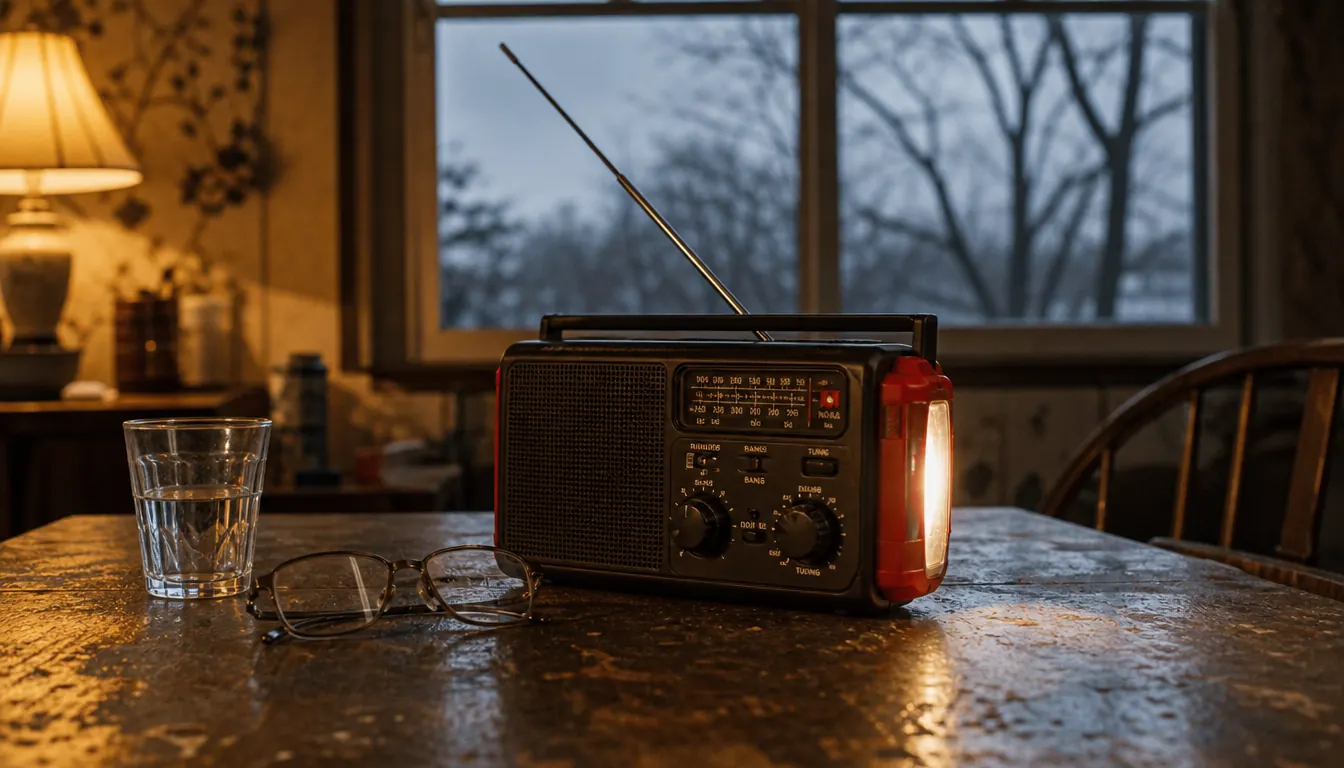
The ice storm this past January made the case in a few hours. The freezing rain started on a Tuesday afternoon, and by about six that evening a limb came down on the line and the power went out. I had owned the radio about four months. I sat at the kitchen table and cranked it and got the forecast for our part of the state. Nobody had to reach me and nothing had to be delivered. I knew what the weather was going to do overnight, which is more than I could say for the phone in my pocket. Tuesday night we ate cold food out of the refrigerator and slept in the bedroom with the radio still on the table. Wednesday morning I switched from the crank to the six AA batteries that came in the box, and it ran that way for the rest of the storm. Thursday the road stayed iced and nobody left the house. Friday about noon the power came back. Three days, one table, one radio, and the same six batteries the whole time.
By Wednesday morning the cell signal got weak and then stopped for most of the day. That is the part people underestimate. A phone alert is a message that has to travel over a network, and in a wide outage the network is the first thing that tires out. The ER310 does not wait on any of that. It pulls the weather band, AM and FM out of the air with a tuner and a plastic case and a wire. There is no account, no login, no update, and no tower standing between you and the voice reading the forecast. Wednesday about noon it also carried the boil water notice for our utility district, because the water plant had lost power. I would have had no way to hear that on a phone that could not find a signal.
Wednesday morning the signal stopped for most of the day. The radio did not.
Where Phone Alerts Win
Here is the fair part. My phone is better at the thing that matters most in the first ten minutes, which is telling me a warning exists at all. It knows where I am. It pushes a warning for my county and not the county ninety miles east. It wakes me at two in the morning. It is in my pocket at the grocery store, in the pickup, and at the fellowship hall in town. The radio is on my kitchen table and it stays on my kitchen table. If I am not in the kitchen, the radio is not helping me.
The phone also handles weather better than the radio does. The ER310 is listed as not water resistant, so mine lives indoors and has never left the house. A phone in a pocket in the rain is fine. And I was carrying the phone anyway, which is not a small thing. The honest version is that each one does a job the other cannot, and the argument only starts when somebody claims one of them makes the other pointless. My phone still gives me alerts today. Nothing about owning a radio changes that, and I would not want it to.
The radio for the night the signal goes, not for the alert you already got
The Midland ER310 is the piece I reach for when the power is out and the phone has nothing left to tell me. Crank, solar panel or six AA batteries, AM, FM and the weather band, 16 ounces on the kitchen table.
Amazon Check Today's Price on Amazon →What the ER310 Actually Does
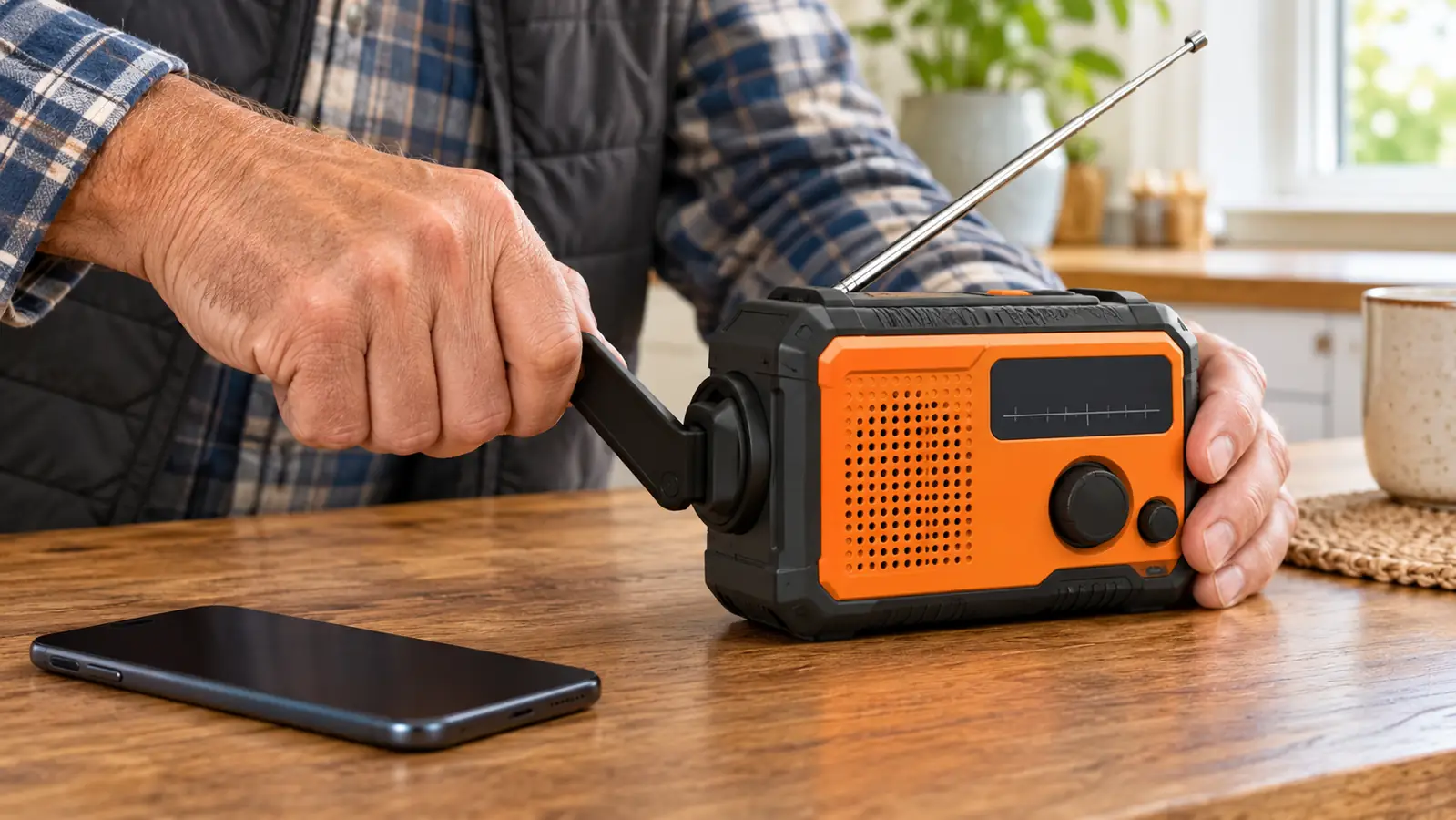
The listing is short, so I will keep it short. It has an AM and FM tuner with the weather band and a built-in flashlight. It runs on a hand crank, a small solar panel, or six AA batteries, and the six AA batteries come in the box. It has a USB connection and the listing says it is compatible with a smartphone or tablet. It weighs 16 ounces and measures 9.61 by 2.95 by 6.85 inches, in a plastic enclosure, with an owner's manual in the box. That is the whole machine.
What the listing does not say is where the limits are. The solar panel is not much on a gray day. I tried it once on a windowsill and it did little, and I have not leaned on it since. The USB connection will give a phone a small top-up and I have done that once or twice, but it is not a phone charger, and the crank will not charge a phone. Phones are the power station's job in this house. The radio's job is news. The built-in flashlight is on the radio itself, and I have used it to cross a dark kitchen more than once. My order is to crank first and switch to the batteries when I want to listen for a long stretch, and that is the order I would suggest to anybody.
The Tornado Warning Night
In March the radio earned a different kind of trust. Storms were forecast, so before bed I carried it from the kitchen table to the bedroom nightstand, the only time it has been anywhere else. About two in the morning the weather band had us up and we went to the hall, the only inside space in this house with no windows. The warning passed to the north of us. No damage at our house, no trees down on the road. The next morning the radio went back on the kitchen table and the power stayed on the whole time. I do not know what a phone would have done at two in the morning with the signal coming and going. I know what the radio did. An alert arrives once and stops. A radio keeps talking, and you can sit in the hall and hear it say the storm is moving north and away from you.
The reason I started is worth repeating, because it also shows what a radio cannot do. August of last year, a thunderstorm took the power out overnight for about nine hours. My phone was at 11 percent and I had no idea what the storm was doing. A radio would have told me. A radio would not have charged the phone. I bought the ER310 in September and the power station in October, in that order, because they answer two separate questions: what is happening, and how do I keep the phone alive long enough to find out.

How I Run Both
None of this is complicated. The phone does what it does on an ordinary day: it buzzes with alerts while it has signal, and I keep it charged. The radio covers the days when the phone cannot. It lives on the kitchen table from November through May and on the hall closet shelf from June through October, because winter is when the lines come down. When a storm is forecast the power station comes out to the counter and the phones get topped up. The radio is already where I need it. The closet is an ordinary inside closet in a heated house, and everything in it has a spot: the power station on the floor at the front, the backpack on the floor just inside the door, the food kits on the shelf, and from June through October the radio too.
The one thing I would tell a neighbor is to know the piece of equipment they are counting on before the night they need it. The six batteries that came in the box ran my radio from Wednesday through Friday of that ice storm and did not run down. I keep the crank for when they finally do. I have never changed them and I do not keep a spare set, which is honestly the weakest link in my setup, and I would fix it before next winter. A spare set of batteries is not a plan, it is a habit, and I have the habit everywhere else in that closet. The radio is the one piece I have left to finish.
That is the whole system in this house: phone first, radio second, and the power station to keep the phone alive. The radio is the piece that still works when the other two are done.
What to Check Before You Buy One
If you are shopping for one, three things are worth checking. Does it take standard AA batteries, because a radio that only runs on a built-in pack you cannot replace is a paperweight after a few years. Does it list the weather band, not just AM and FM. And is the listing honest about water, because the ER310 says plainly that it is not water resistant and I would not carry mine out to the barn in a downpour. Mine has stayed indoors for fourteen months and has never been dropped or damaged. The other test costs nothing: put it on your own kitchen table, turn it on, and see whether the weather band comes in clear where you actually live. Mine does. A hollow road in the hills can surprise you, and it is better to find out on an ordinary Tuesday than on the night the line comes down.
The other thing worth doing is putting it where you will hear it. A radio in a closet is a radio you have to remember. Mine is on the table because the table is where I can reach it, and the one night it moved it went to the bedroom nightstand, and it went there because I carried it. It does not need a network or an account. You turn it on and you listen.
Who Should Buy Which
Buy the ER310 if you live where the power goes out and the signal follows it, if you are the person in the house who wants to know what the weather is doing at two in the morning, or if you have ever sat in the dark with a phone at 11 percent. Skip it if you are never more than an arm's length from a charged phone and a working tower, or if you want something for a boat or a deer stand. It is not water resistant and mine has never left the house.
Keep the phone either way. It is the fastest warning you will get and the one that will reach you in the pickup. The Midland answers the narrower question, which is what happens on the night the tower goes quiet and the kitchen table is the only thing in the house still talking. I would rather have both and know the difference than argue about which one wins.
One radio on the kitchen table beats a dead phone in a dark house
Fourteen months in, the ER310 is the first thing in my hall closet that proved itself. AM, FM and the weather band, hand crank, solar panel, six AA batteries included, 16 ounces, indoors only.
Amazon Check Today's Price on Amazon →