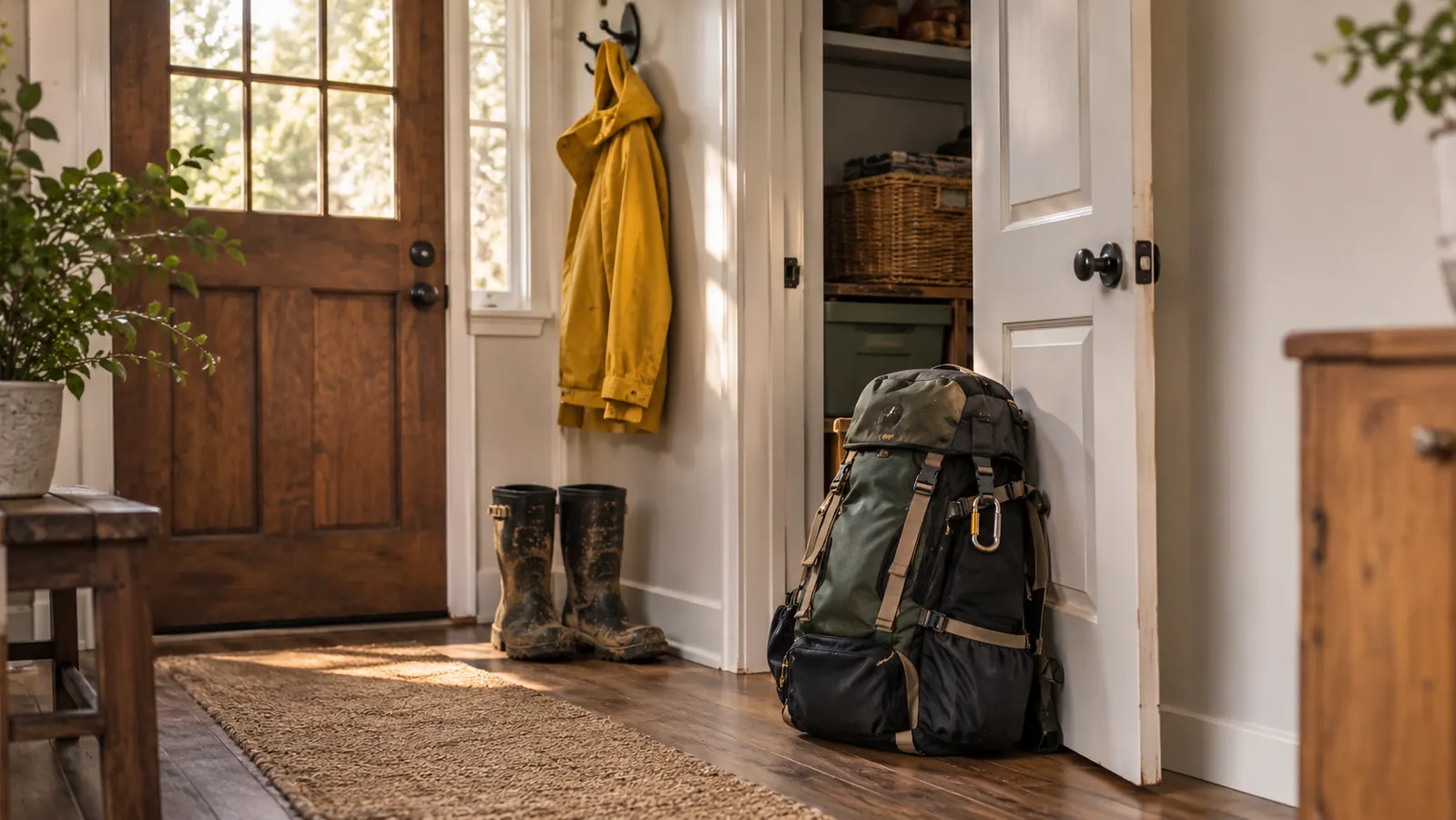
I bought the Ready America 70280 in December of last year, and I want to be straight with you about how it has spent the eleven months since. It has sat on the floor just inside my hall closet door. I have picked it up, set it back down, and unzipped it on the same four dates a year that I go through everything else. That is not a complaint. A bag like this is supposed to be boring. Boring is exactly what you want from the thing by the door.
Then in April the creek at the bottom of our road came up faster than I have ever seen it after two days of rain. A deputy came down the road at dusk and told the low households to leave. I took that bag off the closet floor and we were in the pickup in about ten minutes. So I have now used it the way it was designed to be used, which is once, in a hurry, in the dark, with somebody at the door telling me to move.
The Quick Verdict
A well-made two-person, three-day bag that gets the leaving part right and the eating part only just adequate. Buy it for the structure, then spend one evening adding the six things it leaves out.
Amazon Check Today's Price →Somebody else already packed the hard part
Two people, three days, 7.8 pounds, and one zipper between you and the road. The Ready America 70280 covers the basics in one bag instead of ten purchases you keep putting off. What you put in it afterward is what makes it yours.
Amazon Check Today's Price on Amazon →How I've Used It
Before I bought it I spent a couple of weeks at the kitchen table with a legal pad, making a list of everything it would take to build one myself. Two food bars. Twelve water pouches. Ponchos, blankets, lightsticks, dust masks, gloves, a first aid kit, a whistle. I got about halfway down the list and quit. Not because the bag was the smarter buy. Because I knew myself. I would buy nine of the ten things and never get around to the tenth, and the tenth is always the one you end up needing at eleven at night. So I bought the Ready America bag in December and never finished the list.
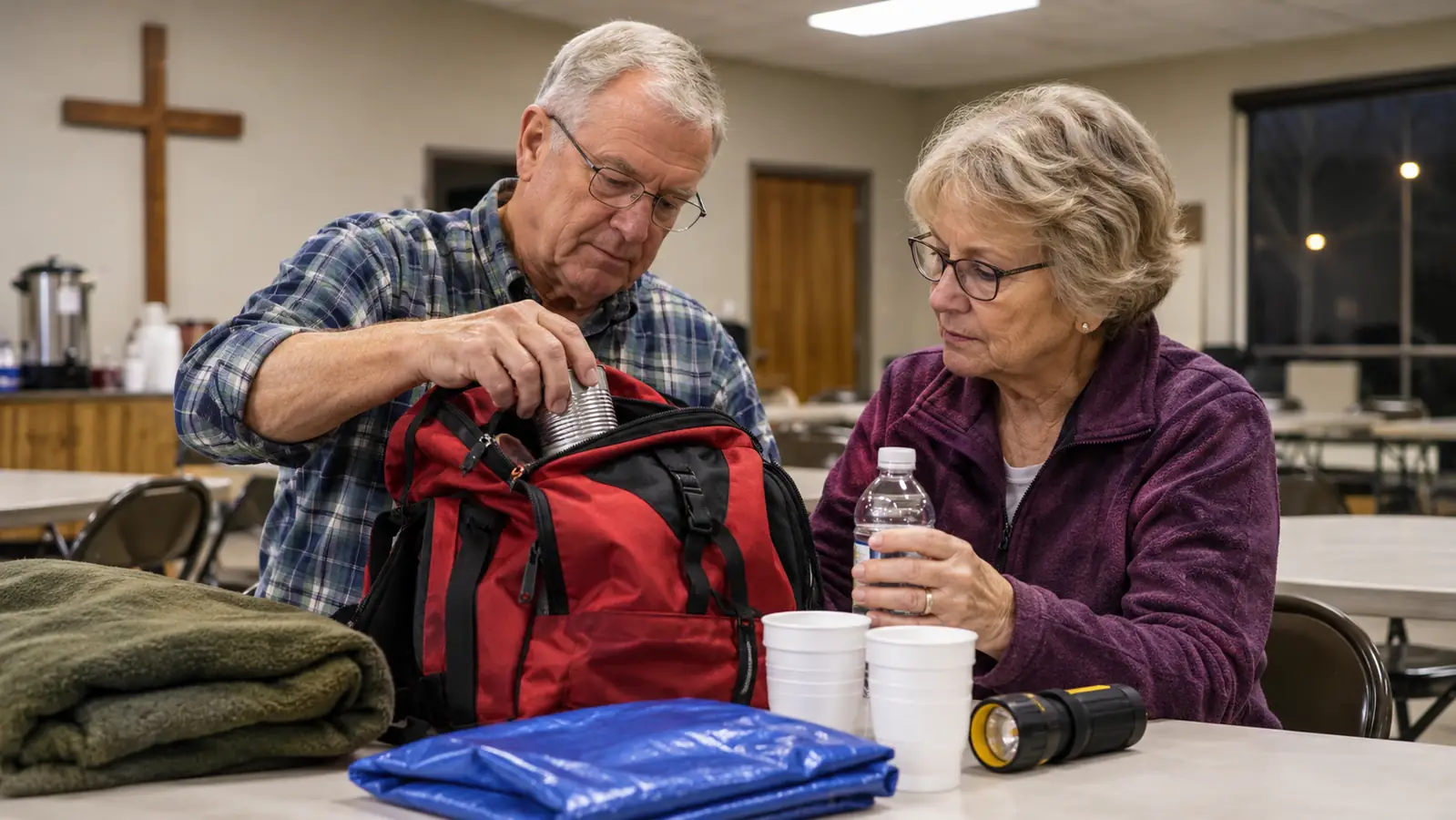
The night I actually used it was the flood in April. Two days of rain, then the creek rose fast. A deputy came down the road at dusk and told the low households to leave. I did not stand there deciding. I took the bag off the closet floor, told Hollis to get his boots, and we were in the pickup in about ten minutes. We spent one night in a church fellowship hall in town and came home the next afternoon. The water reached our yard and stopped short of the porch. The house was not damaged.
In that whole night we used four things out of the bag. A poncho for the walk from the truck to the fellowship hall door. The tissue pack. One food bar split between the two of us. Two of the water pouches. That is the entire list. It is also exactly what a three-day bag is for. It is not for a three-day siege. It is for the ten minutes when you are leaving and the first six hours after you leave. Everything past that is a different bag than the one you bought.
The ice storm last January was the other close call, and the bag stayed in the closet through all three days of it, because we did not go anywhere.
What Is Actually in the Bag
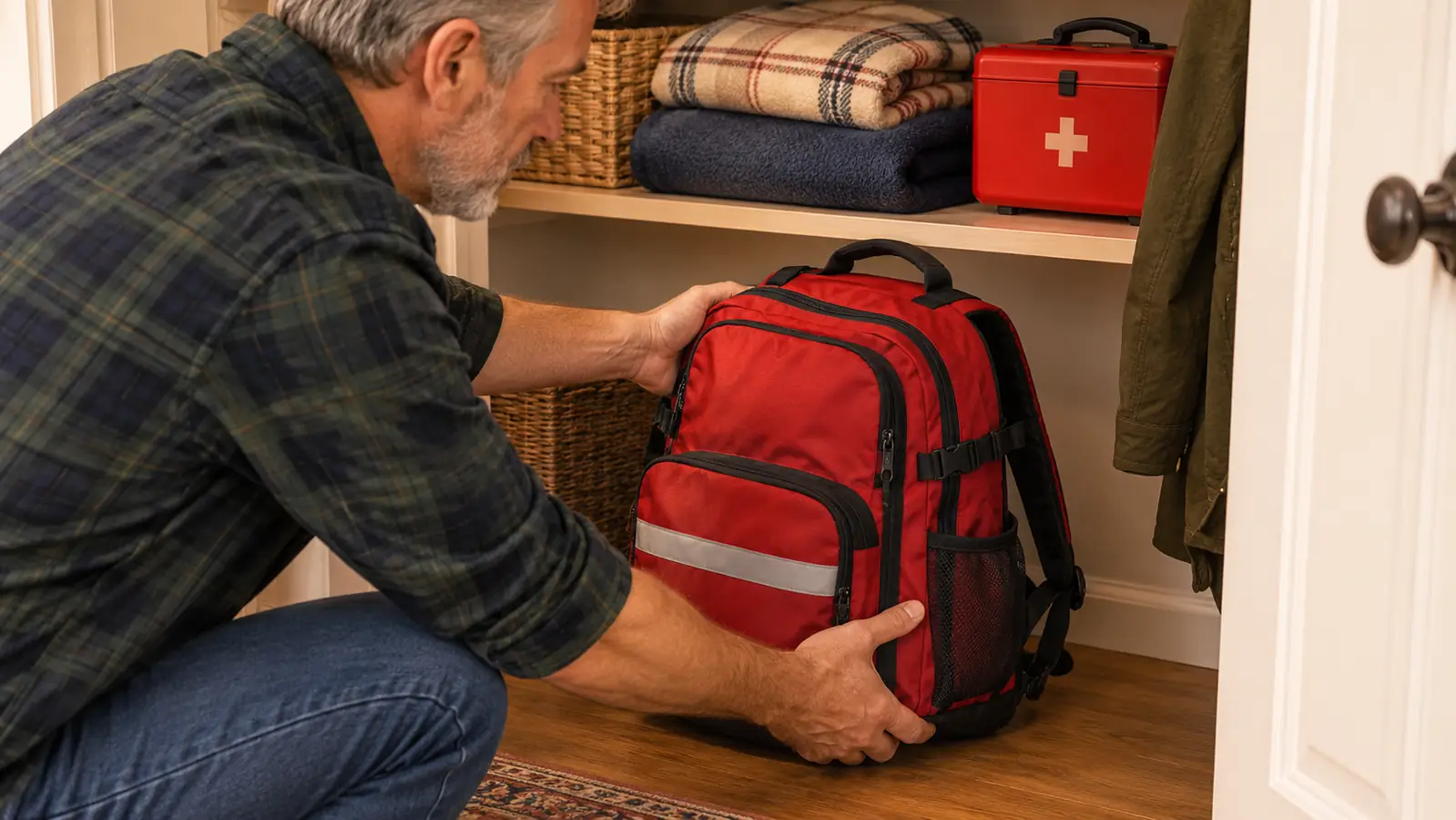
Here is the full inventory, because the listing is not generous with detail and neither is the picture on the front. Two food bars at 2,400 calories each. Twelve sealed water pouches at 4.225 ounces each. Two survival blankets. A 33-piece first aid kit. Two twelve-hour lightsticks. Two dust masks. Four nitrile gloves. A whistle. Two ponchos. A tissue pack. The bag is nylon, 7.8 pounds, and about 9.5 by 6 by 12 inches, which is roughly the size of a small duffel and fits on a closet floor without blocking the door.
The listing gives the food bars and the water pouches a five-year shelf life. Put a piece of tape on the outside of the bag and write that date on it the day the bag arrives. You will not remember it in year three, and a bag of out-of-date food is just weight you are carrying out the door.
Now the arithmetic that is not printed on the front of the box. Twelve pouches at 4.225 ounces is a little over 50 ounces of water, and that is meant to cover two people for three days. Call it eight ounces a person a day. Two food bars at 2,400 calories each comes to 4,800 calories for the two of you, which is 800 calories a day each. That is a ration, not a menu. It will get you to the church hall and back. It will not keep you full and it will not keep you pleasant.
None of that is a flaw, exactly. The bag has to be light enough to carry and small enough to live in a closet, and something has to give. But you should know what you are buying before you are standing in the dark finding out.
The Food Bars Are the Weak Spot
The bars are the part I would change if I could. They need no water, no heat and no dishes, and that is the right call for a bag you may be carrying out the door with the truck already running. In the flood I split one between the two of us in the fellowship hall. It was a bar. It tasted like a bar. Nobody complained and nobody asked for a second one.
The trouble is what 800 calories a day does to a 66-year-old man on the second day. Nothing dramatic. You get cold faster and you get short with each other. If you have ever worked a long day on too little food you know the mood that comes with it. Three days of that is survivable and unpleasant, and survivable and unpleasant is the honest description of most of this.
So treat the bars as the floor and not the plan. Put something with a little salt and fat in it at the top of the bag, and rotate it out every time you check the dates. That is not in the box. That is what the box is missing, and it is missing it on purpose, because fat does not sit on a shelf for five years.
Twelve pouches at 4.225 ounces is a little over a quart and a half of water for two people across three days. That number is not on the front of the box.
The Water Pouches and What They Leave Out
The pouches are sealed, dated five years, and you drink them straight out of the pouch. There is no pouring and no mixing. What there also is not is anything to cook with and anything to wash with. Twelve pouches is drinking water for two people, full stop. If you plan to cook, you need a separate jug, and I would make it a big one.
What the bag leaves out is treatment. There is nothing in it for making more water, and in a real event water is the first thing that runs out. I put both of our LifeStraw filters in the side pockets of the bag in February. Be clear on what one does. The listing says it removes bacteria and parasites and microplastics down to 1 micron, up to 4,000 liters, and I will take the label at its word. It does not remove viruses, chemicals, fuel or salt, and floodwater can carry all of those. If a boil notice comes, boil. The filter is backup, not permission.
That is the thing that surprised me most when I finally laid the whole bag out on the kitchen floor. It is very good at the things that come in a factory-sealed package. Those are not the things that decide how a bad week goes.
The First Aid Kit, the Lightsticks, and the Rest
The 33-piece first aid kit is a bandage kit. That is not a knock on it, but it is not a trauma kit and you should not hear the number 33 and picture a hospital. Spread it out and most of it is adhesive bandages, gauze, tape and a couple of wipes. It handles a cut, a blister and a splinter, which is what actually happens. It does not handle anything a hospital handles. Add whatever the two of you take, and write the doses down on paper, because in the middle of a bad night you will not remember them.
The lightsticks are listed at twelve hours each. Two of those is two nights of a small amount of light, and after that you are in the dark unless you packed something else. I would not count on the sticks for more than finding the bathroom. Put a headlamp in the top of the bag with a spare set of batteries, and check those batteries on the same four dates.
The survival blankets are the foil kind that fold down smaller than a paperback. They reflect heat back at you. They do not make any. Wrapped around your shoulders in a cold fellowship hall they are better than nothing and worse than a real blanket, and they are in there because a real blanket does not fold into a bag this size.
The dust masks, the gloves and the whistle are the ones I have come to appreciate most now that I have looked at them properly. A whistle is the cheapest rescue tool ever made and it still works when your voice has gone. The masks and gloves are for the kind of mess you should not put a bare hand into. A poncho and the tissue pack are what we actually reached for in April, and a poncho is a poncho. It kept the rain off for forty yards and then it was done.
What I Added, and What I Would Tell You to Add
Six things went into that bag after it came home. Both LifeStraw filters. Copies of our papers, which for us is the deed, the insurance and our medical cards, folded into a gallon bag. A one-page list of our medications with the doses. A phone charging cable. Cash in small bills. And a spare pair of my glasses. The glasses are the one nobody thinks of until they cannot read the directions on the side of a can.
Look at that list and notice what the bag does not have. Nothing to charge a phone. Nothing to treat water. No documents, no cash, no medicine, no light beyond two sticks. The front of the box will not tell you that, because the front of the box is a supply list and a supply list is not a plan. The gap between those two things is one evening at your kitchen table.
The other thing I would tell you is to keep the bag where you will trip over it. Mine is on the floor just inside the hall closet door. Not on a shelf, not at the back. The bag you have to move three boxes to reach is the bag you leave behind, and you will leave it behind without ever making a decision to.
Check it on a date you will actually remember. I do the first of March, June, September and December, because that is when I top up the power station and it is easier to do everything in one pass. Ten minutes. You unzip it, you read the dates, you look at the batteries, you zip it back and you set it on the floor.
What I Liked
- Covers two people for three days in one 7.8-pound bag
- The food and water need no heat, no water and no dishes
- Contents are packed so you can find them by feel in the dark
- Sturdy nylon bag with room left over for your own additions
- A whistle, dust masks and gloves are in there without you having to think of them
Where It Falls Short
- 4,800 calories works out to 800 a day each, which is a ration
- About eight ounces of drinking water per person per day
- The 33-piece first aid kit is bandages and wipes, not trauma care
- No water treatment and no light beyond two twelve-hour lightsticks
- Five-year dates on the food and water are a thing you have to track
- Warranty covers defects only, so it covers a seam and not a bad week
The Tradeoffs Nobody Mentions
The bag weighs 7.8 pounds. That is nothing in the back of a pickup and it is noticeable on foot after a mile, which is the trade you make when you buy one bag instead of a shelf of supplies. It also wants floor space about the size of a small duffel, and a closet floor is where things accumulate. If yours is already full, the bag will end up somewhere worse than the floor by the door.
The five-year dates on the food and the water run the whole thing. Five years sounds like forever and it is not. It is long enough to forget. Write the date on the outside of the bag and put a reminder in your phone, because the value of this bag is set entirely by two dates on two kinds of packaging, and neither one announces itself.
The warranty is against defects only. Read that plainly. It covers a bad zipper or a bad seam. It does not cover a bad week. That is a normal warranty on this kind of product and it is worth knowing before you count on it for anything else.
And the bag does not know your household. It does not know what either of you takes, what either of you is allergic to, or where your papers are kept. That part is on you, and it takes one evening, and one evening is the whole difference between a bag off a shelf and a plan.
Who This Is For
This is for the household that has been meaning to get a bag and has not gotten one. Two people, a house at the end of a road, a line that comes down in an ice storm or a creek that rises faster than the forecast said. If you have been putting this off for a while, buy the bag and spend one evening making it yours. That is a real plan. It is a great deal better than the plan you have now, which is none.
It is also the right size for two people in one vehicle with room left over for the rest of what you would throw in the bed of a truck. That sounds like a small thing until you are the one loading it in the rain.
Who Should Skip It
Skip it if you are on your own. This is built for two, and half of what is in it is a duplicate of the other half. A solo bag built from the same list would be lighter and simpler, and you would not be carrying a spare of everything. Skip it if you are packing for children, because nothing in here is sized or planned for them.
Skip it if you want one bag that also treats water, charges a phone and lights a room. This one does none of those. And skip it if you are not going to check the dates four times a year, because a bag you never open is a bag you do not actually know anything about, and knowing is the whole point of owning one.
The ten minutes is the part that makes it work
Mine sat on the closet floor for about four months and then did its job in about ten minutes in April. The Ready America 70280 gets you the structure for two people and three days. Put your own six things in it, write the dates on the outside, and check it on a schedule you will keep.
Amazon Check Today's Price on Amazon →