The part of the BLAVOR power bank people ask me about is the solar panel, and it is the part I trust least. I want to say that early, because a good deal of what I read before I ordered one made the panel sound like it would keep the battery topped off on its own. It will not. What it will do is keep a battery you already charged from going flat on you, and after six months that is the job I have given it. Everything below is the working out of that one sentence.
Here is why a woman who already owns a power station in her hall closet went and bought a pocket battery. In April the creek rose after two days of rain, a deputy came down the road and told the low houses to leave, and we spent one night on cots in a church fellowship hall in town. The outlets near our cots were already in use by other families, and by morning my phone was sitting at about 20 percent. Nothing came of it. But I lay on that cot thinking about it, and in May I bought the BLAVOR Solar Power Bank, 10,000mAh, to keep in my purse so that a phone charge could leave the house with me.
The Jackery Explorer 300 is 7.5 pounds and it lives on the floor at the front of my hall closet. It is the right thing when the power goes out at home. It is the wrong thing to carry out the door at dusk on a moment's notice. Thirty years of carrying mail through ice and heat taught me the difference between gear that stays put and gear that goes with you, and the BLAVOR is the second kind.
The Quick Verdict
A dependable pocket battery with a panel that behaves like a trickle charger. Charge it from the wall on a schedule, let the sun cover your forgetting, and quit expecting the panel to fill 10,000mAh.
Amazon Check Today's Price →The Panel Is a Trickle. The Battery Is the Point.
10,000mAh, about 9.3 ounces, a USB-C port and USB-A ports, and a Qi pad. Four hours on the wall and it goes back in the purse.
Amazon Check Today's Price on Amazon →What Six Months of Carrying It Has Looked Like
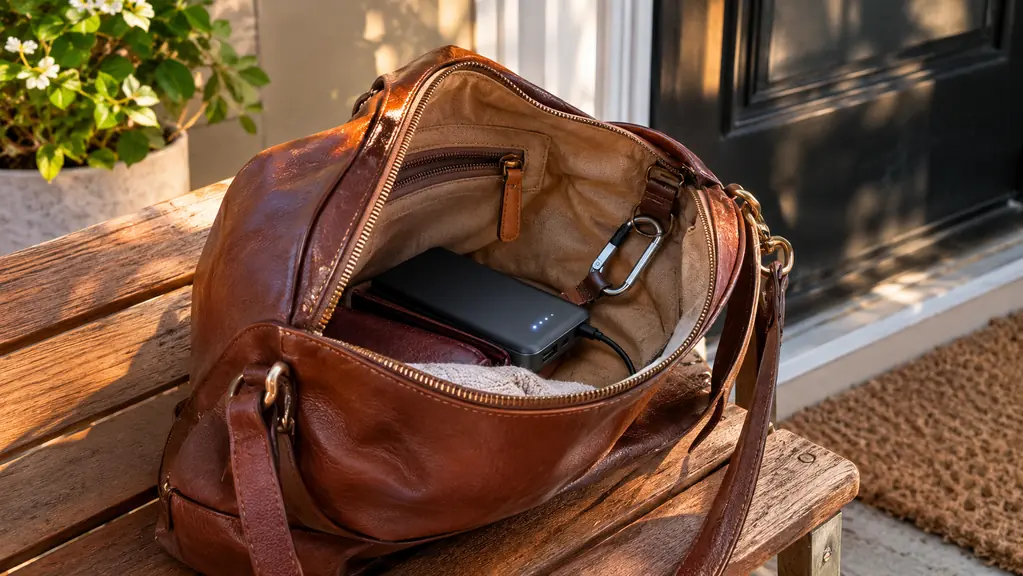
It came in May and it has been in my purse since, with the compass carabiner clipped to the inside strap. I have never once used the compass. I have used the battery.
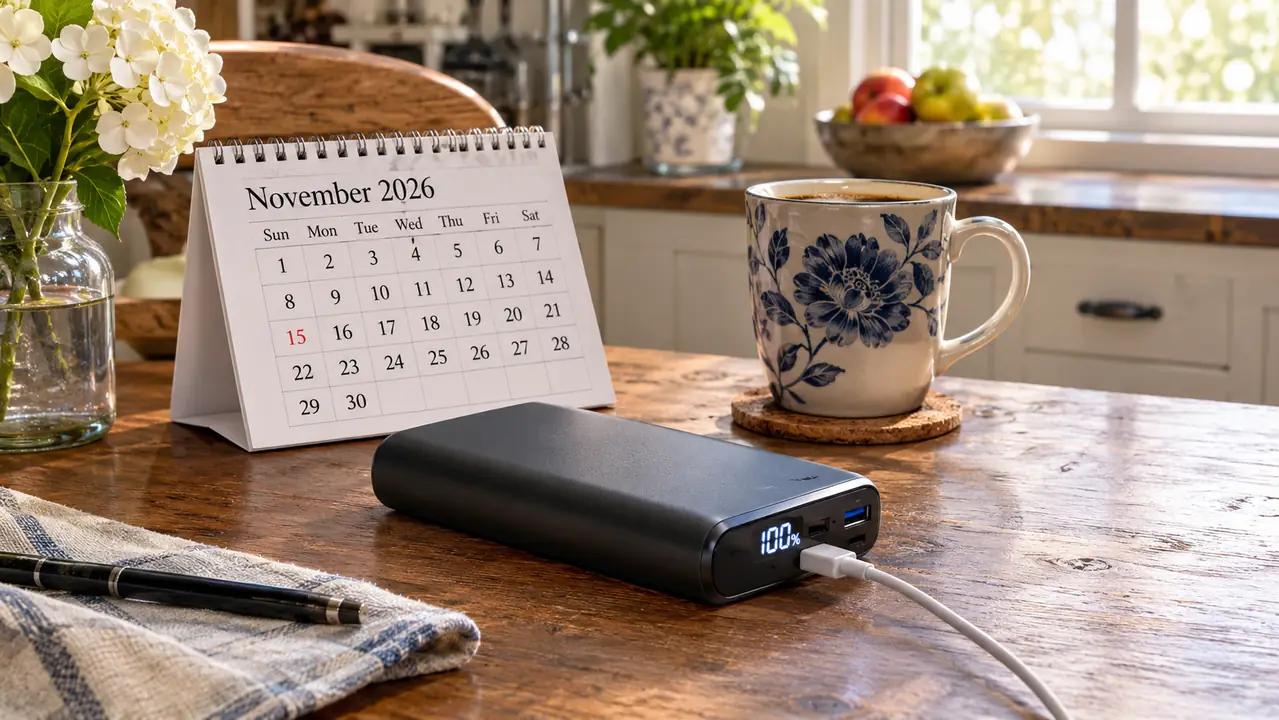
Charging is simple enough that I have actually kept it up, which is a higher compliment than it sounds. I charge it from the wall with a USB-C cable on the same four dates I charge the Jackery: the first of March, June, September and December, written on the paper calendar on the refrigerator. The first charge was the day it came in May. That is the whole routine. There is nothing else to remember, and since the dates were already on the calendar for other reasons, this battery got folded into a habit I already had.
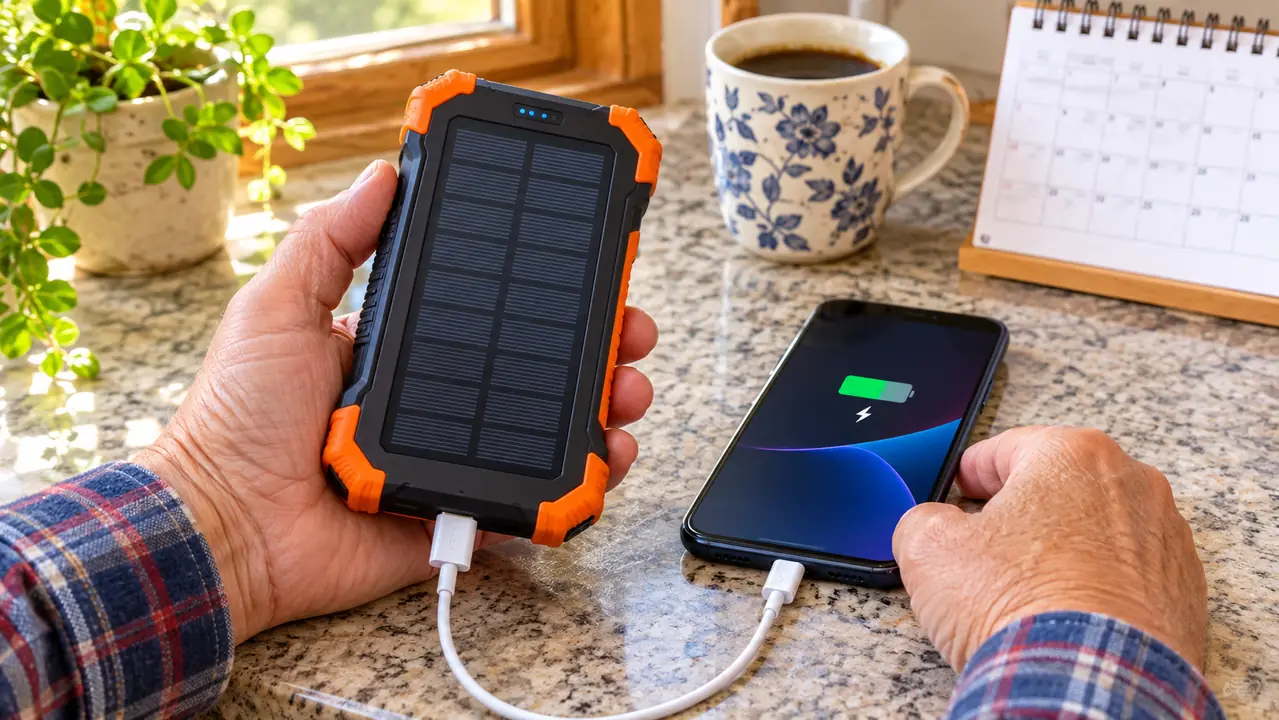
Where it earns its place is on long errand days in town, when I am out longer than I planned and my phone starts sliding toward the red. I have topped up my own phone from it a handful of times, always with the cable. I tried the wireless pad once at the kitchen table. It worked. It was slower than the cable, so I use the cable, and I would use the cable even if the pad were quicker, because a cable does not have to be lined up. The two flashlights on the end have walked me from the pickup to the porch after dark a few times. That is a small thing until the porch light is out.
It has never charged Hollis's phone, a radio or a lamp. It has not been used in an outage, because there has not been one since I bought it. The ice storm this past January came before it did.
One thing about carrying it: it is not invisible in a purse. Nine and three tenths ounces is not a brick, but you know it is in there, and the panel is the reason. I decided I would rather have the panel and the weight than a lighter battery with no backup at all. That is a preference, not a fact, and you may land on it differently.
What the Solar Panel Really Does
Here is the test, all of it. One week in June I set it on the back porch rail in the sun most days and left it alone. Over that week the indicator went from two of the four small lights to three. That is the entire result and I am not going to dress it up. One light, one week, June sun, on a rail that gets sun most of the afternoon.
Four lights means each one is roughly a quarter of the battery. A quarter of 10,000mAh over most of a week of sun is a trickle, and there is no way to write that sentence that makes it sound like more. The panel is a small one on the face of the unit. A small panel in real sun does what small panels do, and the number on the box is a battery capacity, not a promise about the sky.
So what is it good for? It is good for the battery you forgot. If I miss a date on the calendar, or the purse sits in a warm room for a month, the panel means it will not be dead when I reach for it. I chose a solar model so it can never go fully flat on me, and that is the honest case for the panel. It is insurance on my own memory. It is not a power source, and it will not fill the battery in a day. A week of good weather barely moved it one light.
I picked the porch rail because that is where the sun lands in the afternoon and it stays out of the weather. A south-facing windowsill would do about the same. What will not do anything is the inside of a purse, which is where this battery lives almost all of its life, and that is fine. Nothing is supposed to be charging in there.
If you are picturing clipping this to a pack and coming back to a full battery, that picture is wrong and it is the one the product photos encourage. A panel that size on a face that size, in the sun for an afternoon while you walk around, is going to give you a rounding error. Plan to charge from the wall. Let the sun cover the gaps.
One week in June on the back porch rail moved the indicator from two lights to three. That is the whole solar test, and it is the honest number.
What I Got Wrong
I expected the panel to matter more than it does. That is the plainest way to put it. I pictured setting it on the rail in the morning and coming back to a battery that had gained something worth having, and what I got was one light over most of a week. It was not a swindle. The panel works. It just works at a scale that does not match the way these things get sold.
I also assumed the wireless pad would be how I used it, because that is the modern way to do things. It is not how I use it. The pad is slower than the cable and it wants the phone set down in a particular spot on the face. At the kitchen table with a cup of coffee that is fine. Standing in the yard with your hands full it is not, and you cannot set a phone down on a pad in a hurry.
And I assumed 10,000mAh would feel like more than it does. The listing says a recent phone gets about two full charges. I have never run it down to test that, and a handful of top-ups is all I have asked of it. It is a day extender. It is not a spare phone.
The Listing Numbers, Translated
The listing says 10,000mAh and about two full charges for a recent phone. That lines up with how I have used it: a top-up here and there rather than rebuilding a dead phone from nothing. Treat it as a top-up, not a second day.
The listing says about four hours to charge from the wall. I plug it in on a calendar date and go do something else, so I have not sat with a clock, but four hours is in the range of what I have seen. It has a USB-C port with the listing putting the output at 20W, plus USB-A ports, and the listing says it charges three devices at once. I have never charged three things at once. I have charged one phone, with the cable, and that is the honest report.
The Qi pad on the other face works. Four small indicator lights tell you where the charge sits, which beats a single light that only tells you it is not dead. The compass on the carabiner is a carabiner with a compass on it. I would not plan a walk around it, and I have not.
Water is the other number worth reading carefully. The listing says IPX5, which is splashes and rain, and that is exactly what it means. It is not a thing to drop in the creek, and no rating on a label convinces me otherwise. Mine has stayed in a purse and out of the weather and I intend to keep it that way.
Where It Lives, and What It Is Not For
It lives in my purse. Not the hall closet, not the backpack, not anywhere else. The entire point was a charge that leaves the house with me, and a battery in a closet does not do that.
Why not just carry the Jackery? Seven and a half pounds, is the answer. It stays home. It is a fine thing to own and a poor thing to grab at dusk.
So the two have separate jobs, and I keep them that way. The Jackery stays on the closet floor and comes out to the kitchen counter when a storm is coming. The BLAVOR stays in my purse, clipped to the inside strap, and goes wherever I go. If the power goes out at home, the Jackery charges the phones and the BLAVOR stays where it is, as the spare. If I am in town on a long errand day, the BLAVOR is the only one of the two that is with me, and that was the whole point of buying it. Neither one is a reason to ignore what your local officials and your utility tell you to do.
At home in an outage the Jackery is the phone and light station and the BLAVOR stays in my purse as the spare. I want to be plain about that, because a reader could finish a review like this one and think a pocket battery does the household work. It does not. It does not run a lamp. It does not keep a house going. It is one phone, away from home.
It has ridden in a purse for six months, been set down on tables and counters, and it still reads what it read. That is not a durability test, that is a purse. I have not dropped it on concrete and I am not going to tell you it would shrug that off.
What I Liked
- Charged from the wall it holds a real top-up, and the listing says about two full phone charges
- A USB-C port with the listing at 20W output, so the cable charge is quick
- The two flashlights on the end are genuinely useful walking up from the pickup after dark
- Four indicator lights, so you know where the charge sits without guessing
- The panel keeps a forgotten battery from going flat, which is why I picked a solar model at all
Where It Falls Short
- The solar panel is a trickle. One week of June sun moved it a single light
- Heavier than a plain pocket battery of the same capacity, because of the panel
- The wireless pad is slower than the cable, so you will end up using the cable
- IPX5 is splashes and rain only, so it stays out of the creek and out of a soaked pocket
Who This Is For
This is for the person whose phone dies away from home, not the person trying to run a house. If you are out in town longer than you planned, or you are somewhere with no free outlet and a phone sliding toward the red, a battery this size is the difference between a working phone and a dead one. If you want the panel to be your charging plan, this is the wrong product and I would rather say so now than have you find out on a porch rail in June.
It is also for the person who worries about forgetting to charge it. Four dates on a paper calendar is a system I can actually keep, and the panel is a backup so it never goes fully flat.
Who Should Skip It
Skip it if you want a battery that fills itself in the sun, because this one does not and no pocket battery does. Skip it if 9.3 ounces in a purse sounds heavy, because the panel is part of that weight and you will feel it. Skip it if your real worry is a multi-day outage at home. That is a power station's job, and mine is 7.5 pounds and sits on the closet floor for exactly that reason.
One plain thing before I stop. Follow what your local officials and your utility tell you, and leave when a deputy tells you to leave. A battery in a purse is a convenience and a comfort. It is not a plan, and nothing in this review should be read as one.
Charge It from the Wall. Let the Sun Cover the Forgetting.
10,000mAh, about 9.3 ounces, a USB-C port and USB-A ports, a Qi pad, and a small panel that keeps it from going flat. Six months in a purse and it is still the spare I reach for.
Amazon Check Today's Price on Amazon →