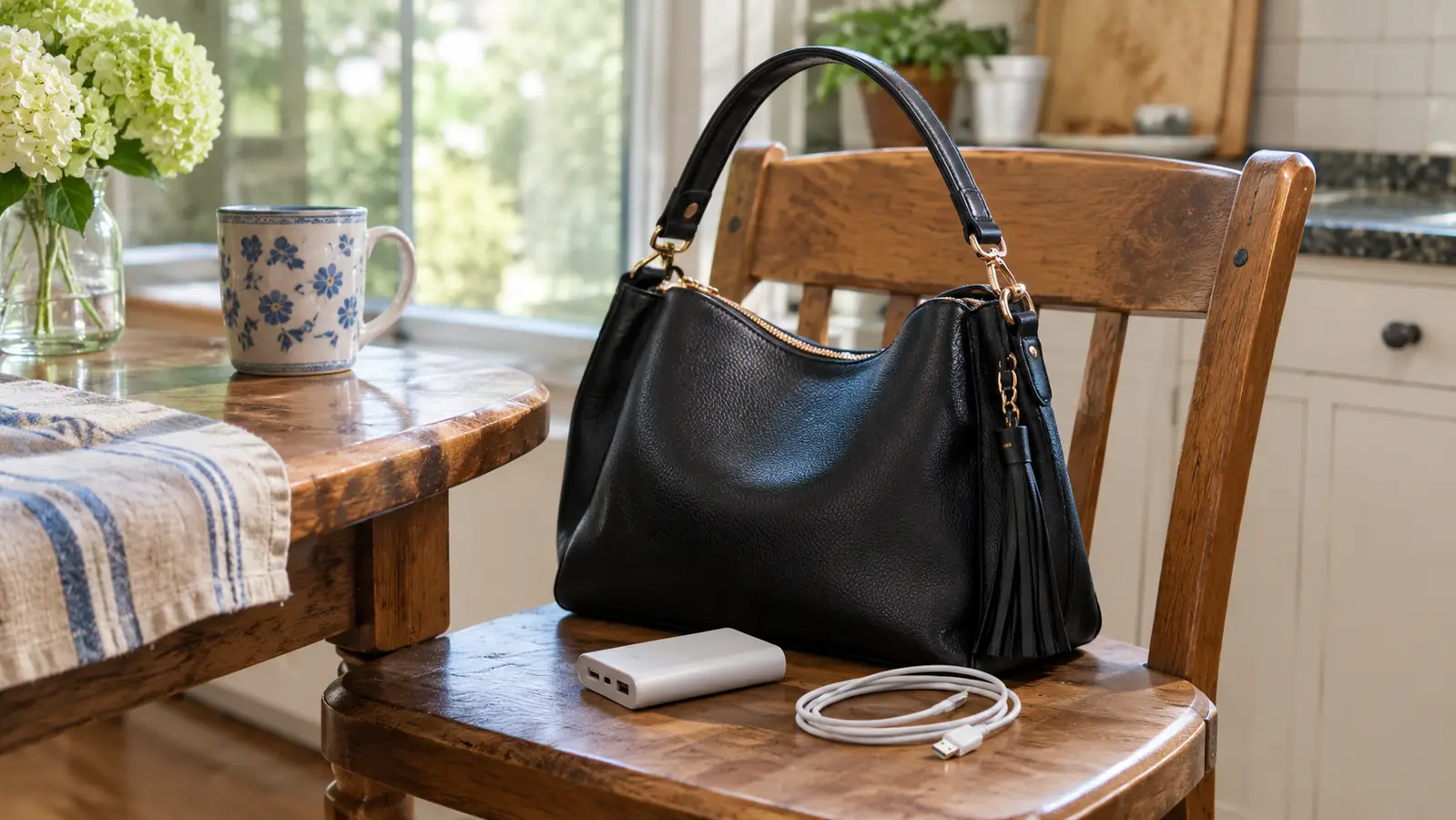
The BLAVOR Solar Power Bank came into my purse in May 2026 and has stayed there since. I am sixty-one, retired after thirty years carrying mail on one rural route, and I do not buy a charger for entertainment. I bought this one because of a night in April. After two days of rain the creek rose, a deputy told the low houses to leave, and we spent one night on cots in a church fellowship hall in town. The outlets near our cots were already in use by other families, and my phone sat at about 20 percent by morning. Nothing bad came of it, but I did not like the feeling.
The Jackery we keep for home power outages is 7.5 pounds and lives on the hall closet floor, so it stayed home that night. A home battery is not a purse item. What I wanted was a phone charge that could leave the house with me. The BLAVOR is that, with limits. It is a 10,000mAh portable charger, not a household power station, and most of what I have to say comes from keeping those two jobs separate. I have carried it for six months. I have charged it on a schedule. I have used it the way a person uses a spare, not the way a person uses a generator.
The Quick Verdict
A pocket charger that earns its place in a purse, as long as you charge it from the wall and treat the solar panel as a trickle, not a fuel tank.
Amazon Check Today's Price →The charger that goes to town, not the one that runs the house
If you want a spare phone charge in a bag, the BLAVOR does that. It is not a home backup. It is the thing in my purse when the Jackery stays in the closet.
Amazon Check Availability on Amazon →How I've Used It
For six months it has lived in my purse, with the compass carabiner clipped to the inside strap. I have never used the compass. I have used the charger. That is the short version. The longer version is that it has become part of the bag the way a pocketknife or a pen does. I do not think about it until I need it.
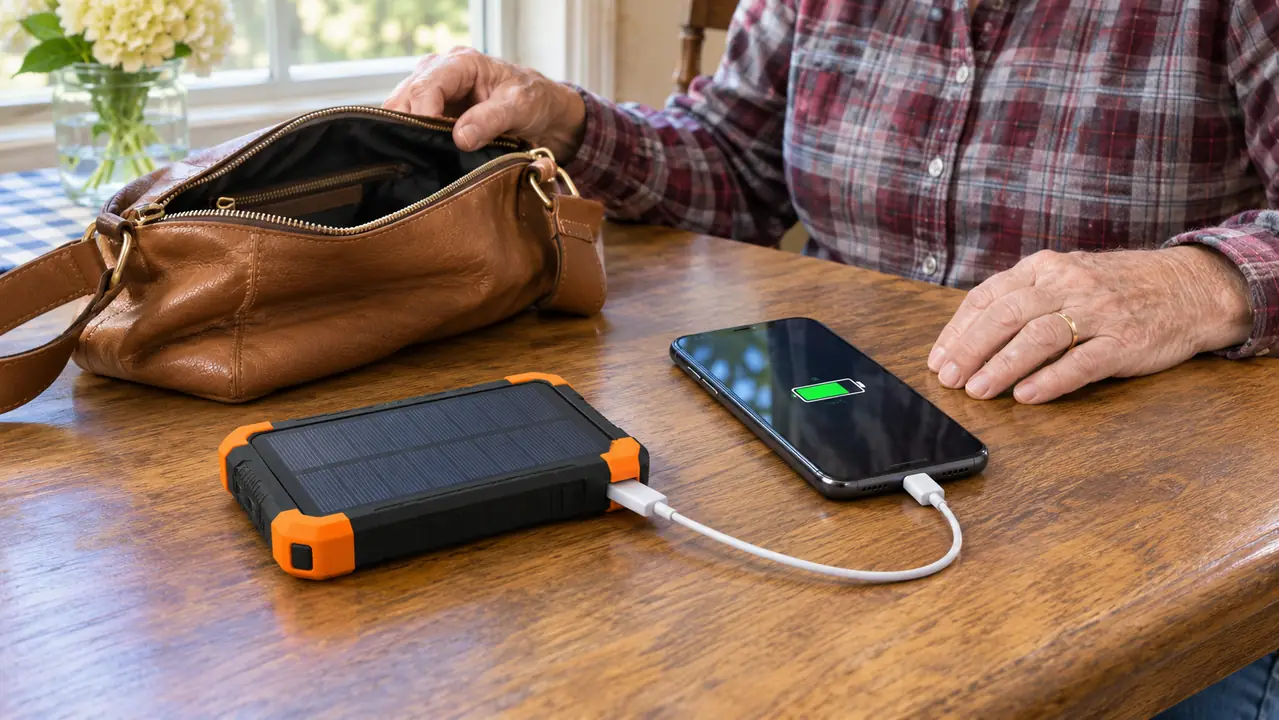
The uses are ordinary. On long errand days in town I have plugged my phone into it with the cable a handful of times. I tried the wireless pad once at the kitchen table. It worked. It was slower than the cable, so the cable is what I use. I have not run a phone from zero to full twice in one sitting. I have not charged three devices at once. I have done the simple thing: phone low, cable out, top it up, put it away.
I have used the two flashlights on one end a few times walking from the pickup to the porch after dark. That is the whole list. It has never charged Hollis's phone, the radio, a lamp or anything else. It has never been used in an outage, because there has not been one since I bought it. I want to be plain about that. I am not going to invent a storm to make a charger sound more exciting than it is.
I did not put it in the hall closet with the five things. The hall closet holds the radio, the power station, the food, the water filter and the backpack. The BLAVOR is not one of those, and it is not in the backpack either. It is in my purse, because the whole reason I bought it was a night when the home battery stayed home. The bag goes with me. The closet stays home. That is the division.
What the BLAVOR Is and What It Is Not
From the listing, the BLAVOR is a 10,000mAh battery that weighs 9.3 ounces. It has a USB-C port with 20W output and USB-A ports, and the listing says it can charge three devices at once. There is a Qi wireless charging pad on one face and a small solar panel on the other. There are four small indicator lights for charge, two bright flashlights on one end, and a compass carabiner in the box. That is the hardware list. I am not going to add to it.
The listing says a recent phone gets about two full charges, and about 4 hours to charge from the wall. I have not run a phone from zero to full twice in one sitting, so I am giving you the listing's number, not mine. I plug it in on the calendar dates and it is full by the time I think to check. I have no complaint about the wall charge. It is the simple part of owning it.
The listing says IPX5 water resistant, which means splashes and rain. I would not dunk it. It is not a home power station. It will not run a lamp, a radio or a household. At home in an outage, the Jackery is the phone and light station, and the BLAVOR stays in my purse as the spare. I would not ask it to do the Jackery's job. It is too small for that, and I knew that when I bought it.
The four small indicator lights are the gauge I use. They are easy to see in the kitchen light. I look at them, then put it back in the purse. I do not need a number. I know it was charged on the calendar date, and the lights tell me it is still holding. That is enough for a spare.
The Solar Panel, Tested Honestly
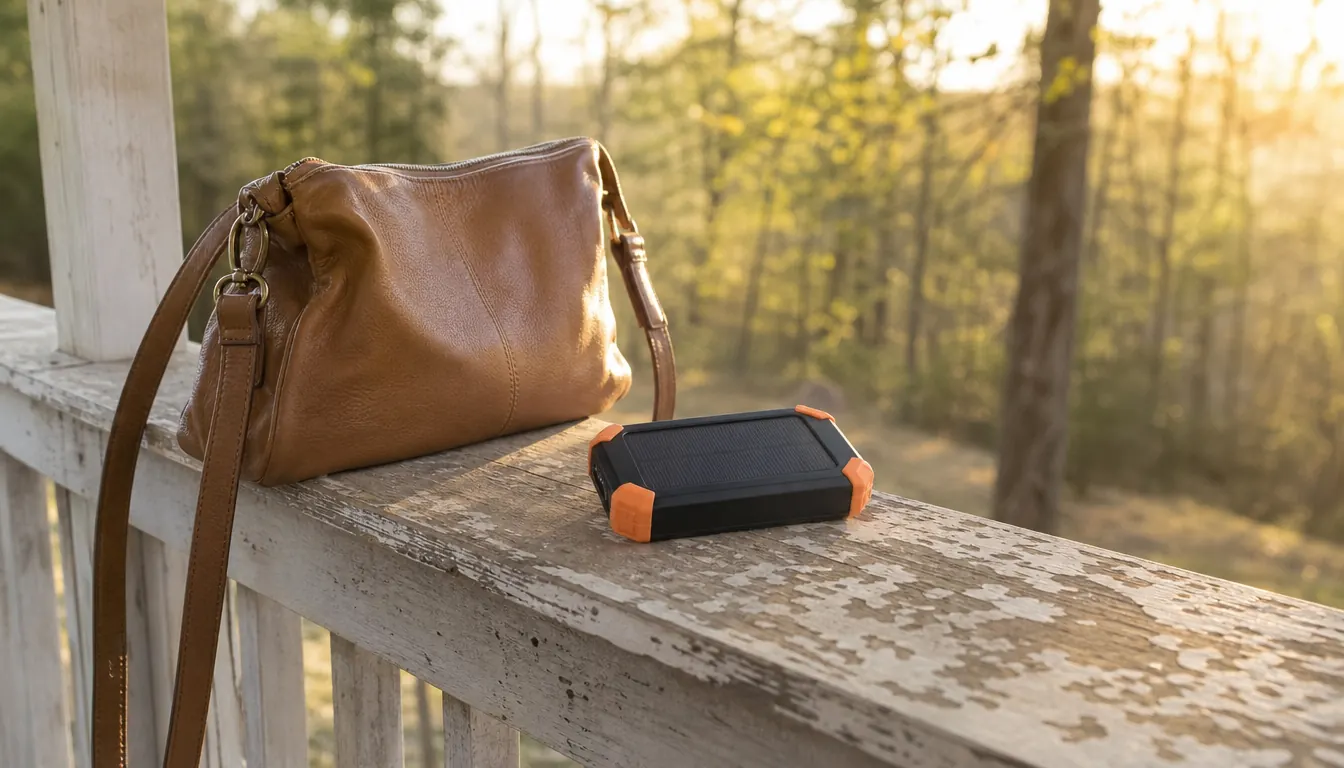
I left it on the back porch rail for one week in June 2026, in the sun most days. The indicator went from two of the four lights to three. That is the whole test. I did not stand over it with a meter. I did not time it. I wanted to know one thing: would the panel do anything at all if the charger sat in the sun? It did a little.
The solar panel is a slow trickle. It is a backup so the battery does not go flat if I forget, not the way to fill it. I would not tell you to count on the sun to charge a phone after dark. Charge it from the wall and let the panel keep it from dying in the purse. That is the honest use I have found for it. If you want solar to be your main charger, this is not that product.
This is also why the BLAVOR is heavier than a plain pocket battery. Some of that weight is the panel. If you want the lightest possible brick, a plain one will be lighter. I wanted the panel because I wanted a battery that could sit for a while and not be dead when I reached for it. That was the trade I made. I would make it again, but I would not pretend the panel is fast.
I brought it in at night and I did not leave it out in the rain, even though the listing says IPX5. Splashes and rain are one thing. A porch rail in a storm is another. I am not going to test a water rating on a charger I need. The panel had its one week in the sun, and that was enough for me to know what it will and will not do.
Charging, Ports, and the Wireless Pad
I charge it from the wall with a USB-C cable. The first charge was the day it came in May. Since then it goes on the first of March, June, September and December, the same four dates I charge the Jackery, all written on the paper calendar on the refrigerator. I do not charge it when it feels low. I charge it on the dates. That is how I keep from thinking about it.
The USB-C port is the one I use. The listing says 20W output and three devices at once across the ports. I have only charged my phone, one at a time. I cannot tell you how it does with three. I can tell you the one phone charge has been fine. The cable is short work. The charger does not get hot in my hand. It just does the job.
The wireless pad is real. I set my phone on it at the kitchen table once. It charged, but slower than the cable. If you are in a hurry, use the cable. The pad is fine for a slow top-up, and it is one less cable to hunt for. I still use the cable. I am not going to change a habit that works for a feature that is just a little slower.
The compass carabiner is clipped to the inside strap of my purse. I have never used the compass. It is a clip to me, and a good one. The cable lives in the purse with the charger. I have never been without it when I wanted it. A charger without its cable is just weight, so the two stay together.
Living With It in a Purse for Six Months
It rides in my purse, not the hall closet, not the backpack, not the pickup. The carabiner is clipped to the inside strap. I have never used the compass. It has not been dropped or damaged, and nothing has gone wrong with it. I have not had to replace it. I have not had to think about it. For a spare, that is the report.
The listing calls it pocket size, and at 9.3 ounces it is not weightless. In a purse, that is fine. In a shirt pocket, you would know it is there. The weight is the trade for the panel and the battery, and I would rather carry it than need it. A light battery that is dead is not lighter in any way that matters.
Because there has been no outage since May, I cannot tell you how it performs in one. I can tell you what I would do. At home, the Jackery is the phone and light station. The BLAVOR stays in my purse as the spare. I would not use the purse battery first. The home battery is already out and set up. The spare is for when I am away from the house.
Six months in, the routine is simple. It goes in the purse. It comes out when my phone needs a top-up. It goes on the wall on the four dates. It has not replaced the Jackery, the radio or anything else. It is one more thing in the bag, and it has done the job I bought it for. I do not ask more of it than that.
What I Would Check Before You Buy
First, decide what job you want it to do. If you want a phone charge in a bag, the BLAVOR fits. If you want to run a lamp or keep a household going, this is the wrong tool. It has no AC outlet and no hand crank. It is a battery with a cable and a pad. That is the whole product. The listing is clear about it, and I am clear about it.
Second, be honest about the solar panel. One week on a porch rail moved it one light. That is not a charge. It is a slow bleed stopper. If you buy it expecting the sun to fill it, you will be disappointed. If you buy it to sit in a bag and not be dead, it makes sense. The panel is a reason to choose this over a plain battery, but it is not a reason to expect free power.
Third, use the cable for speed. The wireless pad works, but it is slower. The cable is also how I charge the battery itself. I keep the USB-C cable with it, and I put it on the wall on the calendar dates. A charged spare is the whole point. A dead spare is just weight. If you are not going to charge it on a schedule, the solar panel will not save you.
Fourth, respect the water rating for what it is. The listing says IPX5, which means splashes and rain, not a dunk in the creek. And none of this is a substitute for listening to your local officials and your utility. If they say leave, leave. A charger in a purse is a convenience, not a plan. It will not keep you safe, and it is not meant to.
What I Liked
- Fits in a purse and goes to town with me
- USB-C and USB-A ports, plus a Qi wireless pad
- Simple wall charge and four easy-to-read indicator lights
- The solar panel slows the drain if I forget to charge it
- Two bright flashlights are handy from the pickup to the porch
Where It Falls Short
- The solar panel is a trickle, not a charger
- Heavier than a plain pocket battery because of the panel
- The wireless pad is slower than the cable
- No AC outlet and no hand crank, so it is not a home backup
One week on the porch rail moved it from two lights to three. That is the solar panel in one sentence.
Who This Is For
This is for the person who wants a phone charge in a bag, not a home power station. If you have a home battery for the house and you do not want to carry it, this is the small spare. It is also for someone who forgets to charge things, because the panel slows the drain. It is for a purse, a bag you carry to town, and the kind of day when your phone is at 20 percent and the outlet is taken. It is for someone who will use the cable and not expect the sun to do the work.
Who Should Skip It
Skip it if you want to run a lamp, a radio, or a refrigerator. Skip it if you want a hand crank or an AC outlet. Skip it if you want the lightest possible battery, because a plain one will be lighter. Skip it if you expect the solar panel to fill it in a day, because one week on a porch rail moved it one light. And skip it if you need a home backup. That is the Jackery's job, and the BLAVOR is not a replacement for it.
A spare phone charge for the purse, not a second power station
If that is the job you need done, the BLAVOR does it. Charge it from the wall, let the sun slow the drain, and keep the cable handy.
Amazon Check Availability on Amazon →