I had never owned a power bank of any kind until this past May, and the thing that finally made me buy one was a cot in a church fellowship hall. The creek rose after two days of rain in April, a deputy came down the road and told the low houses to leave, and we spent one night in town. The outlets along that wall were already taken by other families, and by morning my phone sat at about 20 percent. Nothing bad came of it. But I lay on that cot doing arithmetic on a phone that was going to quit before breakfast, and I did not care for the answer.
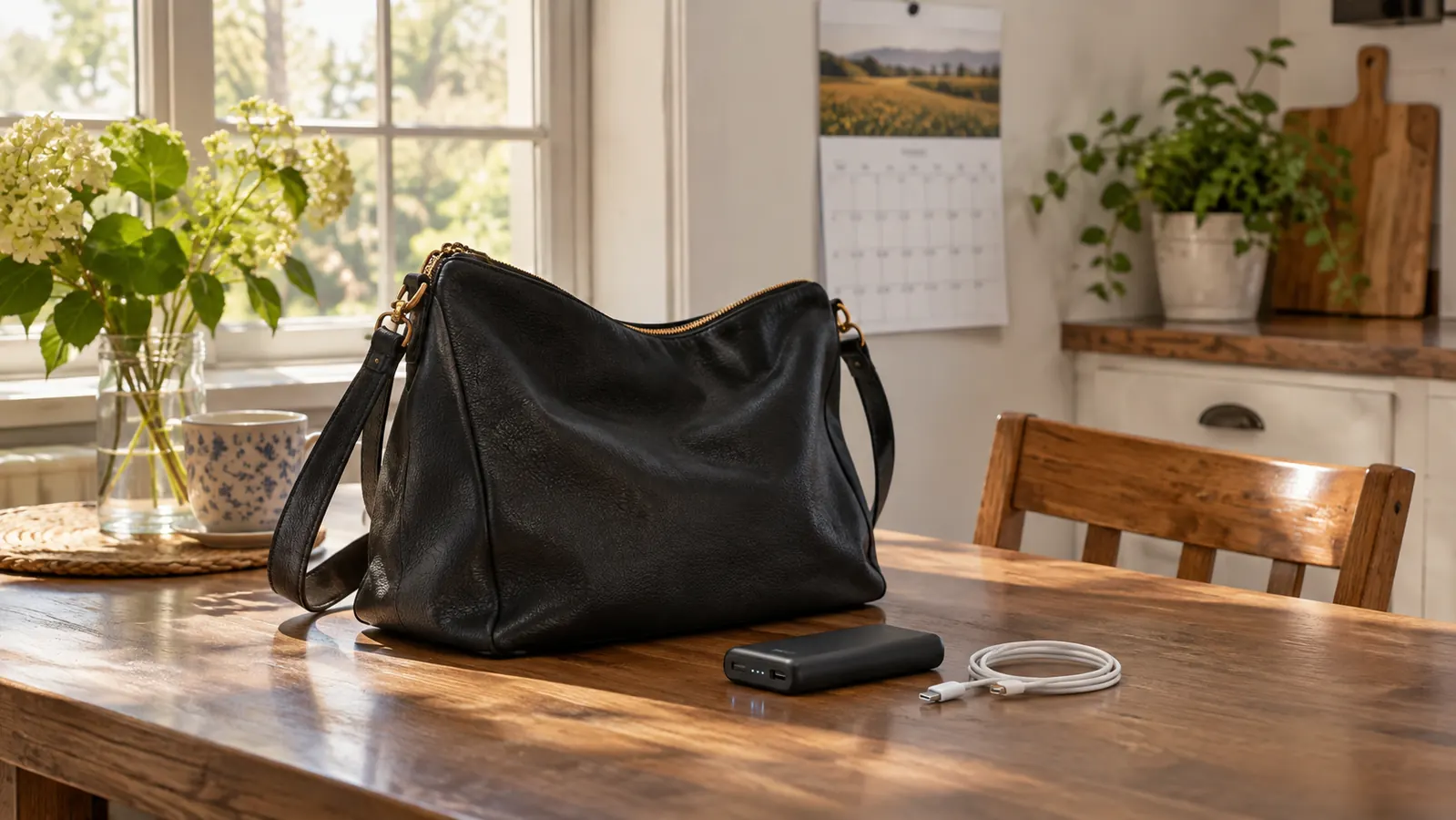
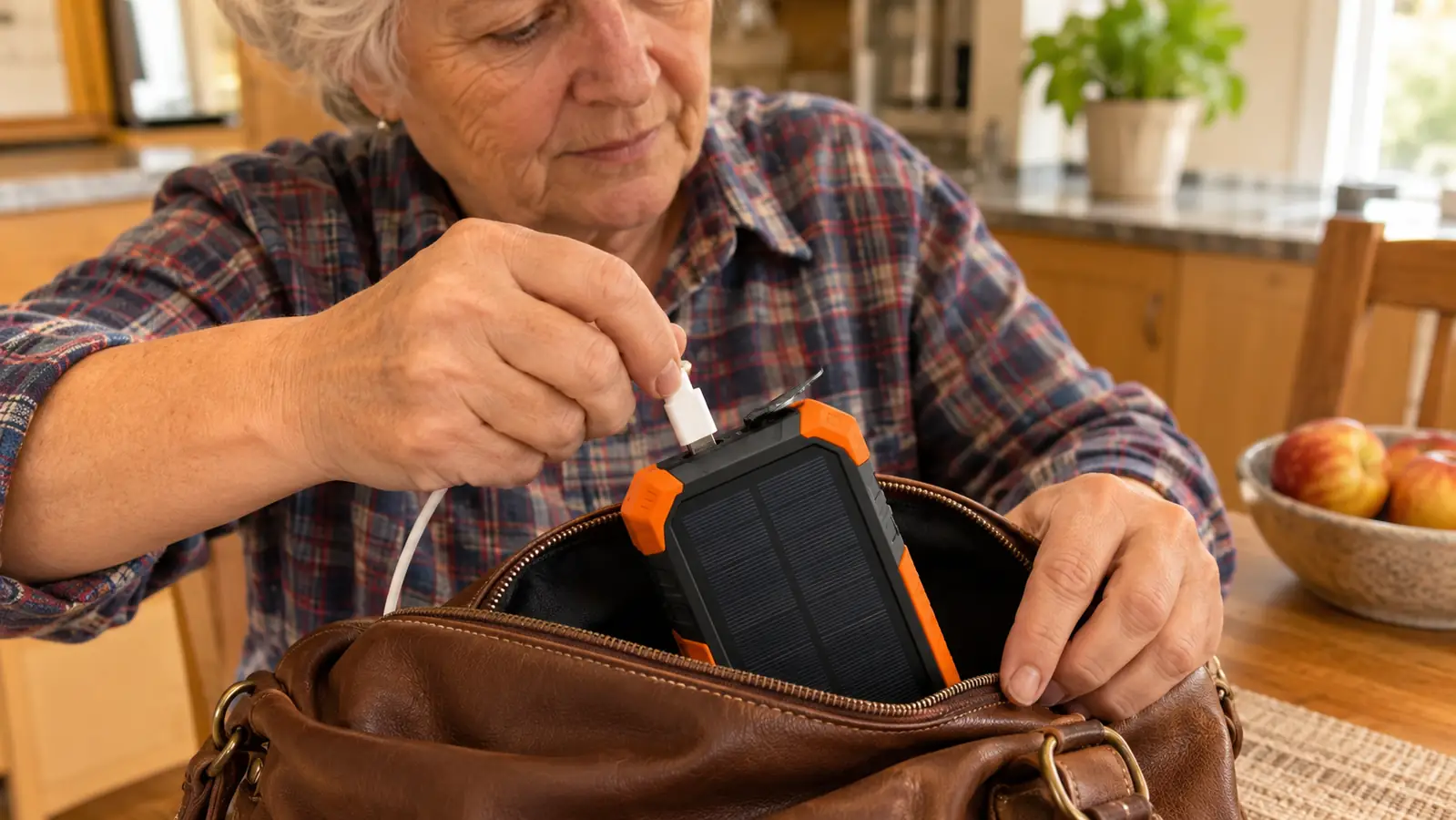
So in May I bought the BLAVOR Solar Power Bank, 10,000mAh, and it has been in my purse ever since. Hollis does not have one. It is not in the hall closet with the rest of the storm supplies, because the whole trouble that night was that the supplies were at home and I was not. A battery that stays in the house does you no good in a fellowship hall.
| BLAVOR Solar Power Bank | A plain 10,000mAh pocket battery | |
|---|---|---|
| Capacity | 10,000mAh | 10,000mAh at the same rating |
| Weight | 9.3 ounces | Lighter, because there is no panel and no housing around one |
| Wall charging | About 4 hours, per the listing | A few hours, same idea |
| Solar panel | A small panel on one face, a trickle in sun | No panel at all |
| Wireless charging | A Qi pad on the opposite face | Cable only, on most of them |
| Light | Two flashlights on one end | Usually none |
| Ports | USB-C rated at 20W output per the listing, plus USB-A, three devices at once | Usually one USB-C and one USB-A |
| Bulk in a pocket | Pocket size per the listing, with the panel adding thickness | Flatter |
| Best for | A phone that leaves the house and sits in a bag for months | A phone that needs a charge today and nothing else |
Here is the short answer before the details. The solar panel is worth having, but not for the reason the box suggests. It will not fill this battery in a day and I would not plan anything around it. What it does is keep a battery that lives in a bag from going flat between the four times a year I charge it from the wall. As a trickle it earns its keep. As a charger it is a disappointment. The panel and the housing around it are also why this one weighs 9.3 ounces, which is more than a plain pocket battery of the same capacity, and that is the trade you are making.
What the Solar Panel Actually Did
One week in June I left it on the back porch rail in the sun most days. I did that because I wanted to know, not because I needed the charge. It went out with two of the four small indicator lights lit and it came back in with three. That is the entire result: one light, over most of a week, in Tennessee June sun.
Those four lights are the only gauge it has, so I cannot give you a finer number than that. But one light in a week tells you what you need to know. The panel is a slow backup, not a way to fill it. If your phone is at 4 percent and you set this thing on a rail and wait, you will be waiting a long while.
What about a gray February week, which is most of what we get here. I do not know and I am not going to guess at it. The one test I ran was in June sun. If the panel holds the battery steady through a gray stretch, good. If it does not, the wall date in March catches it. That is why the calendar on the refrigerator matters more than the panel does.
I am not sorry I bought the version with the panel on it. I am telling you what it is. A trickle is a real thing, and it is the reason this battery has never been empty when I reached for it. What it is not is a way to charge a phone without a wall. That distinction is the whole comparison, and the rest of this page is just the working out.
Where the BLAVOR Wins
Three things, and the panel is not one of them. The first is the wireless pad. There is a Qi pad on the face opposite the panel, and I tried it once at the kitchen table. It worked. It was also slower than the cable, so I use the cable. The pad is there if you ever want it, and you would not have to find a cord in a bag in the dark.
The second is the light. There are two flashlights on one end of it and they are bright enough to be useful. I have used them a handful of times walking from the pickup to the porch after dark. A plain pocket battery has no light at all, and a phone light means holding the phone in your teeth while you do whatever you needed both hands for.
The third is the ports. There is a USB-C port the listing rates at 20W output, plus USB-A ports, and the listing says it charges three devices at once. I have never charged three. I have charged one, mine, with a cable, which is a modest use of a feature. But on an errand day with Hollis along there are two phones, and there is room for both.
And a fourth thing that belongs here rather than in its own section. It comes with a compass carabiner, and that clip is fastened to the inside strap of my purse. I have never used the compass, not once. The clip keeps the bank where I can find it in my purse, and it is the part of the whole package I would miss first.
Where a Plain Power Bank Wins
Weight and thickness, and I am not going to pretend otherwise. This one is 9.3 ounces. The panel is a face of glass and the housing that holds it, and that housing is what keeps the thing from being a plain slab. A plain 10,000mAh battery with no panel and no pad is lighter and it lies flatter in a purse pocket. If your phone lives in a jacket pocket and you want a battery that disappears next to it, the plain one is the better object, and it is not close.
Simplicity is the other one. A plain battery does one job and does it without a second thought. There is no glass face to keep out of a pocket full of keys, no second way to charge that turns out slower than the first, and nothing on it that anybody wants explained. Six months on, I stopped noticing the panel a long time ago. The honest accounting is that I traded weight and thickness for a feature I use as a safety net and not as a tool.
The panel is slow. The pad, the light and the ports are why it stays in my bag.
10,000mAh, 9.3 ounces, pocket size per the listing. A Qi pad on one face, two flashlights on one end, a USB-C port the listing rates at 20W output plus USB-A ports, three devices at once. Wall charge on the first of March, June, September and December, and the sun keeps it off empty in between. That is all it does, and it has been enough.
Amazon Check Today's Price on Amazon →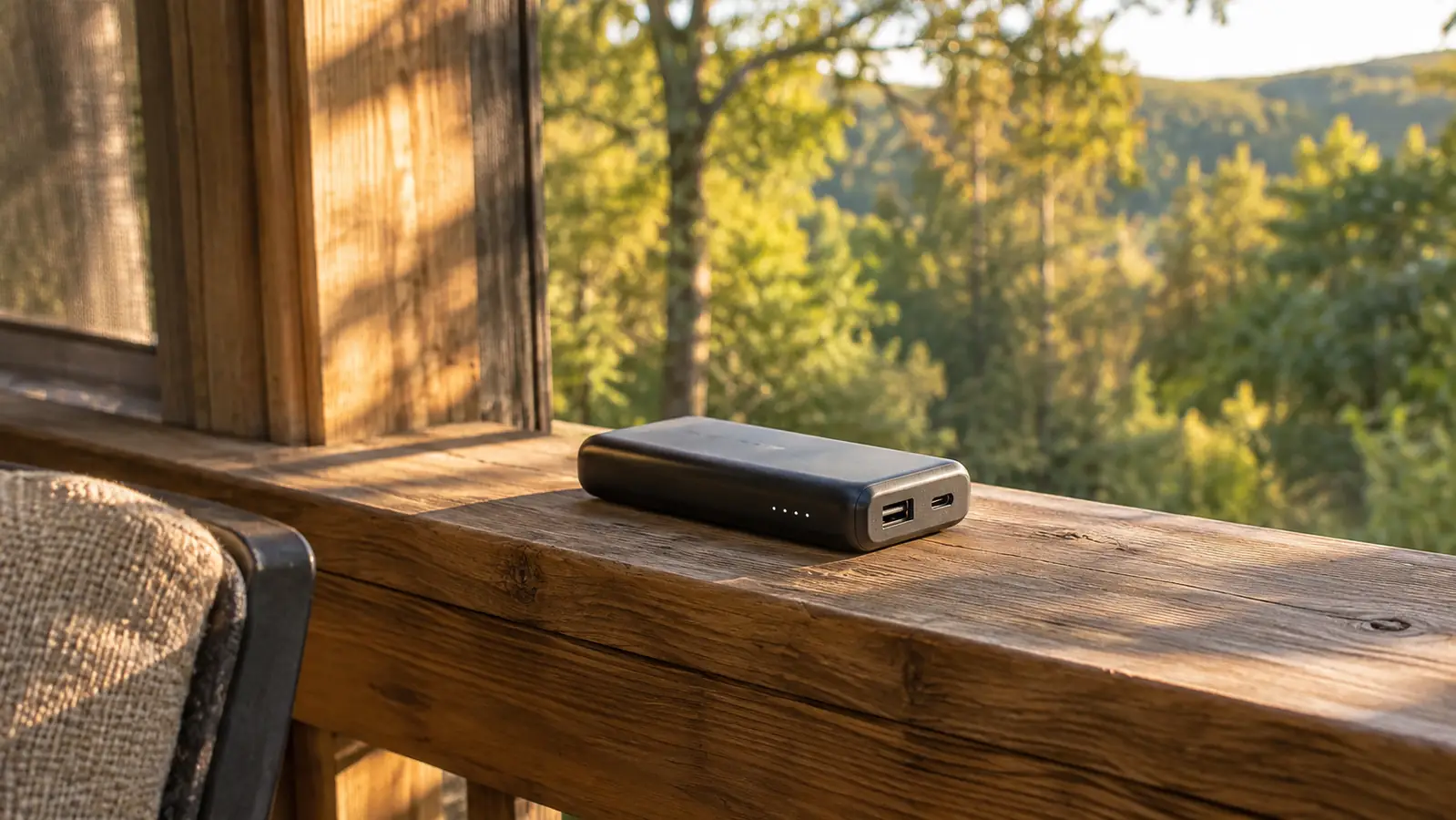
How I Charge It, and Where It Lives
From the wall, with a USB-C cable, on the first of March, June, September and December. Those are the same four dates I top up the Jackery and check the backpack, and they are written on the paper calendar on the refrigerator so I do not have to hold them in my head. The first charge was the day it came in May. The listing says about four hours to fill from the wall and I have not stood over it with a watch, but four hours matches what I have seen.
Then it goes back in my purse with the clip on the strap. It is not in the hall closet, it is not in the backpack, and it is not in the pickup. If the power goes out at home, the Jackery is what charges phones and runs a lamp, and this one stays in the purse as the spare. I want to be clear on that point, because a 9.3 ounce battery in a handbag is not a household plan. It is the thing you are glad about when you are away from the house, and away from the house is exactly where I was in April.
One week on the back porch rail in June took it from two lights to three. That is the whole solar story, and I would rather you hear it from me now than find it out on a gray morning when you needed it.
What It Will Not Do
It will not fill in the sun in a day, and it will not give you more than the listing claims. That figure is about two full charges for a recent phone. Two is a real number and it is the size of the thing: two charges, and then it is empty and looking for a wall. If anyone tells you a battery this size will keep a household running through an outage, they are selling something, and what they are selling is not a battery.
It also has not been through an outage here. I bought the BLAVOR in May and the power has stayed on since, so I can tell you what it does on errand days and on a porch rail, and I cannot tell you what it does across three days of ice, because it has not been in one. I would rather say that plainly than dress it up. What I can tell you is that in an outage at home I reach for the Jackery first, and the BLAVOR is the spare in my bag and nothing more.
One more line, and I put it in everything I write about gear. Follow your local officials and your utility. A battery in a purse is not a plan. It is one less worry while the plan is already running.
Who Should Buy Which
Buy the BLAVOR if the battery is going to live in a bag you carry and you want it to still have a charge when you finally reach for it, weeks or months after you last plugged it in. The panel, the pad and the light are small conveniences that add up in a bag, and 9.3 ounces is nothing in a purse. That is my situation exactly, and after six months I would buy it again.
Buy a plain power bank if the battery lives in your jacket or clipped to a pack and you charge it every week or two anyway. In that case the panel is dead weight you are carrying for no reason, the pad is a party trick, and the flashlight you already own is enough. There is nothing wrong with the plain one. It is smaller and it is simpler, and if you keep it charged on a schedule you will never miss the sun.
And if the battery is going to sit in a hall closet, buy neither. A 10,000mAh pocket battery in a closet is a phone charge nobody ever uses. The closet is where the radio, the power station, the food, the filter and the backpack live, and a pocket charger does not belong in that lineup.
One thing in the bag that is not dead when you reach for it
I bought it because of a night on a cot with a phone at 20 percent. Six months on it has topped up my phone on errand days, lit the walk from the pickup to the porch, and never once been empty when I wanted it. That is a small claim to be able to make about a piece of gear, and it is the only one I am making.
Amazon Check Today's Price on Amazon →