
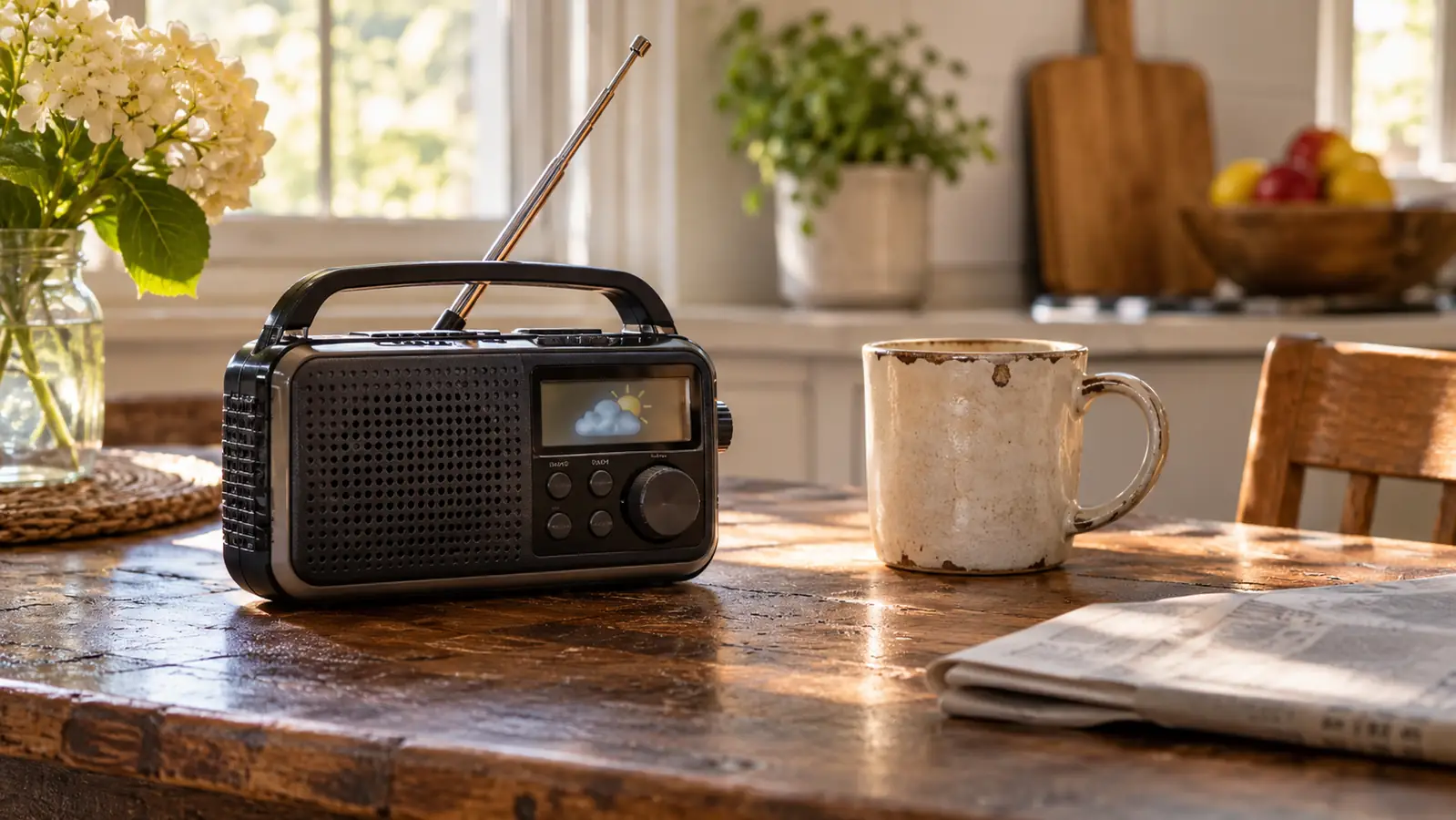
At eleven o'clock on a night in August of last year, I stood in my kitchen holding a phone that said 11 percent. A thunderstorm had knocked the power out a little after nine, and it stayed out about nine hours. I had no idea whether the worst of it was still coming or already gone. Nothing bad happened that night. Nobody was hurt, nothing was lost. But I did not like knowing so little about the sky over my own house.
I spent thirty years carrying mail on one rural route through the hills of middle Tennessee, so weather and I are old acquaintances. I am not writing this to talk anybody into a bunker. I am writing it because my phone is my news, my weather report and my telephone all at once, and on that night it was down to 11 percent with nothing to plug it into. In September of last year I bought a Midland ER310. It has been in this house fourteen months, and it is the one thing on my list I would replace first.
Here is the plain description, no label talk. The Midland ER310 is a weather and alert radio. It weighs 16 ounces and measures 9.61 by 2.95 by 6.85 inches, so it fits on a kitchen table without taking the table. It runs on a hand crank, a solar panel or six AA batteries, and those six batteries come in the box. It tunes AM and FM and the weather band, and it has a built-in flashlight and a USB connection. It is not water resistant. That last part is why mine lives indoors.
The radio on my kitchen table through three days without power
Fourteen months of ownership, one three day outage, and it never once quit on me. If you only buy one thing before the next storm, buy the thing that tells you what the storm is doing.
Amazon Check Today's Price on Amazon →Five Steps, About Twenty Minutes
Step 1: Put It Where You Will Hear It at Two in the Morning
An alert radio in a closed closet is a radio you do not really own. Mine sits on the kitchen table from November through May and on the hall closet shelf from June through October. That is one winter on the table so far, and there is a reason for the arrangement. From November to May, the weather that matters here arrives at night, and the kitchen sits between the bedroom and the back door.
Choose the room you already walk through half asleep. Not the garage, not a shelf over the washer, not the top of the refrigerator. The ER310 is not water resistant, so it stays out of the bathroom and off the porch. At 16 ounces it is easy to move around, which means there is no excuse for leaving it somewhere you cannot hear it.
The second half of this step is telling the other person in the house where it is. Hollis can put his hand on it in the dark because from November through May it stays in the same spot. That is not luck. That is a decision made once and then left alone.
June through October it goes up on the closet shelf, and I will be honest that those are the low months for the kind of weather that puts us out of power. It is also the season when the kitchen table is covered in tomatoes and a radio would only be in the way. The point is that it has a place in both seasons and I never have to think about where.
Step 2: Settle the Power Question Before the Storm Does
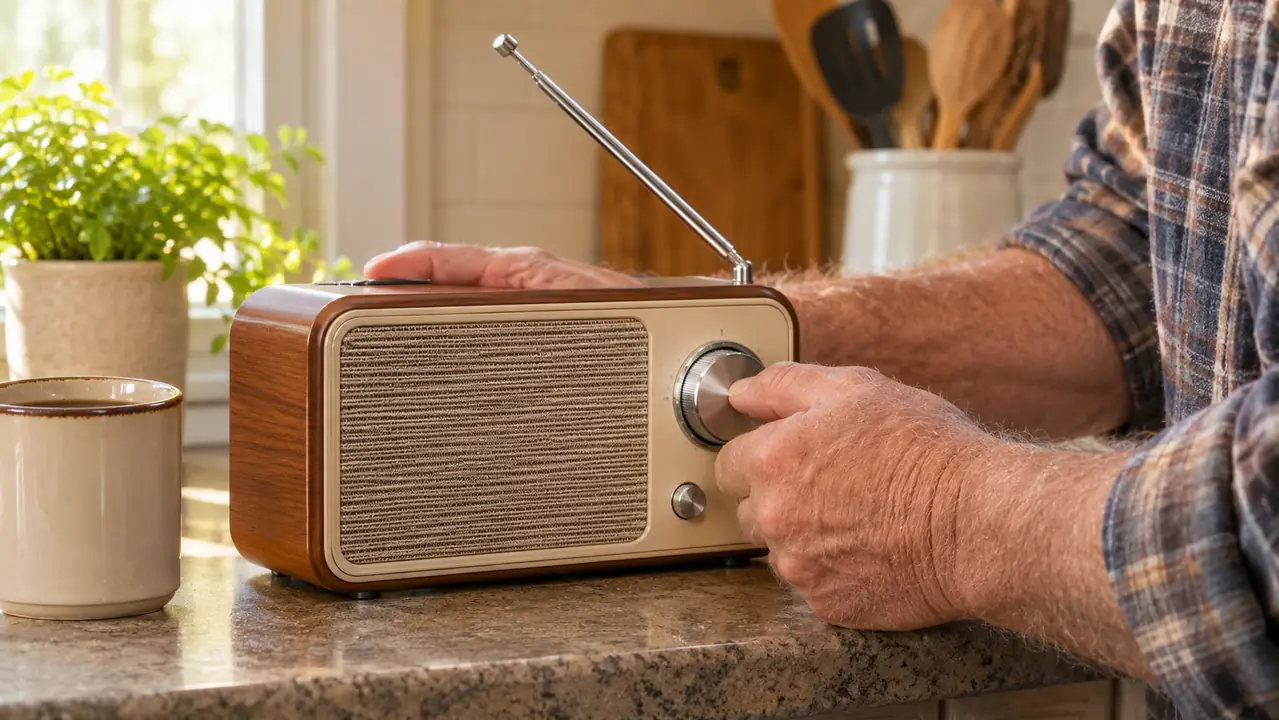
The ER310 gives you three ways to keep it running. Only one of them is dependable in a real outage, and it is the one that looks like a toy.
The crank comes first. On the first night of the ice storm this past January, freezing rain brought a limb down on the line about six in the evening and the power went out with it. That night I cranked the radio on the kitchen table and heard the forecast. That is the entire scene. No drama, no heroics. A woman turning a handle and finding out what the sky was going to do next.
The six AA batteries that came in the box are the second way and they are better than they sound. I switched over to them Wednesday morning and they ran the radio from Wednesday through Friday noon without running down. Same six batteries, still in there. I have never changed them and I do not keep a spare set. The crank is what I fall back on when they finally give out.
I will say one thing about the batteries that is advice rather than report. I have gotten away without a spare set because the crank is there, and that is a reasonable bet for me. If you would rather not turn a handle at all, buy the spare set when you buy the radio. Six AA batteries are not a hard thing to store in a closet.
The solar panel is the third way and I will not oversell it. I set the radio on a windowsill one gray afternoon and the panel did very little. It played no part in the ice storm and I have not built any plan around it. If you are counting on January sun in Tennessee, count again.
The USB connection will give a phone a small top up. I have done that once or twice and it is a nice thing to have. It is not a phone charger. The crank will not charge a phone either. Charging phones is a separate job with separate equipment at my house, and I would rather say that plainly than have somebody turn a handle for an hour expecting a full battery.
Step 3: Find the Weather Band and Then Stop Moving It
The tuner covers AM and FM and the weather band. Weather band is the position you want, because that is where the forecasts and the alerts come from rather than a disc jockey and a truck commercial.
Spend five minutes on a clear afternoon finding that position, and then leave it alone. A storm is a poor time to be hunting for a station in the dark.
On the March night we had a tornado warning, the radio was already sitting on the weather band. I did not have to tune anything at two in the morning. I picked it up and carried it, and that was the whole of the work.
One caution. The weather band repeats the same forecast every few minutes, and by the second day that will wear on your nerves. I leave it on anyway and go about my business. The radio does not mind, and I would rather be tired of a voice than be guessing.
Step 4: Test It on a Clear Afternoon, Not a Dark One
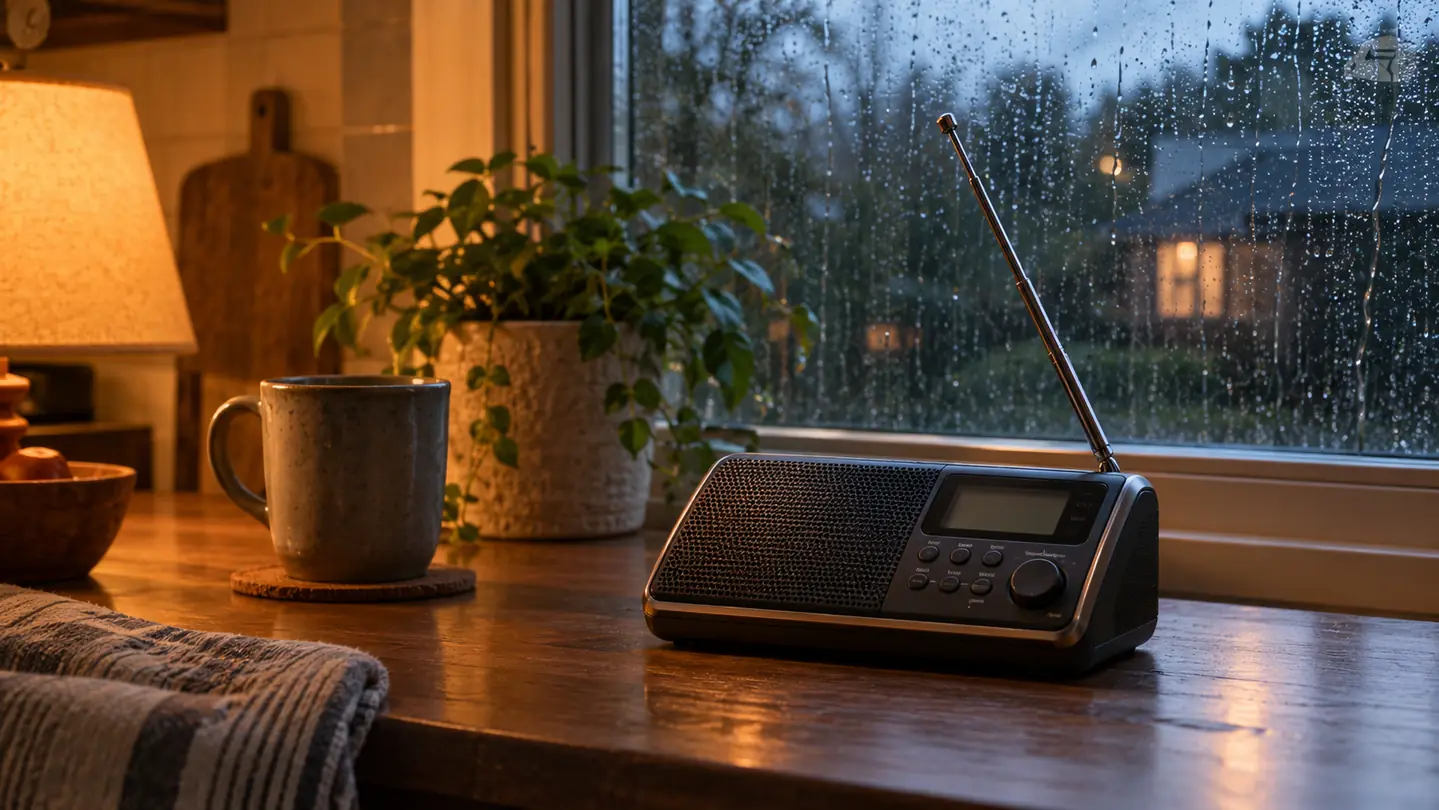
When the radio comes back to the kitchen table in November, crank it for a minute and confirm you hear a voice. That is the whole test. It takes less time than finding your keys.
The rest of this step is a habit rather than a check. The night of the March tornado warning, I carried the radio to the bedroom nightstand before bed because storms were forecast. It sat there while we slept and it was within arm's reach when it went off.
The Midland also has a built-in flashlight, which matters more than it sounds like it should. When the power goes, the first thing everybody hunts for is a light. Mine is attached to the thing I was going to pick up anyway.
Show the crank to whoever else lives with you, because it is not obvious that the radio has one. That thirty second demonstration is worth more than any instruction I could leave on a note.
Step 5: Know What the Alert Means, and What It Does Not
About two in the morning in March, the radio was on the weather band and we went to the hall, the only inside space in this house with no windows. The storm passed to the north of us. No damage at our place and no limbs down in the yard.
Here is the limit of the thing. A radio tells you what is happening. It does not shelter you and it does not make a decision for you. If a local official tells you to leave, leave. Follow the evacuation orders and the instructions from your own officials, not a paragraph from a retired mail carrier in Tennessee.
And keep it in perspective. Your phone still gives you alerts when it has a signal. In the ice storm the cell signal went weak Wednesday morning and was gone for most of that day. The radio is for the hours when the phone has nothing to say. That is a narrow job, and it is a job worth having.
Knowing the difference between a watch and a warning helps too, and no product can do that part for you. A watch means conditions are right. A warning means it is happening somewhere near you. I have heard both on the weather band and I have learned which one to get out of bed for.
What Else Helps
A radio is a receiver, not a plan. What has helped most around here is having the pieces and knowing which one does which job. The radio gets the news. The power station on the closet floor runs phones and light, nothing else. The food kits are for meals. The water filters are a backup for when the tap stops being trustworthy. The backpack by the closet door is for leaving.
Two rules matter more than any product I own. A camp stove stays outside on the back porch, never in the kitchen, no exceptions and no cold morning that changes your mind. A generator stays outside and away from the windows. Ray up the road runs one, and I can hear it when the wind is right.
The other thing that helps is a habit small enough that you will actually keep it. Mine lands on four dates a year, the first of March, June, September and December. On those dates I top up the power station and go through the backpack. The radio comes back to the kitchen table in November and goes up to the shelf in June. Twenty minutes, four times a year, and nothing in that closet gets a surprise.
Buy it a piece at a time. I bought mine over four months, starting with the radio. That was not a plan I drew up. It was the piece I went looking for after August of last year, when a thunderstorm took the power out overnight and left me with a dying phone and no idea what was coming.
None of it is expensive in the way people imagine. It is mostly a matter of buying one thing at a time and putting it where you can find it in the dark. The radio is the one I would not be without.
The same six AA batteries that came in the box ran that radio from Wednesday morning through Friday noon, and they never ran down.
It has never been the thing that failed
Fourteen months, one three day outage, one tornado warning at two in the morning. The radio did its job both times. Mine is on the kitchen table right now.
Amazon Check Today's Price on Amazon →