November is when I start thinking about ice. Not because of anything the forecast has said yet, but because of the three days last January when the power went out and the only light in this house after dark came from a battery sitting on the kitchen counter.
I am not going to tell you that a portable power station makes an outage comfortable, because it does not. What the Jackery Explorer 300 did in that storm was smaller and more useful than comfort. It kept two phones alive, and it kept one LED lamp burning, for three days, and it was never recharged. It started at 100 percent and it finished at about 30 percent. That is the whole case for owning one, and it is also the reason the preparation matters more than the purchase. A unit that sat half charged in a cold shed since last winter would have done nothing at all. Here is the order I do things in, and the order I would give a neighbor who keeps meaning to get around to it.
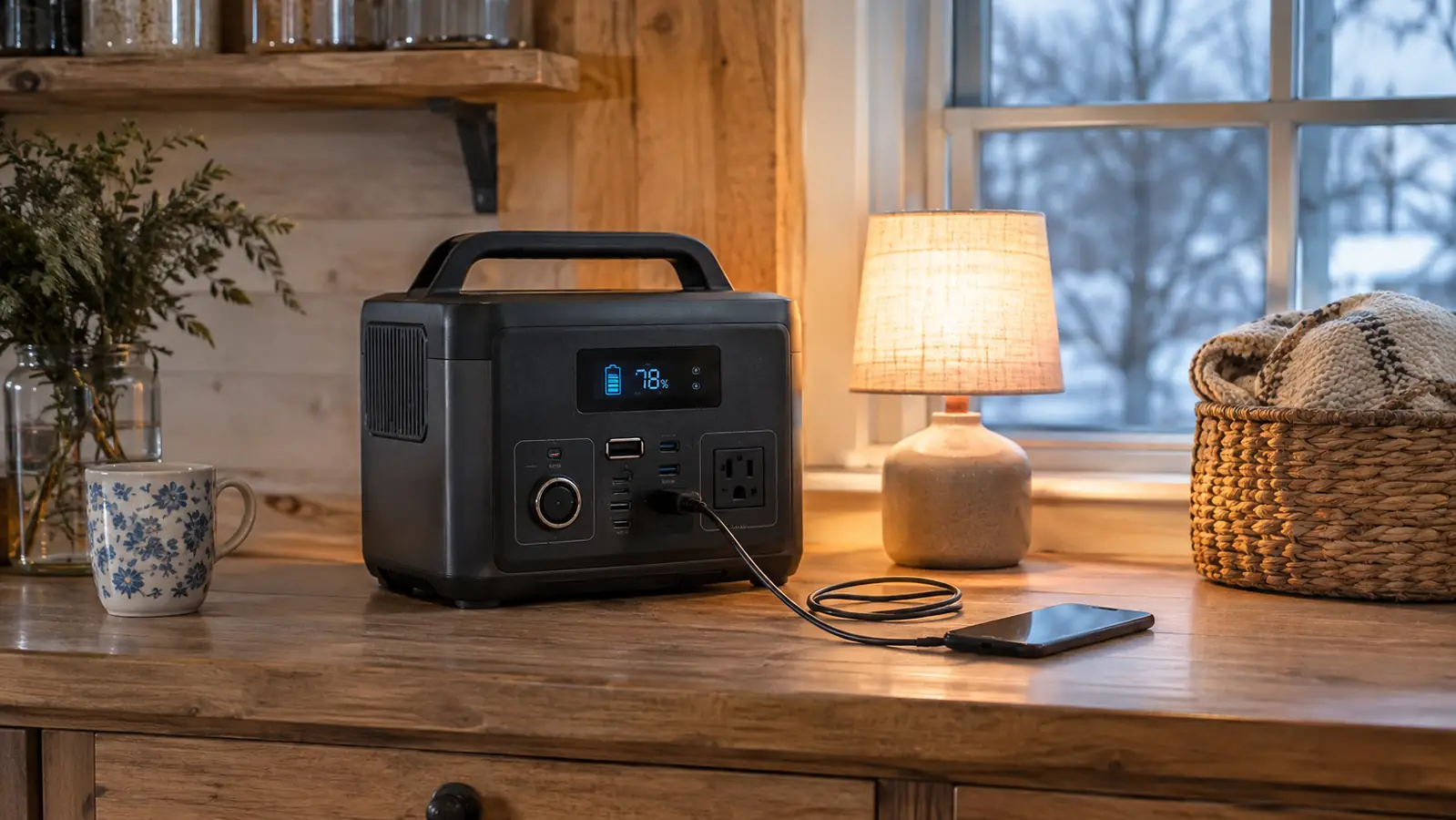
The 292 watt-hour battery that ran two phones and one lamp for three days
The Explorer 300 charges from a wall outlet in about four hours, weighs about 7.5 pounds, and fits on the floor of a hall closet. See the current price and the full port list before the next front comes through.
Amazon Check Today's Price on Amazon →Step 1: Charge it fully, then put it on a calendar
Mine gets plugged into the wall on the first of March, the first of June, the first of September and the first of December. That is four dates a year, and it takes about four hours from a wall outlet to bring it back to full. I do not stand over it. I plug it in before bed, and the next morning it goes back on the closet floor. If a storm is forecast, I do the same thing a day early, because the night before an ice storm is not the time to discover that a four-hour charge has to happen during it.
The battery in the Explorer 300 is LiFePO4, and the listing says it is built for more than 4,000 charge cycles. I cannot verify a number like that from my kitchen, and I am not going to pretend I can. What I can tell you is that a battery left sitting low for months is how people ruin these things, and a calendar on the refrigerator is the cheapest insurance there is. A power station is not a fire extinguisher. You cannot hang it on a wall, forget it for years, and expect a full battery when the lights go out.
Where it lives matters as much as how often you charge it. Mine sits on the floor at the front of the hall closet, never on a shelf. It weighs about 7.5 pounds, and 7.5 pounds coming off a shelf onto a foot in the dark is a poor start to a bad week. The closet is inside a heated house, and I have never put a thermometer in there, so I will not quote you a temperature for it. A garage, a shed or a truck toolbox gets cold and damp, and none of those is kind to a battery. Keep the handle clear and keep the floor dry.
Step 2: Learn what it will run and what it will not
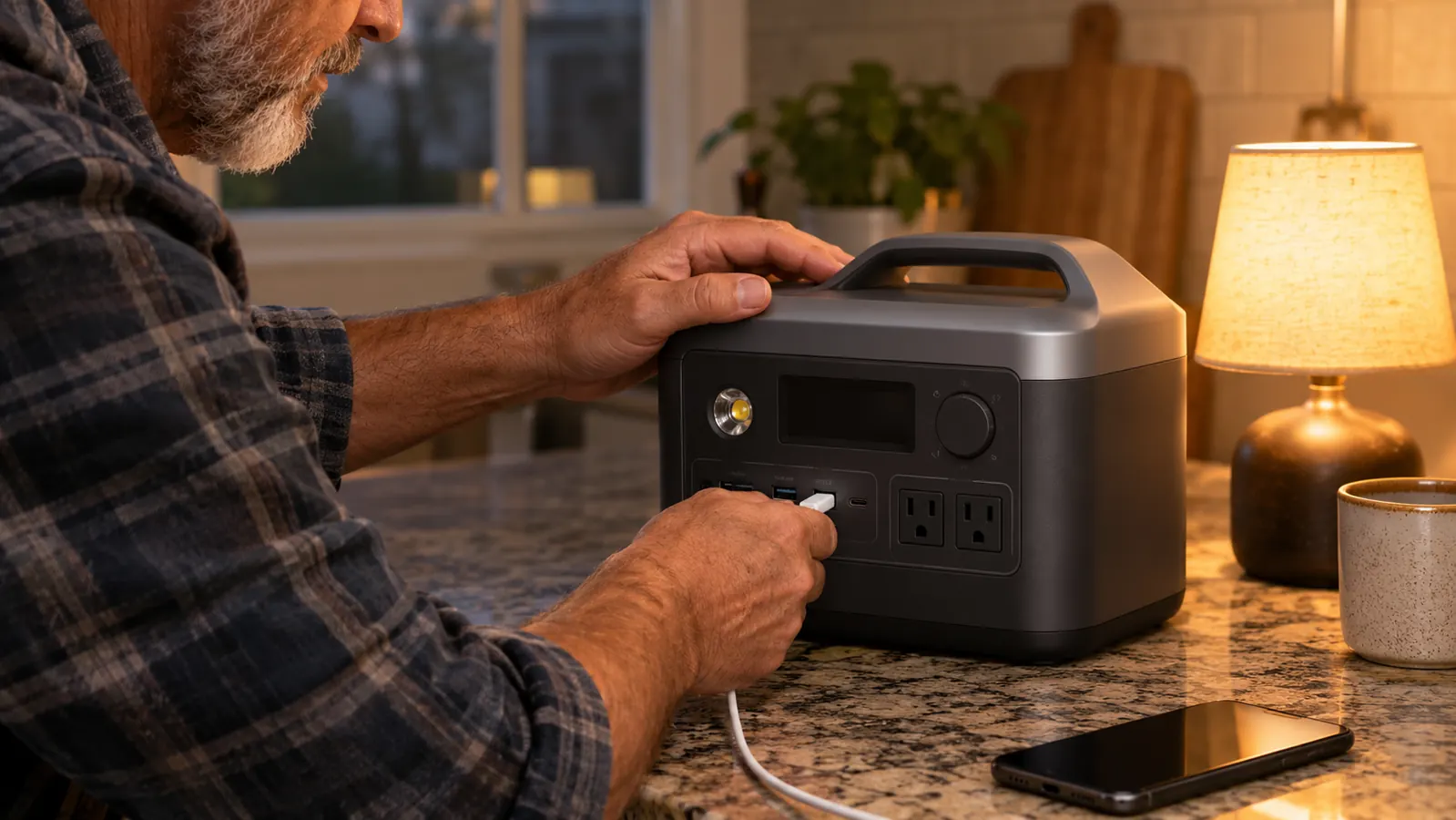
The Jackery Explorer 300 is 292 watt-hours, with 300 watts of rated output and a 600 watt peak. In plain terms, watt-hours are how long it can go and watts are how much it can push at one time. It has two AC outlets, a 100W USB-C port, two USB-A ports and a 120W car port, and it comes with the AC adapter and a car charger cable. Solar is not included and I do not own a panel, so I count on the wall outlet and nothing else.
In this house it runs phones and light. That is the entire list. Two phones and one LED lamp were what it carried through the ice storm, and it carried them the whole three days without a recharge. Phones and a lamp are a small load for 292 watt-hours, which is exactly why it lasted. The car charger cable is in the closet with it and I have never needed it. The 100W USB-C port is the higher-power one, so that is the cable I reach for first when a phone is low.
What it will not run matters just as much. It will not run the refrigerator, the electric range, the heat pump or a space heater. I never tried, because the arithmetic is not close. That is not a flaw in the unit. It is the difference between a 292 watt-hour battery you can pick up with one hand and a whole house backup that takes two people and a concrete pad. If a salesman tells you this size will run your house, walk away from him. If a webpage tells you, close the tab.
Step 3: Stage it before the weather, not during it
Tuesday afternoon last January, freezing rain was in the forecast, and I carried the Jackery from the closet floor to the kitchen counter. The readout said 100 percent. That was the whole staging process, and it took less time than finding my boots.
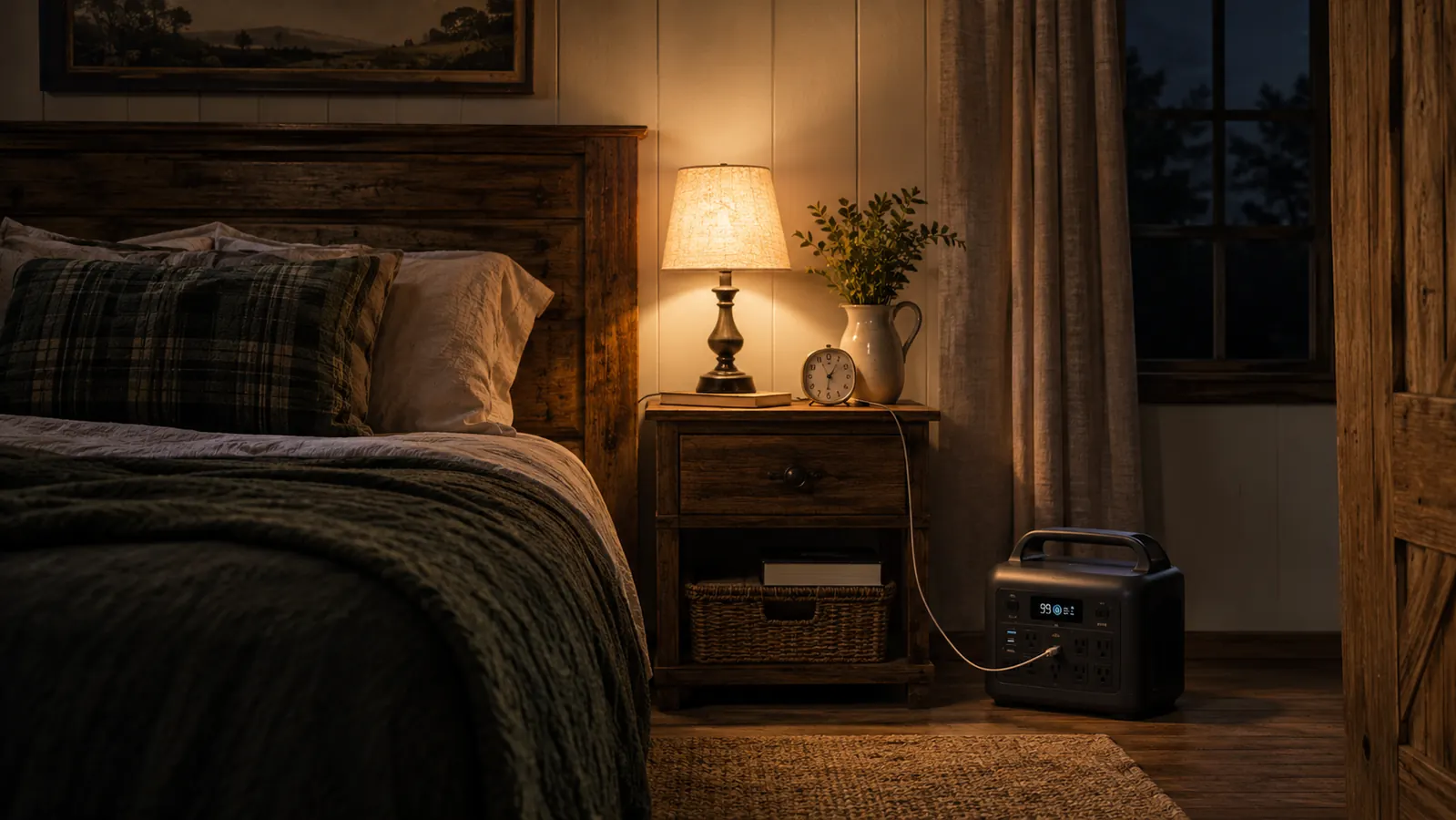
It stayed on the counter through the day, and it moved with us at night. Tuesday night it went to the bedroom floor beside the bed. Wednesday and Thursday nights it went to the den, where we slept because the wood stove was there. A phone charging in the kitchen is no help when you are in the den at midnight and the cell signal has gone. Move the battery to the room you are actually sitting in. It is 7.5 pounds with a handle, not a piece of furniture.
Keep it indoors and dry, on a hard surface, out of the path between the bed and the bathroom. It does not go out on the porch with the camp stove. Nothing gets set on top of it and nothing gets stacked against the front of it. If you run a cord to a lamp, run the cord along a wall instead of across the floor. In a dark house, most of what goes wrong is a fall, not a battery.
It started at 100 percent and finished at about 30 percent. Three days, two phones, one lamp, no recharge. That is what 292 watt-hours buys you in a real outage.
Step 4: Pair it with the things it cannot do
The power station covers two jobs, phones and light, and an outage asks for more than two. News is the first one. My radio is a different tool with a different job, and it is the reason I knew what the weather was doing on the first night. Water is the second. A boil notice went out for our water district during that storm, and we followed it. Neither of those jobs belongs to a battery with two AC outlets.
Food is the third. The kit in my closet needs boiling water and a heat source, and the heat source is a two-burner propane camp stove that gets used on the back porch and nowhere else. A camp stove indoors can kill you in a way a dead phone cannot. The same rule goes for a gas generator: outside, away from windows, never in a garage with the door down. Ray up the road has one, he said it ran fine through that storm, and it ran outside where it belongs.
The last job is leaving. That is a backpack by the closet door, not the power station. If a deputy comes down the road and tells you to go, you are not unplugging a battery and loading it in the truck. You take the bag, your phones and the vehicle, and the power station stays home. Knowing which tool does which job is most of being ready, and it keeps you from asking 292 watt-hours to be something it was never built to be.
Step 5: Spend five minutes on it on the same four dates
On the dates I charge it, I also check it. I look at the readout and make sure it is where I left it. I plug a lamp into one of the AC outlets and switch it on. I check that both phone cables are still in the closet and not in the truck. I make sure nothing has been leaned against the front of it and that the closet floor is dry. Then it goes back on the floor, and I shut the door.
The other half of the routine happens after the storm. When our power came back on a Friday around noon, the Explorer 300 went back to the closet floor at about 30 percent and I plugged it into the wall that same afternoon. Do not wait for the next forecast to recharge it. The week after an outage is when people are tired and busy and forget, and that is how a full battery becomes a dead one by the following winter.
What I would tell you about that storm is that the Jackery was not one of the things that went wrong. The camp stove lighter had gone missing and I used kitchen matches. We lost the food in the refrigerator on the third day. The cell signal dropped on the Wednesday. The battery did exactly what I asked of it, which was to keep two phones and one lamp going, and it still had about 30 percent left when the lights came back on.
What Else Helps
The power station is one line on a short list. A battery radio with a hand crank and AA batteries tells you what is happening when the cell signal drops, which it did for most of one day in our storm. Six gallons of bottled water in the hall closet is another line. So is a food kit that needs only boiling water and a heat source you can use outdoors, plus a hand can opener for the pantry and a spare lighter with the camp stove, which is the one thing I added after that week.
Then there is the part no product covers. Follow the local officials. If they say boil, boil. If they say leave, leave. A closet full of gear does not make you safe on its own, and it is not supposed to. What it does is keep a bad three days from turning into a worse one. Ours was three days, two people, and nobody hurt. That is the goal. Not a comfortable week. A week where the phones work, the lamp burns, and you know what is coming next.
Four hours to charge it, four dates a year to keep it ready
The Explorer 300 is 292 watt-hours, 300 watts rated, about 7.5 pounds, and it lives on the floor of a hall closet until the forecast turns. For phones and light, it does the job.
Amazon Check Today's Price on Amazon →