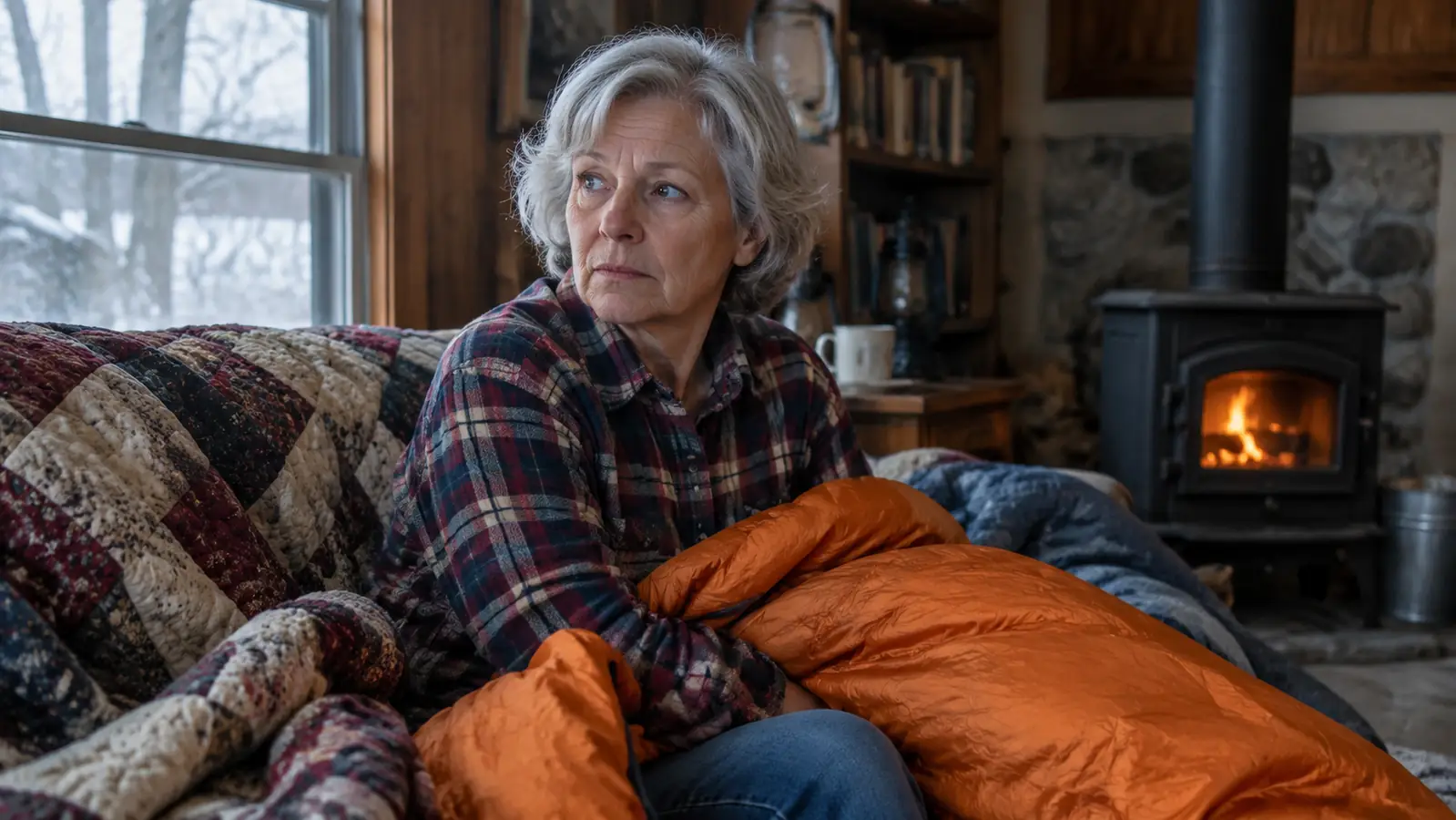
The cold in a winter outage does not arrive all at once. It comes in behind the news, after the heat pump quits and before anybody has decided this is going to last. You sit in the room you were already in, and an hour later your shoulders are tight and your feet are cold and you are doing arithmetic about how many quilts you own. I have been through one of those, three days in January, and what I came away with is that staying warm is mostly a matter of order. Do the right things in the right sequence and a house with no power is merely uncomfortable. Do them in the wrong order and it is a good deal worse than it needed to be.
The piece of gear I added afterward is the Go Time Gear Life Bivy, an emergency sleeping bag. Two of them, one for me and one for my husband Hollis, bought in February 2026 after that ice storm. The listing says it retains up to 90 percent of body heat. I did not measure that and I am not going to pretend I did. What I can tell you honestly is where a bag like this belongs in a cold house and where it does not.
The layer that goes under the quilts, not instead of them
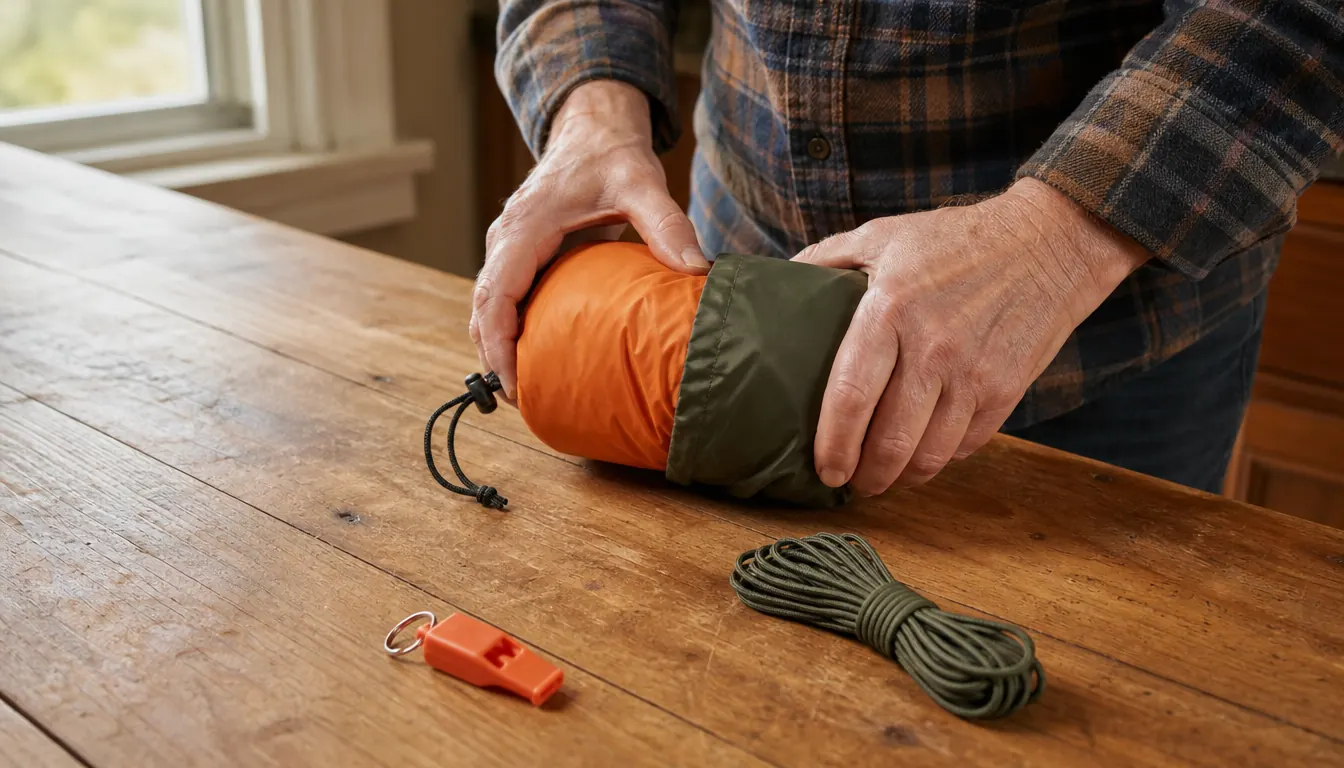
A one person emergency sleeping bag with a heat reflecting lining, a 120 decibel whistle and 20 feet of paracord, 4.1 ounces, packed in a small stuff sack that fits in a cedar chest. It is not a bed. It is the warmest layer you can add to the bed you already own.
Amazon Check Today's Price on Amazon →Here is the order I would do it in now, in a house with the power out and the temperature falling. None of it is complicated and none of it takes long. It is just that each step makes the next one work, and skipping a step costs you more heat than the step was ever worth.
Step 1: Shrink the room before you touch a single blanket
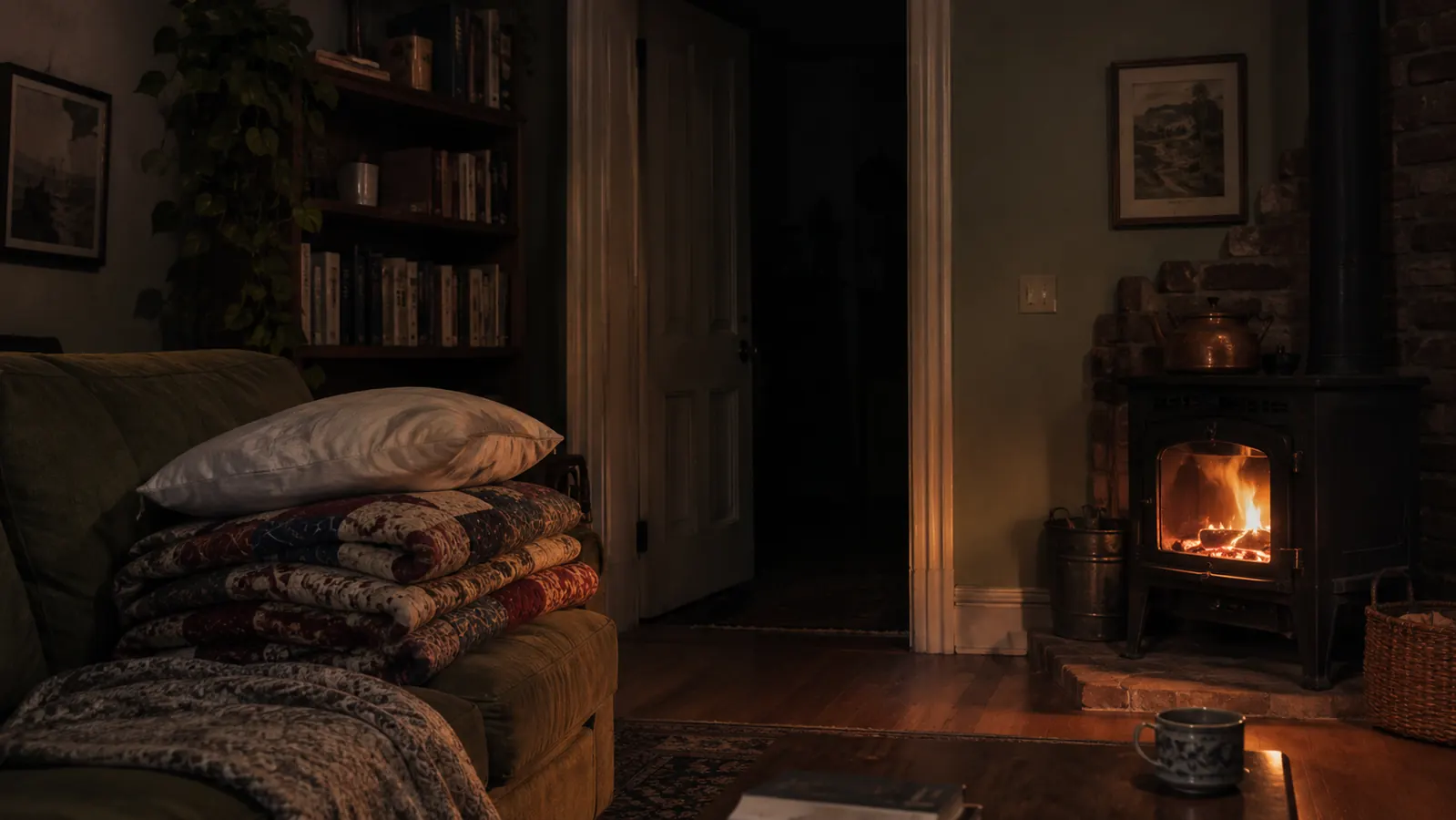
Everything after this assumes one room. A one story farmhouse with every door standing open and a heat pump that is not running is a cold building, and a cold building is not a shelter. Pick one room, close the doors on the rest, pull the curtains, and put everybody in it. In our house that is the den, because the wood stove is in there. If you have no stove, pick the smallest inside room with the fewest windows, and hang a blanket over the doorway if the door does not shut tight.
The reason to do this first is that heat is a budget. Your body is producing some. A wood stove or the sun is producing some. Every square foot of cold room you leave open takes a bite out of that budget. Shut the doors and the same body heat raises the temperature of a smaller box. That is not a theory, it is arithmetic, and it is the difference between a night that is uncomfortable and a night that is very long.
Ours runs on an electric heat pump and an electric range, so without the utility we have the wood stove in the den and nothing else that makes heat. I know how that sounds to somebody in an apartment with no stove at all. A small room, a closed door and layers is still the plan, and it still works better than sitting in a cold living room waiting for the lights to come back on. Waiting is not a method.
One more habit for that room. Move the things you will want at two in the morning in there before dark, while you can still see and while you are still warm. Water, a flashlight, your shoes, the radio, the quilts off the beds. Getting up in a cold house to go hunt for something in a cold room is the fastest way to lose whatever heat you had built up.
Step 2: Put the bag under or inside the quilts, never alone on the floor
During the ice storm we slept in the den on the Wednesday and Thursday nights, under quilts, with the stove holding the room at about 62 degrees. The stove burned down toward dawn on that last night, Thursday into Friday, and I lay there cold. Nobody was hurt and nothing was damaged. It was simply cold, the kind that gets into your back and stays there, and I decided in the dark that I was not doing that again without something better in the house.
So in February I bought two Go Time Gear bags. They live in the cedar chest at the foot of our bed, on top of the spare quilts, and that placement is deliberate. Not the hall closet with the other supplies. Not the truck. In with the bedding, because that is where I will be standing when I want one. Gear you have to go find in the dark is gear you will not use.
An emergency sleeping bag is a thin layer that reflects your own heat back at you. It is not a tent and it is not a bed. If you unroll one on a bare floor in a cold room and get in, you will be cold and disappointed, and you will decide the thing does not work. Lay it on the sofa or a cot or a mattress, get in, and put a quilt over the top. Then it does the job it was made for, which is to keep the heat you are already making from leaving the room.
The listing also says it can be used as a blanket or as a liner inside a regular sleeping bag. I have not used mine either way, so I am only passing along what the package says. What I have done is the plain version, bag on the sofa with a quilt over it, and that is what I would tell a neighbor to try first.
Step 3: Get in with your face out at the top
On a cold evening in late February I took mine out of its sack and got into it on the den sofa the way you get into a sleeping bag, with a quilt over the top and the heat on in the house. It warmed up fast. Faster than I expected, and I am not a person who is easily impressed by a piece of plastic.
Your face stays out at the top opening. Do not pull it over your head, not for any reason. You need the air and you need to be able to hear what is going on in the house, and there is nothing about a cold night that makes covering your face a good trade.
It crinkles. Every time you move, and I mean every single time. If you are sharing a room with somebody who sleeps light, know that going in. That is the price of a bag that weighs 4.1 ounces, about 5.6 with the sack and the cord. There is a 120 decibel whistle and 20 feet of paracord attached to it. I have never blown the whistle and never used the cord. I know they are there and that is enough for me.
One bag per person, not one bag for the household. That is why there are two in the chest. Hollis has never opened his, and I will get to that, but the point stands. A single bag shared between two people keeps neither of them warm, and in a cold house you want everybody to have their own layer rather than a rotation.
Step 4: Keep the plastic away from every flame
The bag is polyethylene, which is a plain way of saying thin plastic. Keep it away from the wood stove, away from candles, and away from anything with an open flame. That is not a criticism of the bag. It is what thin plastic is, and you should treat the foil survival blankets in any kit the same way.
Never bring a camp stove, a grill or a generator indoors to stay warm, no matter how cold the room gets. Ours is a two burner propane camp stove and it lives on the back porch. It has never been inside this house, not during the storm and not since. A generator runs outside and away from the windows. A cold night is a bad way to spend an evening. Doing it with a stove burning in a closed room is worse.
And when a cold snap goes past what a house and a bag can handle, go where the county tells you to go. Warming centers open for a reason and there is no prize for staying. Follow your local officials and your utility. If they say leave, leave.
Step 5: Dry it out and repack it before you put it away
After about an hour inside mine, the inside of the bag was damp from my own body. It does not breathe, which is exactly why it holds heat and exactly why it collects moisture. I got out, wiped it down with a towel, and let it air overnight before I rolled it up.
Getting it back into the sack took a few tries. Roll it tight, start at the foot end, and do not rush it. That is a job for a warm evening at home, not for two in the morning with cold hands and a flashlight in your teeth. Practice the repack once while you are comfortable and it stops being a problem you dread.
Hollis has never opened his. It is still in its sack in the cedar chest, and I have decided that is fine. A bag that has never been out of the sack is still a bag. There is no rule that says everybody in the house has to try theirs on the same evening, and I would rather he have one he has never touched than need one he does not have.
What Else Helps
The bag is one layer in a stack and it is not the stack. Quilts do most of the work in this house and I would not trade them for anything in the closet. Put the bag inside or under them and you have added a reflective layer at almost no weight. Put the bag on and skip the quilts and you have made a small improvement to a bad plan.
Dry socks and a hat do more than people expect. So does eating something, and a thermos of something hot carried in off the porch stove is worth the trouble of filling it. The Ready America backpack in our hall closet has two foil survival blankets folded in it. Those are a different item than the bag, thinner and meant for one use, but they will also hold heat against a body in a pinch, and I would not turn my nose up at either one.
A battery radio earns its place too. Ours sits on the kitchen table from November through May, and in a winter outage that is where the forecast comes from when the cell signal is not cooperating. You cannot decide how long to hold out in a cold house if you do not know what the weather is doing. A three day outage that is going to be a five day outage is a different set of decisions.
And know yourself. If you are older, if you take medicine that makes you sleepy, if you live alone, make the call early. There is a point where a warm house stops being a preference and becomes a medical matter, and it arrives sooner than most people think. Warm food, warm feet and a warm head buy you time. They do not buy you unlimited time.
It warmed up fast. It crinkles every time you move, and after an hour the inside was damp from my own body. It still lives on top of the spare quilts in the cedar chest, and I still want it there in January.
The whole business takes one evening to set up. Two bags in the cedar chest, quilts where you can reach them, a radio on the table, a stove that stays on the porch, and a plan to leave if the county says leave. The Go Time Gear Life Bivy is the newest of that in our house and it is the one I am least likely to think about until it is cold. That is the point of it. You want a cold night to be a night, not an event.
One bag per person, under the quilts, in the chest before the next cold night
4.1 ounces, a heat reflecting lining, a 120 decibel whistle and 20 feet of paracord, in a stuff sack small enough to live with the bedding. Two of these are in a cedar chest at the foot of our bed. That is the whole of my cold night plan, and it took one ice storm to get there.
Amazon Check Today's Price on Amazon →