
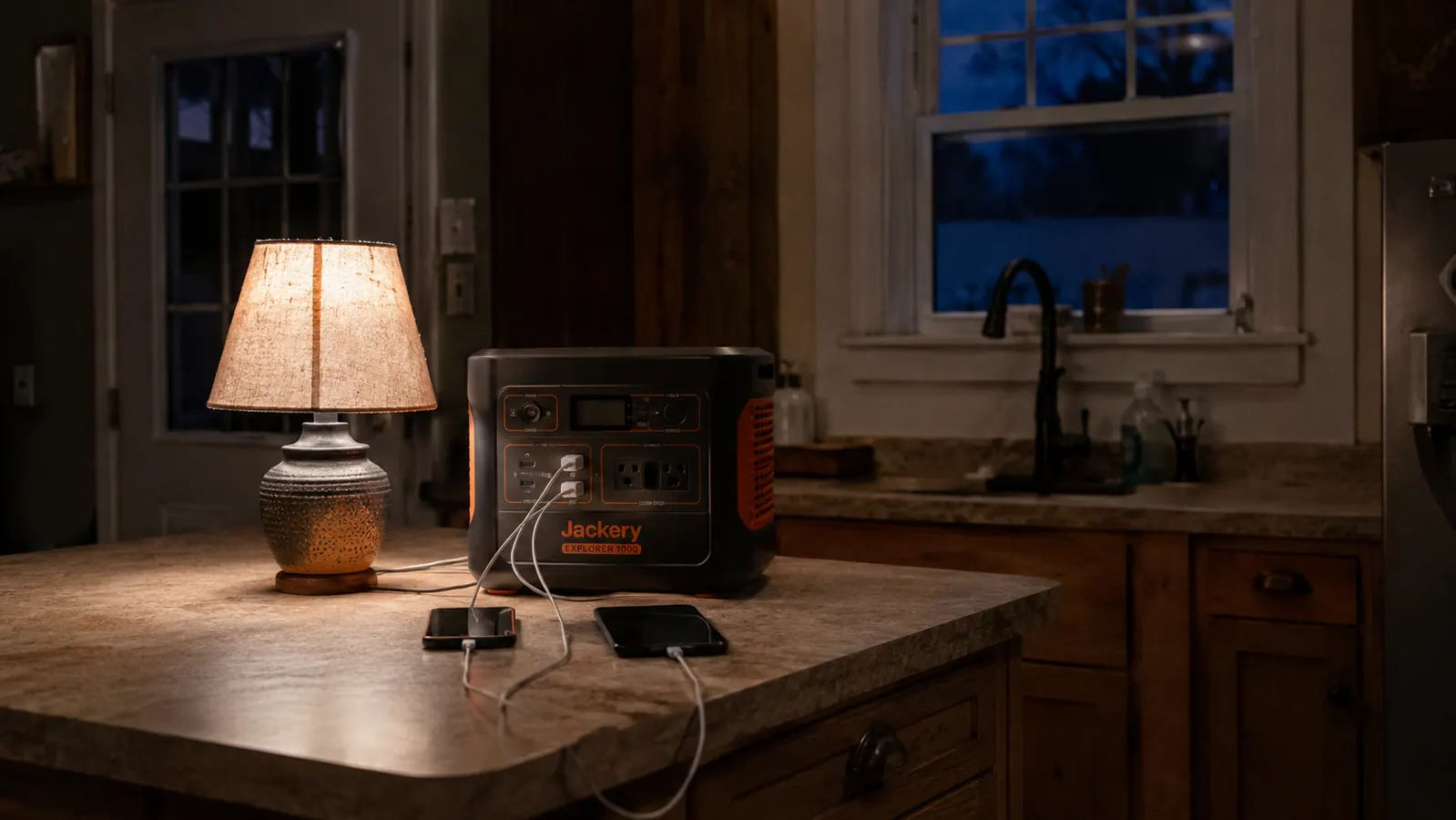
I bought the Jackery Explorer 300 in October of last year, and for thirteen months it has sat on the floor at the front of my hall closet doing nothing. That is not a complaint. Doing nothing is the job. I carried mail on one rural route for thirty years, through ice and heat, and the lesson out of all of it is that you buy the dull thing before you need it and then you forget about it on purpose. A battery you have to fuss over is a battery you cannot count on when the lights go out.
So this is the honest version, not the version where a battery saves the day. Mine has been used in one outage, three days in an ice storm this past January. It ran two phones and one lamp. It started at 100 percent and finished at about 30. Everything else I can tell you about it is either arithmetic or it is what the listing says, and I intend to keep those two things separate, because you are entitled to know which is which before you decide anything.
The Quick Verdict
A small battery that does one job well: two phones and one lamp for three days, with about 30 percent to spare. Anything with a compressor or a heating element is out of reach, and no setting on this unit changes that.
Amazon Check Today's Price →Buy it for phones and light, not for the refrigerator
That is the whole test. If your outage plan is two phones, one lamp and a way to hear what is going on, 292 watt hours covers it with room left over. If your plan is anything else, this is the wrong size and no accessory fixes that.
Amazon Check Today's Price on Amazon →The 300 in the Name Is Not the Number to Shop By
Three numbers get printed on and around this unit, and only one of them tells you how long it lasts. The 292 is watt hours. Think of that as the size of the tank. The 300 is the running watts, which is how fast it can pour. The 600 is peak, and peak is a spike, a second or two while something starts up, not a load you plan an evening around.
The arithmetic takes about a minute and it will save you an argument at the kitchen table. Take the watts of whatever you want to run, divide 292 by that number, and you have your hours. Something that sips a few watts will run a long while. A load up close to the 300 watt ceiling gets less than an hour, and it works the battery hard the whole time. Anything that pulls past 300 watts running, or needs more than 600 to start, does not belong on this unit at all.
I make a fuss about this because people shop the front of the box and then feel let down by the back. The 300 is a ceiling. The 292 is your actual evening. Those are two different kinds of number, and only one of them is honest about what the machine is for.
What that means in practice is that the useful question is not how big the box is. It is how long you need it and at what draw. I answered that for my own house before the storm ever arrived, and the answer was two phones and one lamp, three days, and a wall outlet afterward to put the charge back. Nothing in that answer needed more than 292 watt hours.
The One Storm It Came Off the Closet Floor
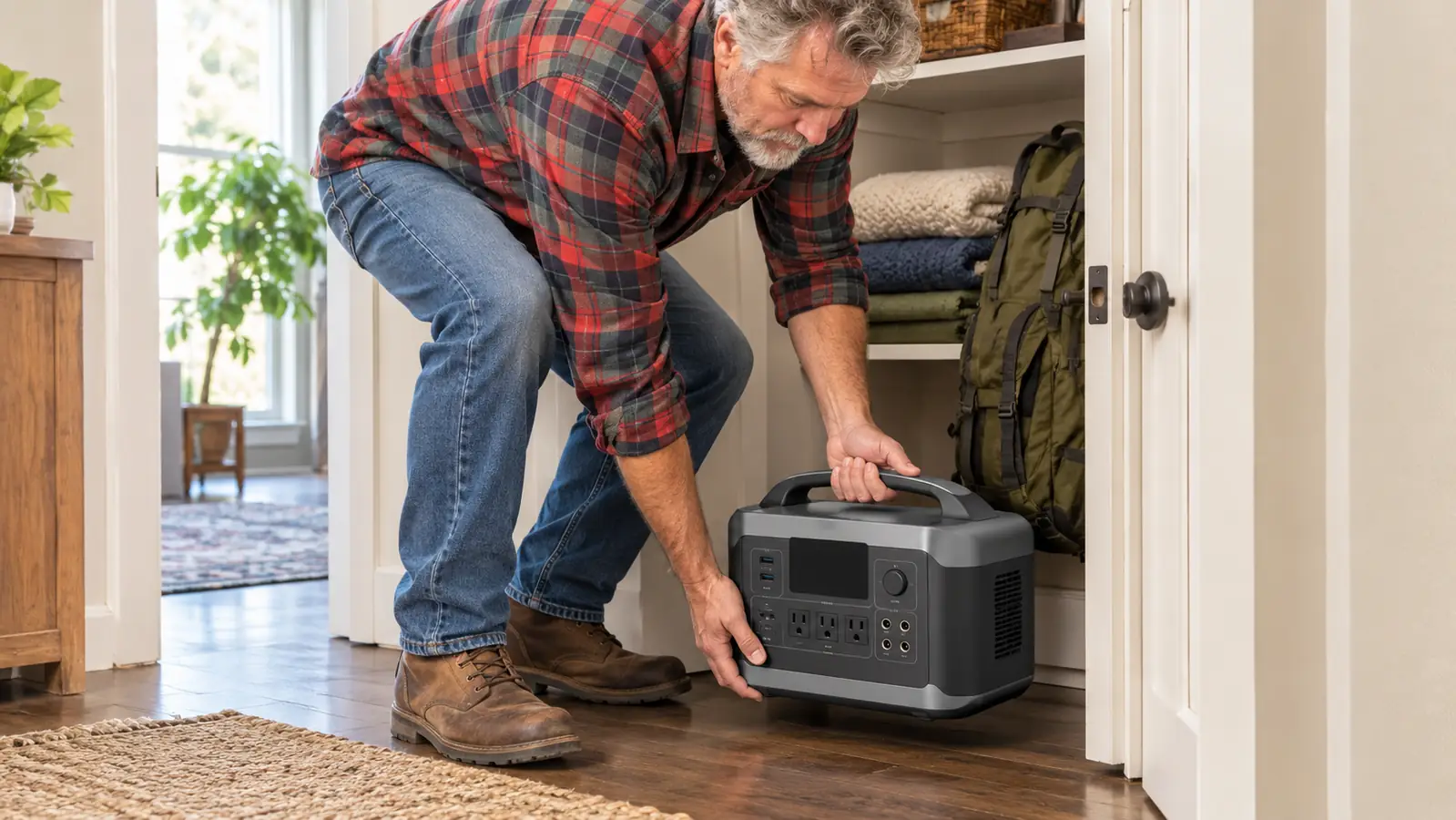
Freezing rain was forecast for a Tuesday in late January. I took the Jackery off the closet floor that afternoon and set it on the kitchen counter. It read 100 percent. The power went that evening and did not come back until around midday on the Friday. Three days, two people, one battery that was never recharged the whole time.
Here is the complete list of what it did. Two phones, charged when they needed it. One LED lamp, on the counter by day and carried with us at night. That is all. It went to the bedroom floor beside the bed that first night, to the den the next two nights, and back to the counter every morning. When the power came back on the Friday I carried it to the closet and it was sitting at about 30 percent. I set it on the floor, plugged it into the wall and let it fill.
Seventy percent of 292 watt hours went into two phones and one lamp over three days. That number cuts both ways and I want you to feel both edges of it. On one side, it is a real result. Nobody in this house spent three days hunting for an outlet or watching a battery icon turn red. On the other side, if you are picturing this thing running your house, you will be disappointed by the first evening, not the third.
The lamp ran on one of the two AC outlets. The phones went into the USB ports. That is the honest shape of it: a small battery doing small work, very well, for three days, in a house that had other answers for heat and for cooking.
I looked at the display when we went to bed each night and again first thing in the morning, mostly out of habit. It came down slower than I expected it to, and it never got near empty. Two phones and a lamp are a light load, and 292 watt hours turns out to be more than a light load needs for three days. That surprised me and I would rather say so than pretend I knew it all along.
What It Will Not Run, and Why I Did Not Test It
The refrigerator is the first thing everyone asks about. No. The math is not close. A refrigerator runs a compressor, compressors pull hard when they start, and 292 watt hours is one evening, not four days of cold food. Ours lost what was in it on the third day and we threw it out. I am not going to pretend this battery was ever going to change that.
The electric range is out. The heat pump is out. A space heater is out, and I want to be plain about that one, because a space heater is what people reach for in a cold outage and it is about the worst load you can put on a battery this size. The wood stove kept the den warm. The Jackery was never asked to heat a thing.
I did not hook any of it up to find out. That was deliberate. I had one battery, a storm in progress, and no way to put charge back except the wall. Running a bad load just to see what happened would have cost me the phones and the light, and those were the only two jobs I had. Do the division before the storm, not during it.
It started at 100 percent on a Tuesday afternoon and went back to the closet floor at about 30 percent on a Friday, with two phones and one lamp to show for it. That is the whole case for it and the whole limit of it.
Why This Size and Not Something Bigger
I bought this size on purpose and I would buy it again, so let me give you the reasoning while it is still honest. I wanted something I could pick up with one hand and carry from the kitchen to the den at bedtime. I wanted it to sit on a closet floor and not on a shelf. I wanted no fuel, no fumes and nothing going stale in the garage. A battery with a handle covers all four of those in a way a generator does not.
Ray up the road has a gas generator and it was running fine through that storm, and I have nothing against one. It stays outside and away from the windows and it does a job mine cannot. But it is not a thing I can lift, and it is not a thing that waits quietly in a closet for thirteen months without asking for anything except a top-up every three months.
The trade for all of that is capacity. There is no version of this where a battery weighing about 7.5 pounds runs the heavy loads in a house. If you want more, you buy more weight or you buy fuel. I picked the weight I could handle and I have not once regretted it at two in the morning.
Somebody will read this and decide I should have bought something larger and parked it in the garage. That is a fair choice for a different house with a different person in it. For this house the deciding question was whether I could get the thing where I needed it at night, alone, without help. That question picked the size for me.

The Parts Nobody Mentions
It weighs about 7.5 pounds and it has a handle. I am 61 and I moved it room to room without thinking about it. That sounds like a small thing and it is not. A battery you cannot carry is a battery that lives in one room, and in a cold outage the room you are in changes at bedtime.
Mine lives on the closet floor rather than a shelf for that same reason. Lifting 7.5 pounds off a shelf is easy in the daylight. Lifting it off a shelf in the dark, in a hurry, with the power out, is how somebody my age ends up on the floor beside it. It stays on the floor and I keep that space clear.
Recharging from a wall outlet takes about four hours. I top it up every three months, on the first of March, June, September and December, and it has taken a charge every one of those times. The listing says the battery is LiFePO4 and rated for more than 4,000 charge cycles, which for a thing I top up every three months is a very long runway.
The ports are two AC outlets, one 100W USB-C, two USB-A and a 120W car port. I have used the USB ports and a lamp on AC. I have never used the car port. I never bought a solar panel for it and I do not plan to, so my recharge plan is the wall, full stop. If the wall is out longer than my charge lasts, my plan is whatever I carried in. I would rather say that out loud than let you imagine a setup I do not have.
One more thing nobody puts in a review: an empty outlet is not a plan. Two AC outlets sounds like plenty until you are standing in front of it holding more than two things. I decided ahead of time that the lamp had one outlet and the other stayed free, and I stuck to it. Small decisions made before a storm are worth more than good intentions made during one.
What I Would Check Before You Buy
Write down what you actually want to run in an outage and find the watts on each one. Add them up. Divide 292 by the total and see how many hours you get. If the answer embarrasses you, the battery is not the problem. The list is.
Then measure your outages. Ours ran three days. If yours run four hours, this is more than you need and something smaller would do the job. If yours run a week, one battery of any size is the wrong plan, because sooner or later you have to put the charge back and a wall outlet is the only way I have.
Decide where it will sit before it arrives. Somewhere you can lift it from, in the dark, without stepping over anything, and somewhere you walk past it often enough to remember it is there at all.
And keep the thing in proportion. A battery is not a plan. It is one line on a list. Follow what your local officials tell you, leave if they tell you to leave, and do not let a device talk you into riding out something you should have driven away from.
If you take one thing from this, take the division. Watts into 292, hours out. It is the only honest way I know to shop for one of these, and it costs nothing but a pencil and ten minutes at the kitchen table.
What I Liked
- 292 watt hours in about 7.5 pounds, with a handle, so one person can move it room to room
- Two AC outlets plus USB-C and USB-A, enough for two phones and a lamp at the same time
- LiFePO4 battery the listing rates for more than 4,000 charge cycles
- Recharges from a wall outlet in about four hours
- Ran two phones and one lamp for three days and finished at about 30 percent
Where It Falls Short
- 300 watts running is a low ceiling, so compressors and heating elements are out
- 292 watt hours does not stretch far once the load gets real
- Two AC outlets only
- No solar panel in my setup, so a long outage means the charge I carried in
- It is not a whole house backup and should not be sold as one
Who This Is For
This is for a household that has already settled on the plan being phones, one lamp and keeping in touch with the outside. Two people, a few days, a house with some other way to stay warm and some other way to cook. It suits somebody who wants the thing sitting in a closet, charged and forgotten and ready to be dull.
Who Should Skip It
Skip it if you are shopping for something to run a refrigerator, a range, a heat pump or a space heater. That is not a knock on the Jackery. It is arithmetic on a 292 watt hour battery, and those loads want a great deal more capacity than this. Skip it if you want to charge from the sun, because I never bought a panel and cannot tell you how that goes. And skip it if what you are really after is a whole house backup. This is not one, and I would not let a sales page tell me otherwise.
Two phones and one lamp for three days is what it does
If that matches the plan you actually have, this is a good small battery and it has earned its spot on my closet floor. If it does not match, spend the money on the size that does, and do it before the forecast turns.
Amazon Check Today's Price on Amazon →