
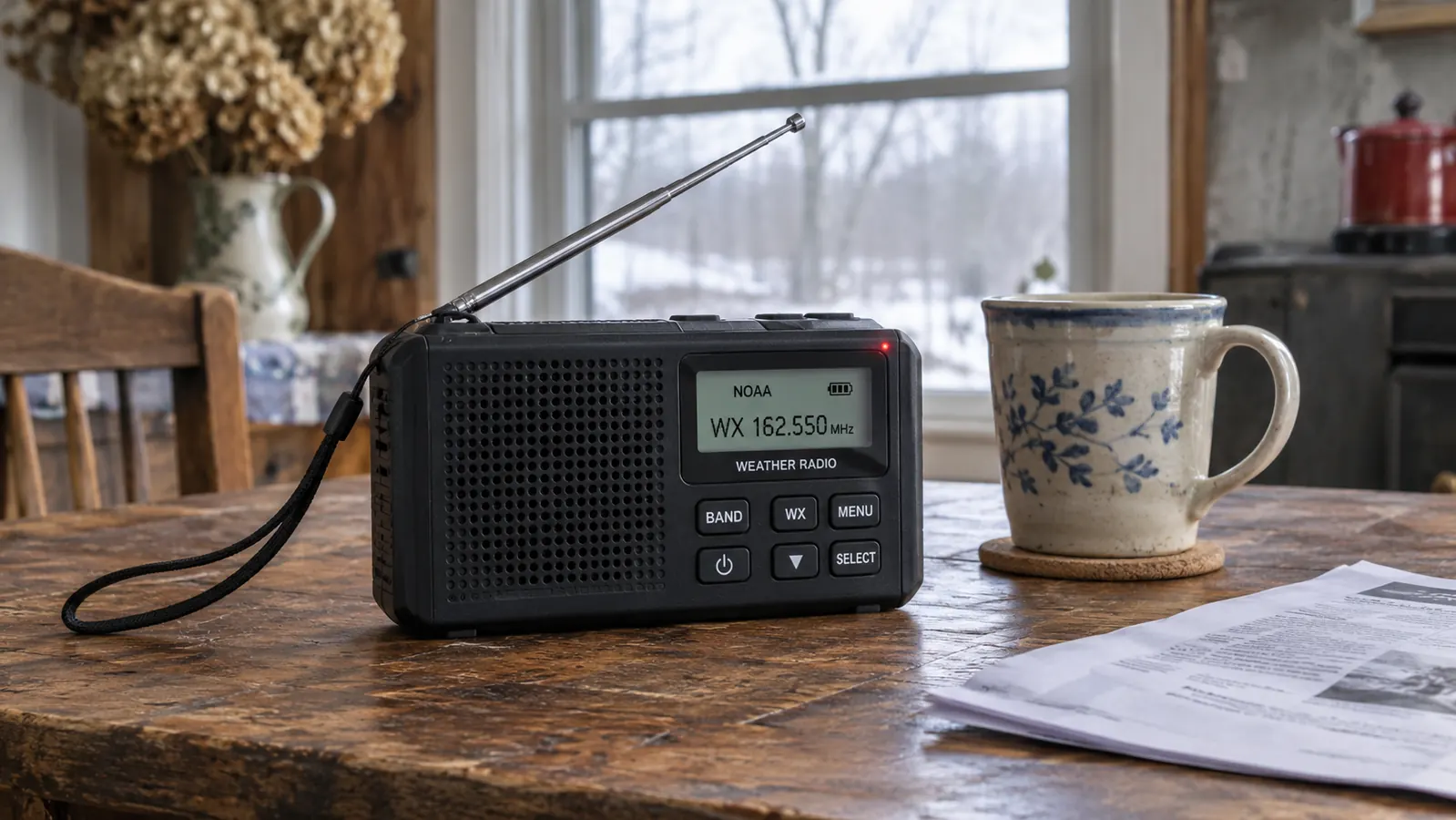
The first honest thing I can tell you about the Midland ER310 is that I did not buy it because I wanted a radio. I bought it because of a thunderstorm in August of last year that took the power out for about nine hours overnight. My phone was at 11 percent when the lights went, and I had no idea what the sky was doing. Nothing bad happened that night. That is the entire reason the radio is in my house. It is a way to know things when the knowing gets difficult, and that is a smaller promise than most product pages make and a more useful one.
I have owned this one for fourteen months. It sits on my kitchen table from November through May and it goes to the hall closet shelf for the summer, because it is not water resistant and I am not going to leave it out where the damp gets at it. In that time it has done the job I bought it for. It has also fallen short in three small ways that no listing mentions. What follows is the review I wish somebody had handed me in September of last year, before I spent the money.
The Quick Verdict
A plain plastic radio that put a forecast in my kitchen on the night my phone could not. Buy it for the weather band. Do not buy it for the crank or the solar panel.
Amazon Check Today's Price →The forecast is the reason to own it, not the gadgetry
Three ways to power it, a weather band, and a flashlight in the same plastic box. It is not a phone charger and it does not pretend to be one.
Amazon Check Today's Price on Amazon →How I've Used It
I bought it in September of last year, and I want to be honest about what fourteen months of ownership actually looks like. Most days the radio does nothing. It sits on the kitchen table and I walk past it. From June through October it sits on the hall closet shelf and I walk past that instead. It has been used in earnest twice. Once during the ice storm in late January, and once on a tornado warning night in March. Everything else has been ordinary weather and a phone that worked fine.
That is the shape of emergency gear, and I think people should hear it before they buy. You are not buying a thing you will use. You are buying a thing that will be there. The reason I am writing this instead of just owning it quietly is that I nearly bought the wrong thing twice before I bought this one. Once because it looked tougher than it was, and once because it did more than I needed. Neither of those would have told me the weather on a Tuesday night in January.
What the ER310 Actually Is
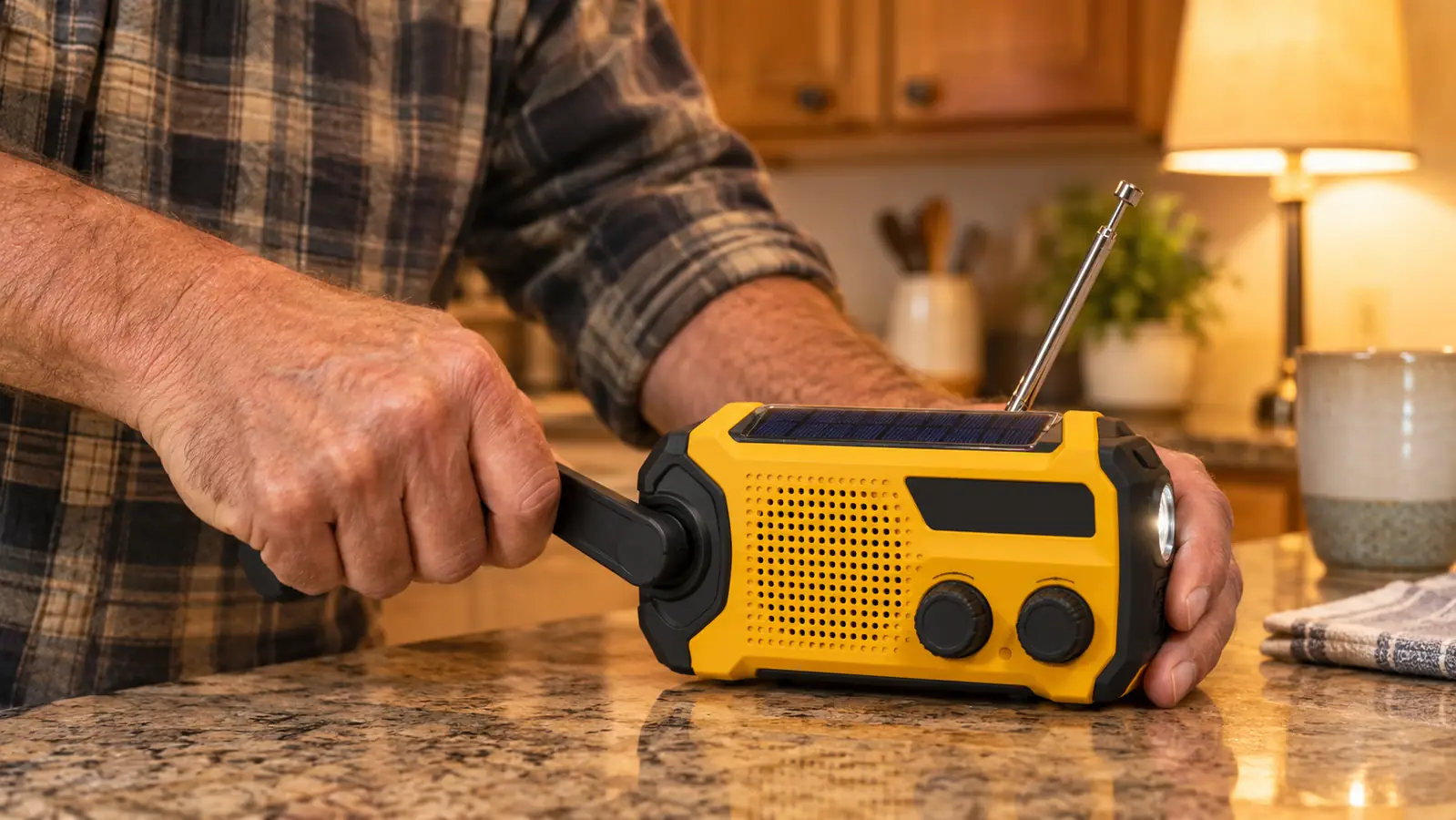
Strip the packaging away and it is a plastic box with a radio in it. The listing gives the weight as 16 ounces and the dimensions as 9.61 inches long, 2.95 inches wide and 6.85 inches tall. It has a built-in flashlight, and it tunes AM and FM plus the weather band. The enclosure is plastic. The water resistance level is listed, plainly, as not water resistant, and I am going to say that again further down because it matters more than any other line on the page.
Power comes three ways. There is a hand crank, there is a small solar panel, and there are six AA batteries, which came in the box. The USB connection is listed as compatible with smartphones and tablets, and I have used it once or twice to give a phone a small top-up. I want to be careful here, because this is where people get their hopes up. It is not a phone charger. The crank does not charge a phone. It will nudge a phone back from the edge and that is all it will do, and in my house the phones belong to a different device.
The Midland ER310 is about the size of a hardback book and it weighs about a pound. In fourteen months it has never been dropped and never been damaged, so I cannot tell you what happens if it falls off a table. What I can tell you is that it does not feel fragile and it does not feel precious. It feels like a tool that expects to be handled.
Where It Falls Short, Starting With the Solar Panel
The solar panel is the feature I would remove if I were designing this. I tried it once, on a windowsill, on a gray day, and it did very little. I have not relied on it since, and it played no part at all in the ice storm. That is not a defect exactly. It is a small panel on a small radio and there is only so much sun in a January in the hills of middle Tennessee. But if you are buying this believing the sun will carry it through a long outage, you are buying the wrong thing for the wrong reason.
The second shortfall is water. The listing says not water resistant and it means it. This radio lives indoors. Mine goes to the closet shelf from June through October because I do not want it sitting out through a Tennessee summer, and I have never carried it to the porch in the rain. If you want something for a boat, a barn or a saddlebag, the Midland is not that thing, and there is no version of this review where I tell you otherwise.
The third is the sound. The weather band comes through clearly enough that I can understand it, and on a quiet night I can hear it from the next room. It is not a speaker you would choose for pleasure. It sounds like a radio from thirty years ago, which is roughly what it is. For a forecast that is fine. For three days of company you will want something else on.
The Crank and the Batteries, Which Is the Part That Mattered
Here is how the radio works in my house, in order. I crank it first. If the cranking gets tiresome, or if I want it running while I do something else, I switch to the six AA batteries that came in the box. I keep the crank for the day those batteries run down. That is the whole system and it has not changed since last September.
During the ice storm the same six batteries that came in the box ran the radio from Wednesday through Friday and did not run down. I have never changed them. I do not keep a spare set, which is a gap in my own planning and not a fault in the radio. When they finally go I will crank, and that is why the crank is worth having even though I would rather not use it.
The crank itself is work. Not difficult work, just the kind that reminds you nothing is free. You turn it and the radio plays. On the first night of the ice storm I cranked it to hear the forecast, and that was the single most useful thing anything in this house did all week. I am not going to pretend the cranking was pleasant. I am going to tell you it was worth it.
The First Night of the Ice Storm
The freezing rain started on a Tuesday afternoon and by about six in the evening a limb came down on the line and the lights went out. That is not a dramatic story. That is how it happens. The radio was on the kitchen table because it was January and that is where it lives in January, and I sat down and cranked it and heard what the forecast was. Three days, as it turned out.
Wednesday morning the cell signal got weak and then it stopped for most of the day. That was the only time my phone has failed me on signal through any of this, and it happened on the day I most wanted it. The radio did not care. I switched it to the batteries and it sat on the table and it worked. About noon it reported a boil water notice for our utility district, because the water plant had lost power. I would not have known that from a dead phone.
The radio stayed on that table for all three days. It never went to the bedroom and it never went to the den, because there was no reason to move it. Friday about noon the power came back and the radio stayed where it was, because it was still January and January is the kitchen table.
The crank bought me one night of not guessing. The six batteries that came in the box carried the other two.

The Tornado Warning Night
In March there was a night with storms forecast and I carried the radio to the bedroom nightstand before bed. That is the only time in fourteen months it has been anywhere but the kitchen table or the closet shelf. About two in the morning the weather band was on and we went to the hall, because the hall is the one inside space in this house with no windows. The storm passed to the north of us. There was no damage at our house and the power stayed on all night. The next morning the radio went back to the kitchen table.
I include that night because it is the argument for this radio that has nothing to do with an outage. A phone gives you an alert when it has signal, when the tower is up and when the battery is charged. The radio gave me a voice reading the weather at two in the morning in a hallway with no windows. I cannot tell you what standard of alert it meets and I am not going to guess at one. I can tell you that I could hear it and understand it, and at two in the morning that was the whole of what I wanted.
Two Things I Got Wrong
The first was assuming the crank made the radio independent of everything. It does not. It makes the radio independent of the wall, which is a different and smaller thing. It still takes my hand, and after a while my hand wants a rest, which is why the batteries are the workhorse and the crank is the backup to the backup. If you think you will crank your way through a week, sit down and crank it for ten minutes first and see how you feel about it.
The second was assuming one device would cover more ground than it does. The radio gives me news. It does not charge a phone in any way I would rely on. It does not light a room, though the built-in flashlight will light a hallway. It does not keep food cold and it does not heat water. I have separate things for all of that, and the radio is one piece of a larger picture rather than the picture.
I also keep no spare AA batteries for it, which I have already admitted and would fix before next winter rather than during it. The six that came in the box have lasted through one three-day storm and they are still in the unit. That is a good sign. It is not a plan.
What I Liked
- Three power sources, so a dead wall is not the end of it
- The weather band comes in clearly and holds up when the cell signal does not
- The six AA batteries that came in the box ran the whole three-day storm
- Built-in flashlight and a USB top-up for a phone in a pinch
- Sixteen ounces and about the size of a hardback book, so it stores without a fight
Where It Falls Short
- Not water resistant, so it cannot live outdoors or in a shed
- The solar panel did almost nothing on a gray day
- The crank is genuine hand work, not a substitute for batteries
- It is not a phone charger, whatever the USB port suggests
- The speaker is serviceable and no better than that
Who This Is For
This is for the person who wants to know what the weather is doing when the phone cannot tell them. If you live out a gravel road, if the power goes out more than once a year, if you are the one in your house who is expected to know things, the Midland ER310 earns its place on the table. It is also for the person who wants one device that runs on hand power, sun or batteries and does not need an account, a subscription or a signal. I am sixty-one and I did not want to learn a new system in the dark. I did not have to.
I would also say this to the person assembling a closet one item at a time, the way I did. The radio was the first thing I bought and it is the thing I would buy first again. It is not the most capable piece of gear in that closet. It is the one that told me what was happening, and everything else I decided afterward I decided with better information.
Who Should Skip It
Skip it if you want a radio for the boat, the barn, the deer stand or the tailgate, because it is not water resistant and it will not survive being left out. Skip it if what you actually need is a phone charger, because it is not one and the crank will not get you there. Skip it if you want something to listen to for three days, because the speaker is serviceable and nothing more. And skip it if you are not going to sit down with it once, before the night you need it, and work out how to reach the weather band. A radio you cannot tune in the dark is a paperweight with a crank on it.
If a forecast is the thing you are missing, this fixes that
Weather band, AM and FM, a built-in flashlight, and three ways to keep it running when the wall goes dead. It weighs a pound and it fits on a closet shelf.
Amazon Check Today's Price on Amazon →